Bihar IPS Officer Reshuffle and District Police Administration
Source:The Hindu ↗
Why It Matters
Understanding administrative reshuffles is important to track law and order governance in Bihar, particularly how the state addresses controversies involving police action and civil unrest in key districts.
Summary
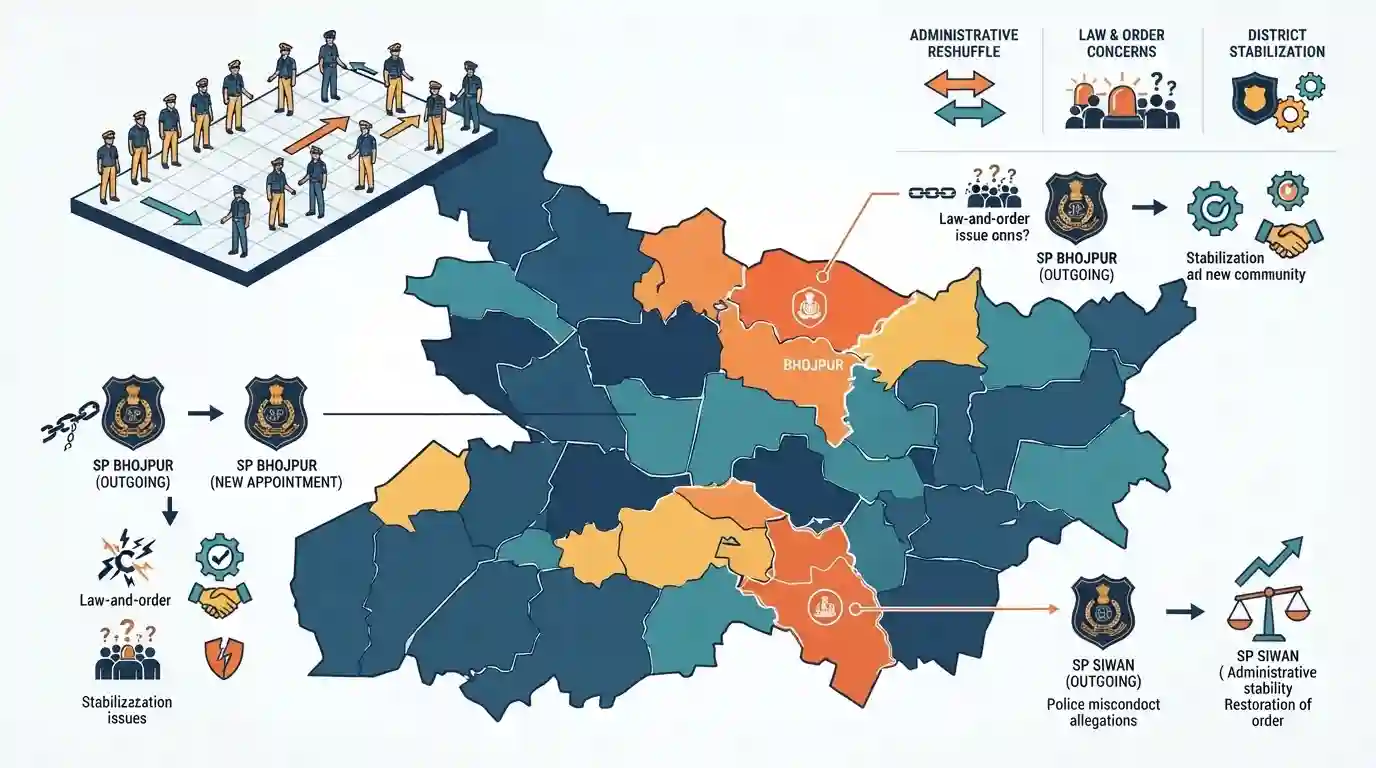
The Bihar government transferred 17 Indian Police Service (IPS) officers, notably reassigning the Superintendents of Police in Bhojpur and Siwan due to controversies surrounding recent law-and-order incidents. New appointments were made to stabilize district administrations following incidents of civil unrest and alleged police misconduct.
Key Points
- The Bihar government executed a major reshuffle by transferring 17 IPS officers across the state.
- The Superintendents of Police (SPs) for Bhojpur and Siwan were notably transferred following recent law-and-order controversies in their respective districts.
- The outgoing Siwan SP, Pooran Kumar Jha, was reassigned following allegations that an AK-47 rifle was fired during a local student protest.
- The Bhojpur SP, Raj, was removed after the controversial encounter of a local activist, Bharat Tiwari, which led to civil unrest.
- New appointments include Hriday Kant as SP of Nalanda, Bharat Soni as SP of Siwan, and Awadesh Dikshit as SP of Bhojpur.
Important Terms
Indian Police Service (IPS)

One of India's three All India Services, established under Article 312, providing senior leadership to state and central police forces.
UPSC context
BPSC GS Paper II (Polity): Tests understanding of All India Services, federal structure, and civil services in administrative governance.
Bihar Police
The primary civil law enforcement agency for Bihar, operating under the Department of Home Affairs to maintain state-wide law and order.
UPSC context
BPSC GS Paper II (State Administration): Essential for topics on regional police structure, administrative reforms, and internal security.
Superintendent of Police (SP)
A senior police officer, typically from the IPS, who serves as the administrative and operational head of police in a district.
UPSC context
BPSC GS Paper II (State Administration): Tests knowledge of district-level executive machinery and police accountability mechanisms.
Director General of Police (DGP)
The highest-ranking police officer in a state, responsible for heading and managing the entire state police department.
UPSC context
BPSC GS Paper II (Polity) and Current Affairs: Tests knowledge of administrative hierarchy, state appointments, and law enforcement leadership.
Bihar State Home Department
The nodal state government department in Bihar responsible for internal security, police administration, law and order, and civil service transfers.
UPSC context
BPSC GS Paper II (State Polity): Evaluates understanding of executive departments, state governance, and administrative oversight.
Prelims Trap
IPS officers' transfers and postings are directly executed by the Union Ministry of Home Affairs.
While the IPS is an All India Service recruited by the Centre, their postings, transfers, and immediate control fall exclusively under the State Government.
Static Concepts Connected
How is control over All India Services (like IPS) divided between Centre and States?
- Immediate Control: Vested in the State Government, which manages day-to-day administration, district postings, transfers, and suspensions.
- Ultimate Control: Rests with the Union Government. The Ministry of Home Affairs is the cadre controlling authority for the IPS.
- Major Penalties: Only the Union Government (President) has the authority to dismiss, remove, or compulsorily retire an IPS officer.
Under which list does police administration fall in the Indian Constitution?
- Seventh Schedule: 'Public Order' and 'Police' are enumerated as Entry 1 and Entry 2 respectively in the State List (List II).
- Exclusive Jurisdiction: The State Government holds exclusive constitutional authority to legislate, structure, and manage police forces within its territory.
Cross-Topic Patterns
Police Encounters & NHRC Guidelines
The Bhojpur encounter controversy directly relates to NHRC guidelines on extrajudicial killings, a recurring theme in BPSC Mains GS-II under human rights and state accountability.
All India Services & Federalism
The dual control mechanism of IPS officers highlights federalism debates, connecting state-level law-and-order exigencies with the overarching disciplinary authority of the Union Government.

BPSC Prelims rarely asks for specific transferred SP names. Focus instead on State vs Union control over All India Services for Polity.
Linked PYQs · 1
Linked PYQs · 1
- 2022BPSC_PRELIMSGS1
The confluence of the rivers Son and Ganga is located in which district of Bihar?
