Rajya Sabha Holds Historic All Night Sitting for Key Bills
Source:Indian Express ↗
Why It Matters
The article is highly relevant for UPSC GS2 as it highlights rare parliamentary functioning (extended sittings, adjournment sine die), the process of parliamentary approval for state emergencies (Article 356 in Manipur), and legislative developments concerning the governance of minority institutions (Waqf Bill).
Summary
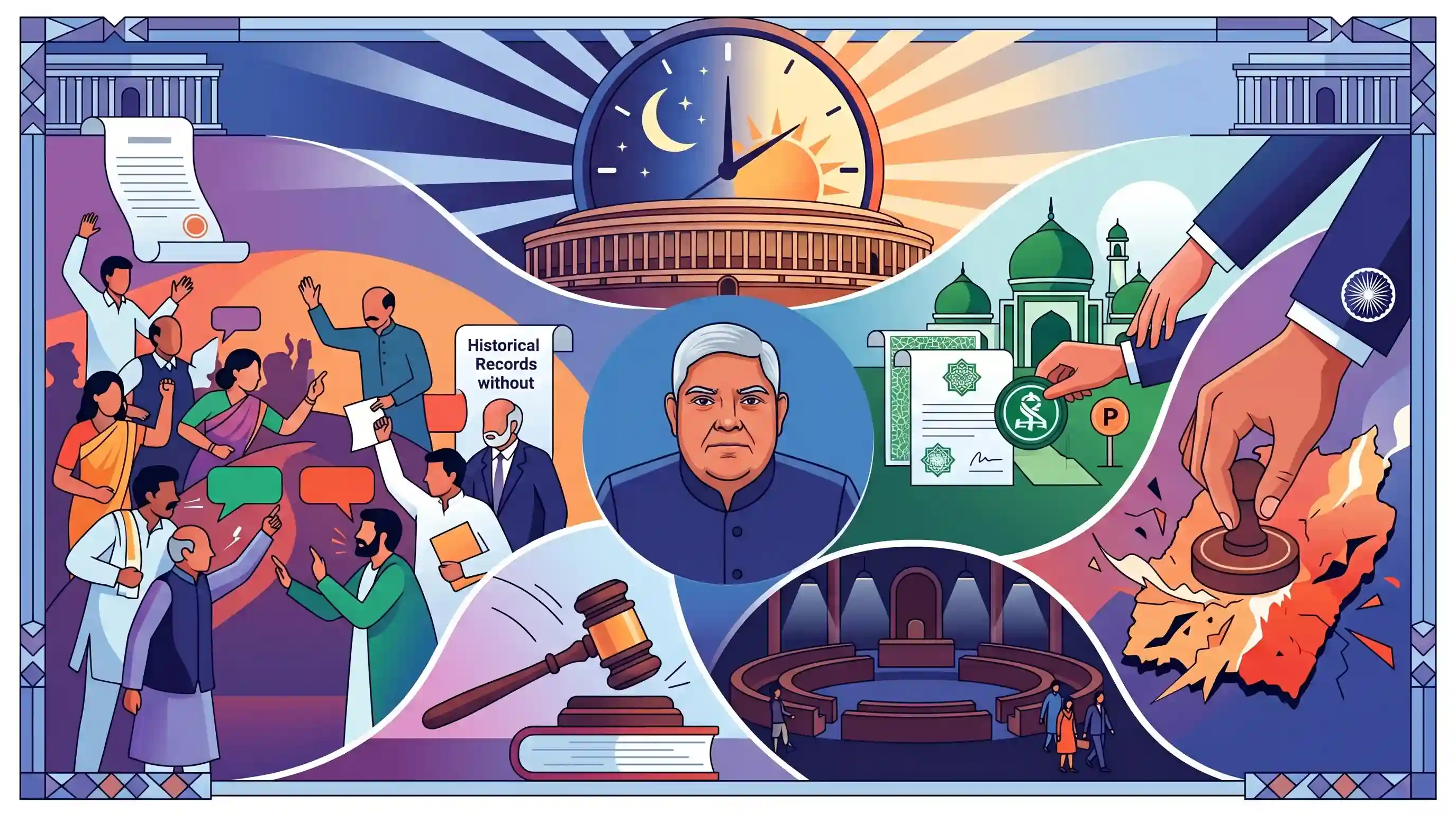
The Rajya Sabha concluded a historic 17-hour continuous all-night sitting to pass the contentious Waqf (Amendment) Bill, 2025, and a resolution invoking President's Rule in Manipur. Chaired by Vice President Jagdeep Dhankhar, the marathon session marks the second-longest sitting in the Upper House's history, second only to a 1981 session on the Essential Services Maintenance Bill. Following the completion of this critical legislative business, the Parliament was adjourned sine die, wrapping up the first leg of the Budget Session.
Key Points
- The Rajya Sabha held a continuous 17-hour all-night sitting to pass the Waqf (Amendment) Bill, 2025, and approve a resolution for imposing President's Rule in Manipur.
- This marathon session stands as the second-longest continuous sitting in the history of the Rajya Sabha.
- The longest sitting in Rajya Sabha history remains a 1981 session where the Essential Services Maintenance Bill was debated for 17 hours and 14 minutes.
- Following the completion of these significant legislative tasks, the Parliament was adjourned sine die, concluding the first phase of the Budget Session.
Important Terms
Waqf (Amendment) Bill, 2025

A legislative reform aimed at modernizing Waqf property management via digitization, mandatory central registration, and mandatory inclusion of women and non-Muslim members in administrative boards.
UPSC context
GS Paper II: Governance and Social Justice. Tests knowledge of minority rights, administrative reforms, and communal property regulation.
President's Rule (Article 356)
The suspension of state government and imposition of direct Union rule under Article 356 due to failure of constitutional machinery; requires parliamentary approval within 2 months.
UPSC context
GS Paper II: Indian Constitution and Federalism. Critical for questions on Centre-State relations and emergency provisions.
Adjournment Sine Die
Termination of a parliamentary sitting by the presiding officer without appointing a specific date for the next meeting; usually precedes the session's official prorogation.
UPSC context
GS Paper II: Parliament and State Legislatures. Tests understanding of legislative procedures and terms used by presiding officers.
Rajya Sabha
The Upper House of Parliament, a permanent body representing States and UTs; it ensures federal balance and serves as a chamber of revision for legislation.
UPSC context
GS Paper II: Parliament. Focuses on the House's unique powers, its role in federalism, and legislative oversight.
Essential Services Maintenance Act (ESMA)
A 1981 legislation enabling the government to ban strikes and ensure uninterrupted delivery of services deemed vital to public safety and national community life.
UPSC context
GS Paper II/III: Statutory Bodies/Internal Security. Relevant for discussions on labor rights versus public order and national interest.
Prelims Trap
Adjournment sine die brings a parliamentary session to an end and is declared by the President of India.
Adjournment sine die terminates a *sitting* indefinitely and is done by the Presiding Officer. *Prorogation* terminates the *session* and is done by the President.
Static Concepts Connected
What is the parliamentary approval process for President's Rule (Article 356)?
- Time limit: The proclamation must be approved by both Houses of Parliament within two months from its date of issue.
- Majority required: It requires only a simple majority in both Houses, unlike a National Emergency which requires a special majority.
- Maximum duration: Once approved, it continues for 6 months and can be extended up to a maximum of 3 years with repeated parliamentary approvals.
How do Adjournment Sine Die and Prorogation differ in Parliament?
- Adjournment Sine Die: Terminates a sitting of Parliament for an indefinite period without naming a day for reassembly. It is declared by the Presiding Officer.
- Prorogation: Brings an entire parliamentary session to an end (not just a sitting). It is declared by the President of India.
Cross-Topic Patterns
Waqf, Article 26 & Property Rights
Waqf governance bridges collective religious freedom under Article 26 and the state's right to regulate secular, financial, or property matters associated with religious endowments.
Article 356 & Internal Security Failures
Imposing President's Rule in Manipur links internal security breakdowns (GS3) directly to core federal debates and the SR Bommai guidelines (GS2).

Expect a comparative Prelims question testing the exact approval timelines and majority types for Article 352 vs 356 vs 360 emergencies.
Linked PYQs · 4
Linked PYQs · 4
- 2020PrelimsGS1
Consider the following statements: 1. The President of India can summon a session of the Parliament at such place as he/she thinks fit. 2. The Constitution of India provides for three sessions of the Parliament in a year, but it is not mandatory to conduct all three sessions. 3. There is no minimum number of days that the Parliament is required to meet in a year. Which of the statements given above is/are correct?
- 2018PrelimsGS1
If the President of India exercises his power as provided under Article 356 of the Constitution in respect of a particular State, then
- 2024PrelimsGS1
With reference to the Indian Parliament, consider the following statements: 1. A bill pending in the Lok Sabha lapses on its dissolution. 2. A bill passed by the Lok Sabha and pending in the Rajya Sabha lapses on the dissolution of the Lok Sabha. 3. A bill in regard to which the President of India notified his/her intention to summon the Houses to a joint sitting lapses on the dissolution of the Lok Sabha. Which of the statements given above is/are correct?
- 2017PrelimsGS1
The Parliament of India exercises control over the functions of the Council of Ministers through 1. Adjournment motion 2. Question hour 3. Supplementary questions Select the correct answer using the code given below:
