Governor Visits ARIES Devasthal for Astronomical Research Review
Source:governoruk-gov ↗
Why It Matters
UKPSC PCS Prelims regularly tests students on scientific and mapping institutions situated within Uttarakhand (such as ARIES, IIRS, and Survey of India). The Devasthal Optical Telescope (DOT) is a landmark facility of national and international significance, making its location, capabilities, and associated developmental activities like astro-tourism highly relevant for state-specific and general science questions.
Summary
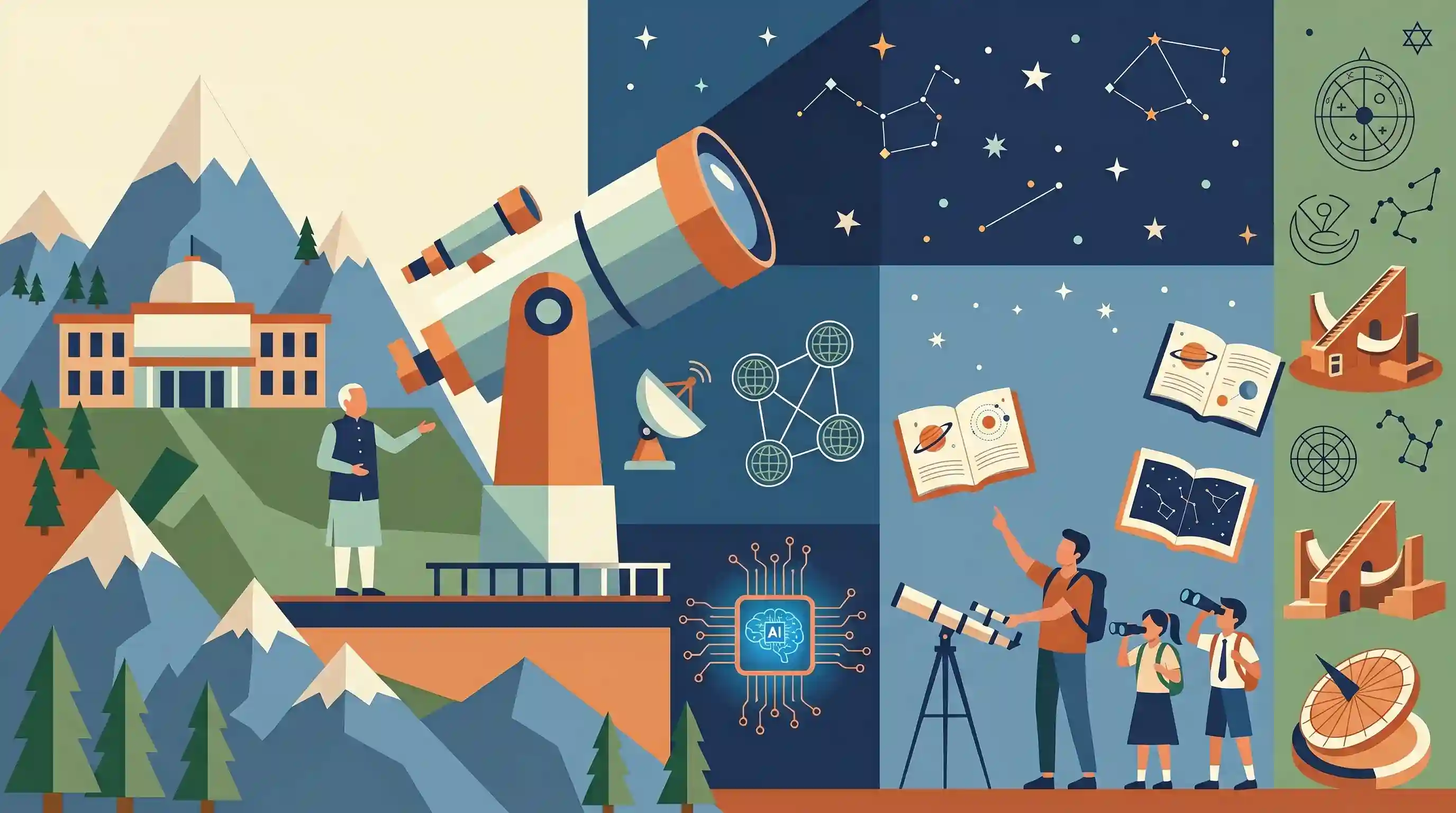
The Governor of Uttarakhand delivered an address at the Aryabhatta Research Institute of Observational Sciences (ARIES) in Devasthal, Nainital. The address celebrated India's scientific capabilities represented by the 3.6-meter Devasthal Optical Telescope (DOT) — India's largest steerable optical telescope. It highlighted international collaborations, the utilization of Artificial Intelligence (AI) under the India AI Mission, and the massive opportunities for astro-tourism and education in the Himalayan state.
Key Points
- The Governor of Uttarakhand addressed scientists and researchers at the Aryabhatta Research Institute of Observational Sciences (ARIES) in Devasthal, Nainital, highlighting its status as a premier modern center of scientific pursuit.
- The 3.6-meter Devasthal Optical Telescope (DOT), inaugurated by Prime Minister Narendra Modi, is India's and Asia's largest steerable optical telescope, symbolizing 'Atmanirbhar Bharat' in astronomical research.
- ARIES actively collaborates with international partners including Belgium and Russia to investigate cosmic events like star formation, supernova explosions, and black holes.
- In alignment with the India AI Mission, the institute is leveraging Artificial Intelligence (AI) and advanced data analytics to process complex astronomical datasets.
- The Governor emphasized the potential of astro-tourism in Uttarakhand to generate local employment and called for opening the facility to students from remote mountain and border villages to build scientific temper.
- The speech paid homage to ancient Indian astronomers including Aryabhata, Varahamihira, and Bhaskaracharya, connecting ancient mathematical wisdom with modern technological research.
Important Terms
Devasthal Optical Telescope (DOT)

India's largest steerable optical telescope (3.6-meter aperture), located at Nainital, Uttarakhand. It is managed by ARIES and used to study celestial objects like distant galaxies at optical wavelengths.
UPSC context
GS Paper III (Science & Technology); tests awareness of indigenous observational infrastructure and international space exploration collaborations.
India AI Mission
A national initiative launched by India to build a sovereign artificial intelligence ecosystem through compute infrastructure funding, startup support, and secure AI model development.
UPSC context
GS Paper III (Science & Technology); tests understanding of emerging tech policies, digital public infrastructure, and sovereign computing strategies.
Aryabhatta Research Institute of Observational Sciences (ARIES)
An autonomous premier research institute located in Nainital, Uttarakhand, under India's Department of Science and Technology, specializing in astronomy, solar physics, astrophysics, and atmospheric sciences.
UPSC context
GS Paper III (Science & Technology); tests knowledge of premier national scientific research institutions and observational space science facilities.
Astro-Tourism
A sustainable form of travel focused on stargazing and celestial exploration, leveraging dark-sky regions to promote science tourism, local economies, and night-sky environmental preservation.
UPSC context
GS Paper III (Economy & Environment) & GS Paper I (Geography); tests concepts of eco-tourism, dark-sky conservation, and regional development.
Atmanirbhar Bharat
A nationwide program aimed at achieving self-reliance by promoting domestic manufacturing, indigenizing advanced technologies, reducing import dependence, and strengthening local supply chains.
UPSC context
GS Paper III (Indian Economy/Science & Tech); tests understanding of economic self-sufficiency, industrial policy, and indigenous technology development.
Department of Science and Technology (DST)
A major department under India's Ministry of Science and Technology that formulates policy, promotes scientific research, and funds institutional infrastructure across various scientific fields.
UPSC context
GS Paper III (Science & Technology); tests awareness of national institutional frameworks, government research bodies, and policy implementation.
Prelims Trap
The 4-meter International Liquid Mirror Telescope (ILMT) at Devasthal is a fully steerable optical telescope.
Unlike conventional glass telescopes, Liquid Mirror Telescopes (LMTs) cannot be steered. They use a spinning pool of liquid mercury that must remain perfectly level, pointing exclusively at the zenith.
Static Concepts Connected
What were the core scientific contributions of Varahamihira?
- Royal Court: Served as one of the legendary 'Navaratnas' (Nine Gems) in the court of Malwa/Gupta era.
- Pancha-Siddhantika: Authored the Pancha-Siddhantika, which systematically preserved and compared five ancient astronomical treatises.
- Brihat Samhita: Wrote the Brihat Samhita, a vast encyclopedia covering astrology, planetary movements, eclipses, rainfall, and agriculture.
How do Liquid Mirror Telescopes (LMTs) differ from conventional optical telescopes?
- Liquid Mirror: Uses a reflective liquid (primary mercury) spun at a constant speed to naturally form a parabolic shape.
- Fixed Zenith Pointing: Cannot be steered or tilted; they point strictly at the zenith (straight up), scanning whatever passes overhead.
- Cost Advantage: Significantly cheaper to construct and maintain compared to casting, grinding, and polishing massive solid glass mirrors.
Cross-Topic Patterns
Astro-tourism + Dark Sky Reserves
Balancing local tourism economies with light-pollution mitigation in fragile Himalayan zones (like Hanle and Devasthal), intersecting environmental conservation with sustainable development goals.
Scientific Diplomacy + Global Space Networks
Indo-European physics collaborations (like ARIES-Belgium) act as soft-power diplomacy tools, bridging global longitudinal coverage gaps in transient space events.

Prelims 2026 may test Devasthal's dual assets by contrasting the steerable DOT with the fixed-zenith tracking of India's Liquid Mirror Telescope.
Linked PYQs · 3
Linked PYQs · 3
- 2012UKPSC_PRELIMSGS1
Indian Institute of Remote Sensing (IIRS) is situated at:
- 2024UKPSC_PRELIMSGS1
Headquarters of which of the following is located in Dehradun, the Capital of Uttarakhand ?
- 2024UKPSC_PRELIMSGS1
UTDB is established in Uttarakhand to promote:
