Sixteenth BRICS Trade Ministers Meeting Concludes in Jaipur
Source:gktoday ↗
Why It Matters
International summits hosted in Rajasthan (like the Jaipur Consensus) are high-probability current affairs topics for RPSC RAS Prelims. The outcomes involve major multilateral trade policies and key geopolitical stances taken by India regarding the WTO.
Summary
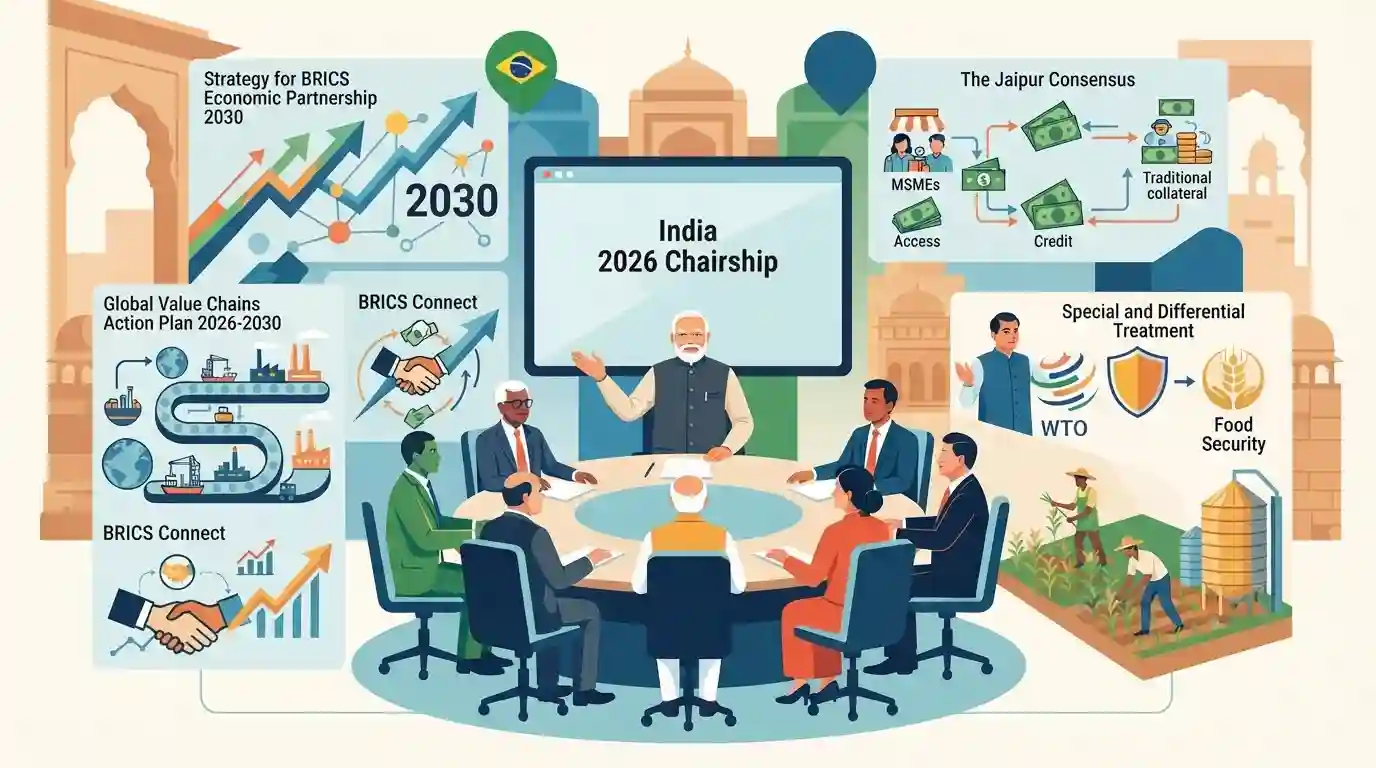
The 16th BRICS Trade Ministers' Meeting was held in Jaipur under India's 2026 BRICS Chairship. Chaired by Union Commerce Minister Piyush Goyal, the meeting culminated in the adoption of the 'Strategy for BRICS Economic Partnership 2030' and the 'Jaipur Consensus', a pivotal agreement focusing on shifting MSME financing to cash-flow-based lending models. The trade leaders also launched the Global Value Chains Action Plan 2026-2030 and established the BRICS Connect initiative to foster capacity building. During discussions, India strongly advocated for the protection of farmers and food security, insisting on preserving Special and Differential Treatment mechanisms at the World Trade Organization (WTO).
Key Points
- The 16th BRICS Trade Ministers' Meeting successfully concluded in Jaipur, Rajasthan, held under India's BRICS Chairship 2026.
- The meeting finalized the 'Strategy for BRICS Economic Partnership 2030', setting a long-term roadmap for intra-BRICS trade and investment.
- Ministers adopted the 'Jaipur Consensus', which outlines guidelines for increasing MSME credit availability through cash-flow-based lending rather than collateral-based models.
- India strongly emphasized the protection of farmers' interests at the WTO, stressing the importance of public stockholding for food security and Special and Differential Treatment for developing nations.
Important Terms
Jaipur Consensus

An agreement from the 16th BRICS Trade Ministers’ Meeting (2026) to bridge the global trade finance gap for MSMEs by shifting from collateral-based lending to a cash-flow-based credit assessment and invoice-discounting mechanism.
UPSC context
Crucial for GS-2 (IR) and GS-3 (Economy), testing knowledge of MSME financing reforms and BRICS trade initiatives.
Strategy for BRICS Economic Partnership 2030
A comprehensive long-term roadmap finalized in 2026 to deepen BRICS cooperation across multilateral trade, investment, digital economy, industrial innovation, financial collaboration, and sustainable development.
UPSC context
Relevant for GS-2 (Multilateral Groupings) to understand the evolving economic frameworks and priorities of the expanded BRICS bloc.
Global Value Chains Action Plan 2026-2030
A BRICS framework to build resilient, diversified supply chains in critical sectors like pharmaceuticals and food security. It establishes a BRICS Technical Council and promotes strategic investment platforms to withstand global disruptions.
UPSC context
Important for GS-3 (Economy) and GS-2 (IR) regarding global supply chain resilience and multilateral industrial cooperation.
BRICS Connect
A cooperation network launched to foster capacity building, employability, new skills, and technology sharing among member nations. It facilitates peer learning and supports the integration of enterprises into international value chains.
UPSC context
Relevant for GS-2 (IR) as it highlights human capital development and institutional connectivity mechanisms within the BRICS framework.
Special and Differential Treatment (S&DT)
A fundamental WTO principle granting developing and least-developed nations specific flexibilities, longer transition periods, and preferential market access to safeguard their economic interests and food security against strict multilateral trade rules.
UPSC context
Highly important for GS-2 (Institutions) and GS-3 (Economy) when analyzing WTO reforms, trade negotiations, and India's defensive stance.
Prelims Trap
"The Jaipur Consensus is a WTO agreement aimed at resolving global disputes over agricultural public stockholding."
Aspirants may confuse it with WTO agriculture issues discussed at the same meeting. The Jaipur Consensus is specifically a BRICS agreement on cash-flow-based MSME lending.
Static Concepts Connected
What is the core WTO conflict regarding Public Stockholding for Food Security?
- Amber Box Limits: Subsidies like India's MSP are considered trade-distorting under the Agreement on Agriculture and are capped at 10% of the total value of agricultural production for developing nations.
- Peace Clause: An interim relief negotiated at the 2013 Bali Ministerial that protects developing countries from WTO legal challenges if their food security programs breach the 10% subsidy limit.
- Permanent Solution: India demands a permanent WTO amendment to exempt public food procurement subsidies from trade-distorting calculations, protecting farmers and domestic food security schemes permanently.
What distinguishes cash-flow-based lending from collateral-based lending for MSMEs?
- Collateral-Based Lending: Traditional lending requires physical assets like land, property, or machinery as security. This creates a high barrier for asset-light service MSMEs and micro-enterprises.
- Cash-Flow-Based Lending: Evaluates loan eligibility using real-time revenue metrics, transaction histories, and digital footprints (like GST returns or UPI data) rather than relying on physical collateral.
Cross-Topic Patterns
DPI enabling cash-flow MSME lending
The 'Jaipur Consensus' on MSME financing aligns perfectly with India's domestic Digital Public Infrastructure push, utilizing tools like the Account Aggregator framework to bypass traditional collateral requirements.
BRICS bloc amplifying WTO negotiations
India is leveraging the BRICS platform to build a plurilateral consensus on WTO reform, building a united developing-nation front to defend the Special and Differential Treatment (S&DT) mechanism.

A 2026 prelims multi-statement question will likely mix the 'Jaipur Consensus' on MSME lending with WTO's Peace Clause and S&DT rules.
Linked PYQs · 3
Linked PYQs · 3
- 2025RPSC_PRELIMSGS1
The Ease of Doing Business ranking for states is issued by
- 2024RPSC_PRELIMSGS1
The Submarine Cable Resilience Initiative was signed by the following countries?
- 2018RPSC_PRELIMSGS1
Why do companies restructure business processes with the help of technology?
