Uttar Pradesh Food Safety Administration Festival Crackdown
Source:new-indian-express ↗
Why It Matters
Illustrates the operational role of state regulatory bodies (like the FSDA) in enforcing food safety laws and ensuring public health protection against food adulteration, which is highly relevant to GS Paper 2 (Governance and Health).
Summary
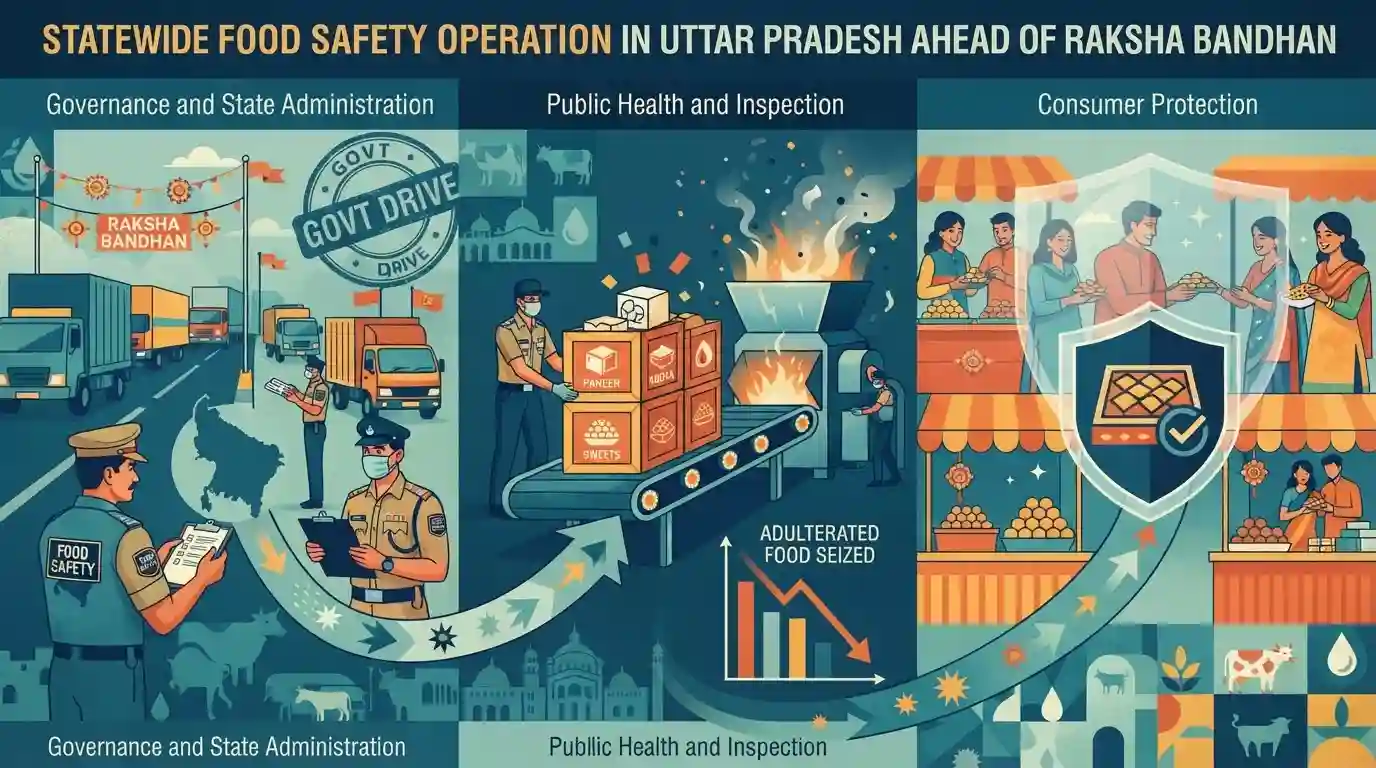
Ahead of the Raksha Bandhan festival, the Uttar Pradesh Food Safety and Drug Administration intensified its drive against food adulteration by conducting statewide highway inspections. Officials seized and destroyed over 16 quintals of suspected unsafe food items, including paneer, khoya, and sweets, worth around Rs 20 lakh, to protect public health during peak festival demand.
Key Points
- The Uttar Pradesh Food Safety and Drug Administration (FSDA) conducted extensive overnight inspections on state highways to curb the supply of adulterated food ahead of Raksha Bandhan.
- Officials seized and destroyed 16.3 quintals of suspected unsafe food products, valued at approximately Rs 20 lakh.
- The crackdown primarily targeted high-demand festive items like paneer, khoya, milk, and sweets, which are often sourced from outside districts and prone to adulteration.
- Vehicles including buses were intercepted and searched to intercept poor-quality food supplies before they reached local markets.
Important Terms
Food Safety and Standards Act, 2006

A comprehensive national law that consolidated earlier legislation to establish science-based standards. It regulates the manufacturing, storage, and distribution of food to ensure safety and prevent adulteration across India.
UPSC context
Central to UPPSC General Studies Paper III (Food Processing) and UPPSC FSO exams; defines legal frameworks for penalizing food adulteration.
Uttar Pradesh Food Safety and Drug Administration (UP FSDA)
The primary state-level regulatory body in UP tasked with enforcing food and drug safety standards, conducting highway inspections, collecting samples, and seizing counterfeit or adulterated products.
UPSC context
Crucial for UPPSC state-specific current affairs and Governance. It acts as the executing agency for FSSAI mandates within Uttar Pradesh.
Food Adulteration
The illegal practice of intentionally or unintentionally adding inferior, harmful, or prohibited substances to food items to increase volume and profit, thereby degrading the product's nutritional quality and safety.
UPSC context
High-weightage topic in UPPSC GS Paper II (Public Health) and GS III; frequently tested regarding legal countermeasures and consumer protection.
Food Safety Officer (FSO)
A statutory field official authorized under the FSSA 2006 to inspect food business premises, enforce hygiene standards, and collect suspicious food samples for laboratory testing.
UPSC context
A key state administrative post directly recruited via the UPPSC examination, testing candidates on food science and safety regulations.
Prelims Trap
Food adulteration in India is primarily regulated under the Prevention of Food Adulteration Act, 1954.
The 1954 Act was repealed. Food safety and adulteration offenses are currently regulated by the overarching Food Safety and Standards (FSS) Act, 2006.
Static Concepts Connected
How is starch adulteration in milk and dairy products commonly detected?
- Iodine test: A few drops of iodine solution are added to the boiled and cooled milk or dairy sample.
- Color change: The presence of starch creates a chemical reaction that turns the sample a distinct blue or blue-black color.
- Adulteration purpose: Starch is commonly used as an adulterant in festive dairy to artificially increase the solid content and thickness.
What are the key features of the State Food Safety Index (SFSI)?
- Releasing body: It is published annually by the Food Safety and Standards Authority of India (FSSAI), not NITI Aayog.
- Assessment parameters: Evaluates states based on human resources, compliance, testing infrastructure, training, and consumer empowerment.
- Objective: It aims to foster competitive and cooperative federalism to enhance food safety standards across Indian states.
Cross-Topic Patterns
Festive Adulteration & General Science
UPPSC frequently links administrative enforcement news to basic science questions, such as chemical tests for common adulterants or foodborne illnesses like Botulism caused by Clostridium botulinum.
Statutory Enforcement & Cooperative Federalism
State-level enforcement drives like UP FSDA's actions are benchmarked nationally by FSSAI's State Food Safety Index, serving as an active example of cooperative federalism in public health governance.

Expect a matched-pair question linking common food adulterants (e.g., starch in milk) to their chemical detection tests or diseases.
Linked PYQs · 2
Linked PYQs · 2
- 2021UPPSC_PRELIMSGS1
Botulism is
- 2024UPPSC_PRELIMSGS1
With reference to National Food Security Act , which of the following statements are correct? 1. It will cover up to 75% rural and 50% urban population. 2. It has special focus on nutritional support to women and children. 3. It was enforced on July 5, 2010. Codes :
