ICAR IVRI Mukteshwar Focuses on One Health and Livestock
Source:governoruk ↗
Why It Matters
Animal husbandry is a primary supplementary occupation in Uttarakhand's hilly regions, which makes topics like native breeds (Badri cow), regional research centers (IVRI Mukteshwar), and ecological concepts (One Health) highly tested areas in UKPSC PCS Prelims.
Summary
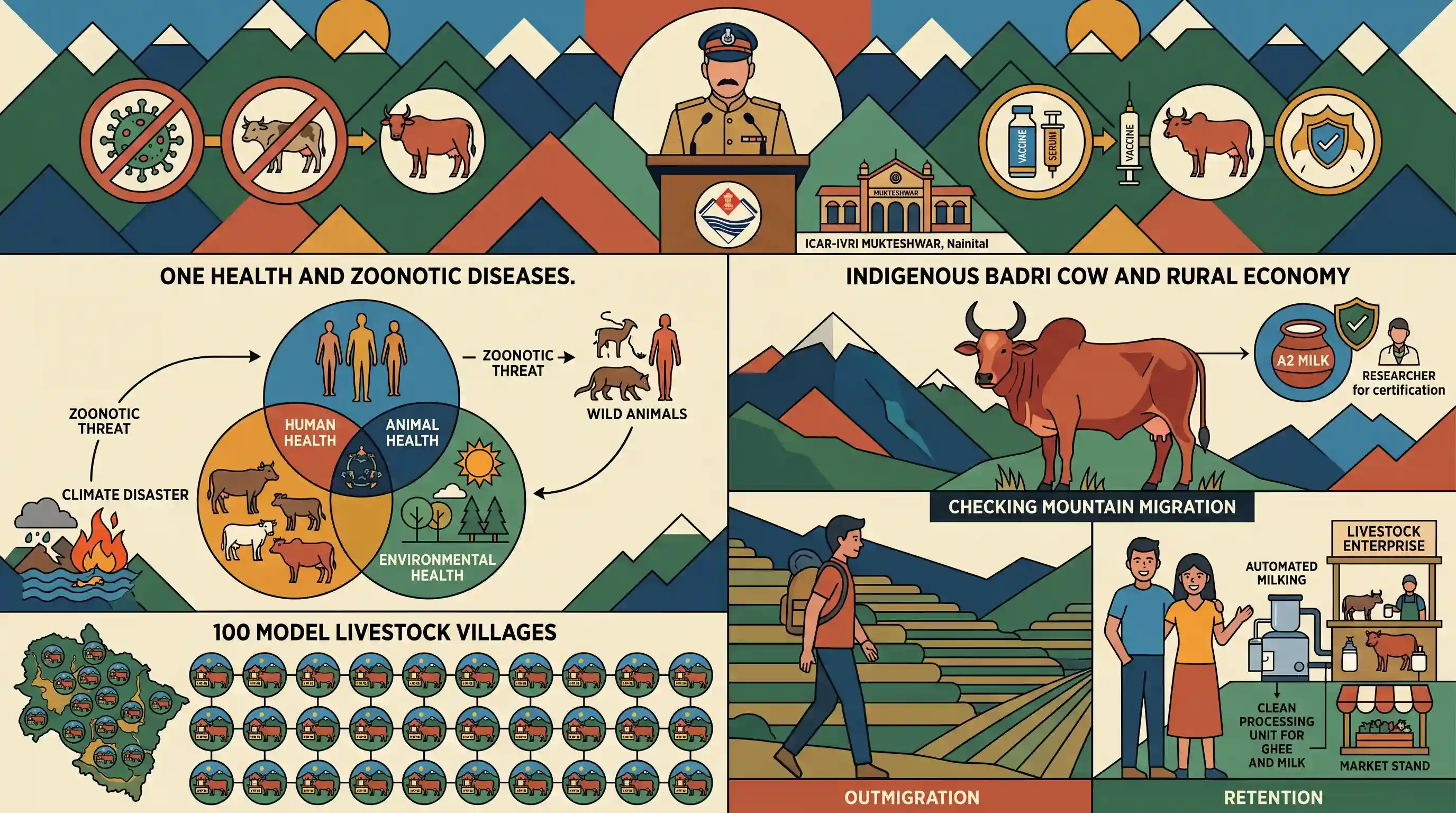
In his address at the ICAR-IVRI Mukteshwar, Nainital, the Governor of Uttarakhand, Lt Gen Gurmit Singh, celebrated the institution's historic contributions to animal health and disease control (such as rinderpest). He outlined key strategies for the state's rural economy, centering on the One Health framework to tackle climate-induced zoonotic threats, the preservation of the indigenous Badri cow, checking mountain migration through modernized livestock enterprise, and launching 100 model livestock villages in Uttarakhand.
Key Points
- ICAR-IVRI Mukteshwar, established over a century ago, is a premier national research center that has historically protected India's livestock economy, particularly through pioneering efforts in eradicating the rinderpest epidemic.
- The Governor highlighted the urgent need to adopt the 'One Health' approach in mission mode to combat climate change-driven diseases like Lumpy Skin Disease (LSD) and zoonoses.
- Genetic conservation and productivity enhancement of indigenous livestock, especially the highly nutritious and medicinally valued Badri cow, as well as native mountain sheep and goats, is a priority.
- To check youth migration ('Pahad ka paani aur pahad ki jawani') from Uttarakhand's hilly terrains, the state must integrate technology-driven livestock farming (dairy, goat rearing, beekeeping, poultry) into viable start-up models.
- The Governor proposed that IVRI Mukteshwar should lead the development of 100 model livestock villages across Uttarakhand, integrating scientific animal rearing, natural farming (Jeevamrit, Panchagavya), and entrepreneurship.
- Emphasized the critical role of hill women as the main workforce in mountain agriculture, demanding the development of women-friendly farming tools to ease physical workloads.
Important Terms
One Health Initiative

A collaborative, multisectoral, and transdisciplinary approach recognizing that human, animal, plant, and environmental health are deeply interconnected, seeking to optimize health outcomes and manage zoonotic threats holistically.
UPSC context
GS Paper 2 (Health) and GS Paper 3 (S&T). Tests understanding of disease epidemiology, public health governance, and pandemic prevention strategies.
Badri Cow
Uttarakhand's first certified indigenous cattle breed, originating from the Badrinath region. This small, climate-resilient cow grazes on medicinal herbs, producing highly nutritious A2 milk and GI-tagged ghee.
UPSC context
GS Paper 3 (Agriculture/Economics). Relevant for indigenous livestock conservation, sustainable mountain development, and geographical indications (GI tags).
ICAR-Indian Veterinary Research Institute (IVRI) Mukteshwar
A premier research institution established in 1889 at Mukteshwar. It pioneered animal virology in India and developed the historical goat tissue vaccine used to globally eradicate Rinderpest (cattle plague).
UPSC context
GS Paper 3 (S&T/Agriculture). Important for history of scientific achievements, animal health, vaccine development, and control of transboundary livestock diseases.
Lab to Land Programme
A frontline extension program launched by ICAR in 1979 to transfer low-cost agricultural, veterinary, and allied technologies directly to small, marginal, and landless farmers to improve their economic conditions.
UPSC context
GS Paper 3 (Agriculture). Tests knowledge of technology transfer mechanisms, agricultural extension services, and rural economic upliftment policies.
Indian Council of Agricultural Research (ICAR)
An autonomous national organization under the Ministry of Agriculture and Farmers Welfare, acting as the apex body for coordinating, guiding, and managing research and education in agriculture and animal sciences.
UPSC context
GS Paper 3 (Agriculture/S&T). Tests understanding of institutional frameworks supporting farming, animal husbandry, food security, and research-led extension programs.
Prelims Trap
The Indian Veterinary Research Institute (IVRI) was originally established at its high-altitude campus in Mukteshwar, Uttarakhand.
It was actually founded in Pune in 1889 as the Imperial Bacteriological Laboratory, then relocated to Mukteshwar in 1893 to ensure bio-isolation for dangerous pathogens.
Static Concepts Connected
How does ICAR-NBAGR register and conserve indigenous livestock breeds?
- Nodal Body: ICAR-National Bureau of Animal Genetic Resources (Karnal) is the authoritative agency for identifying and registering domestic animal diversity.
- Accession System: Assigns unique accession numbers to newly characterized breeds (like the Badri cow) to prevent biopiracy.
- Conservation Focus: Prioritizes climate-resilient, disease-resistant indigenous breeds over exotic varieties for sustainable livestock development.
What is the scientific significance of Rinderpest in global veterinary history?
- The Disease: Also known as cattle plague, it was a highly contagious viral disease affecting cloven-hoofed animals.
- Eradication Milestone: In 2011, it became the first animal disease—and only the second disease in history after smallpox—to be globally eradicated.
- Indian Context: ICAR-IVRI Mukteshwar played a pioneering global role in developing the early vaccines that led to its eradication.
Cross-Topic Patterns
Zoonoses + Climate Change
Shifting Himalayan isotherms expand vector ranges, transforming animal disease dynamics and making the One Health approach critical for mountain ecological security.
Himalayan Hydrology + Weather Infrastructure
Co-locating Doppler weather radars with agricultural research stations enhances localized cloudburst prediction, protecting both vulnerable mountain communities and livestock assets.

Indigenous cattle genetic traits (like Badri's A2 protein) and NBAGR's registration process are highly likely Prelims targets.
Linked PYQs · 3
Linked PYQs · 3
- 2025UKPSC_PRELIMSGS1
Consider the following statements with reference to animal husbandry in Uttarakhand. Select the correct answer from the codes given below : 1. Animal husbandry is a supplementary occupation of agriculture. 2. Sheep rearing in the mountainous areas has been affected by environmental degradation.
- 2021UKPSC_PRELIMSGS1
At which place in Uttarakhand did the Indian, Meteorological Department install a Doppler Weather Radar?
- 2025UKPSC_PRELIMSGS1
Which of the following is incorrectly matched about Central Government Institutes located in Uttarakhand?
