Odisha Crime Probe into Minor Burn Death Sparking Outrage
Source:The Hindu ↗
Why It Matters
Highlights the persistent challenges in ensuring women's safety, the complexities of police investigations in sensitive cases, and the political and social dimensions of crimes against women. Important for understanding issues related to gender justice and law enforcement.
Summary
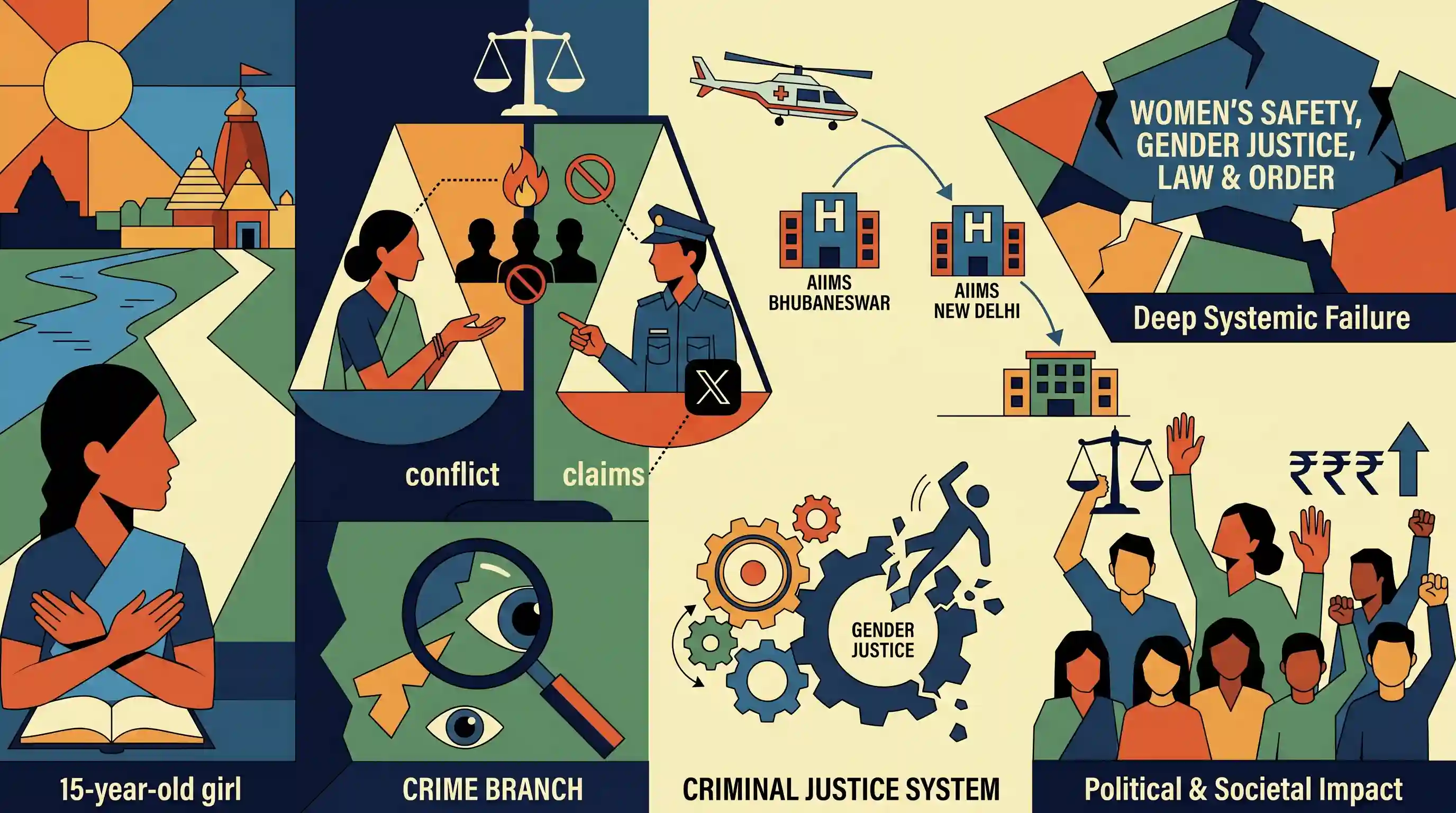
A 15-year-old girl from Puri, Odisha, succumbed to severe burn injuries at AIIMS, New Delhi, after allegedly being set on fire. While initial reports suggested she was attacked by three persons, the Odisha police stated that no other person was involved. The conflicting claims have prompted a Crime Branch investigation. The incident has triggered sharp political reactions and demands for compensation, highlighting ongoing concerns regarding women's safety, gender justice, and law and order.
Key Points
- A 15-year-old girl from Puri, Odisha, succumbed to severe burn injuries at AIIMS, New Delhi, after allegedly being set on fire.
- The victim was airlifted from AIIMS, Bhubaneswar to Delhi for advanced treatment, with the State government covering the medical expenses.
- The Crime Branch of Odisha is investigating the case, especially given the conflicting reports regarding whether she was attacked by others or if there was no outside involvement as initially claimed by some police officials.
- The tragic incident has sparked political outrage, with opposition parties criticizing the government over the state of law and order and demanding adequate compensation for the victim's family.
Important Terms
Gender Justice

The fair and equitable treatment of all genders through dismantling patriarchal norms, ensuring equal rights, dignity, and access to opportunities as enshrined in the Indian Constitution.
UPSC context
Relevant for GS-I (Society) and GS-II (Social Justice); tests application of Fundamental Rights (Articles 14, 15, 21) and landmark judicial precedents.
Crime Branch (Odisha)
A premier investigative wing of the state police (CID-CB) handling complex, sensational, and inter-state crimes that require specialized detective skills, technical expertise, or have significant socio-political ramifications.
UPSC context
Relevant for GS-II (Governance) and GS-III (Internal Security); tests knowledge of the criminal justice system and specialized law enforcement mechanisms.
AIIMS (All India Institute of Medical Sciences)
A group of autonomous public medical universities established as 'Institutions of National Importance' to set high standards for medical education, research, and tertiary healthcare in India.
UPSC context
Relevant for GS-II (Health and Social Justice); tests understanding of public health infrastructure and the role of premier autonomous institutes.
Biju Janata Dal (BJD)
A regional political party in Odisha that champions state identity, local development, and greater autonomy within the federal structure, often playing a decisive role in state governance.
UPSC context
Relevant for GS-II (Polity); tests the role of regional parties in Indian federalism and their impact on state-level policy and administration.
Bharatiya Janata Party (BJP)
One of India's major national political parties, characterized by a pan-India electoral presence and a significant role in central governance and national policy formulation.
UPSC context
Relevant for GS-II (Polity); tests knowledge of the political party system, electoral dynamics, and the balance between national and regional politics.
Prelims Trap
Police and Public Order fall under the Concurrent List alongside Criminal Law.
While Criminal Law and Procedure are Concurrent List subjects, Police and Public Order are strictly State List subjects (Entries 1 and 2).
Static Concepts Connected
How is jurisdiction over criminal justice divided under the Seventh Schedule?
- State List: 'Public Order' and 'Police' (Entries 1 & 2) grant state governments primary authority for crime prevention and localized investigation.
- Concurrent List: 'Criminal Law' and 'Criminal Procedure' ensure nationwide uniformity in core penal statutes (such as the BNS and BNSS).
What were the key institutional recommendations of the Justice J.S. Verma Committee (2013)?
- Police Accountability: Recommended holding commanding officers strictly liable for administrative failures to register gender-based violence cases.
- Rights-Based Approach: Proposed a comprehensive Bill of Rights for women to guarantee bodily autonomy and secure swift trials over mere death penalty inclusion.
Cross-Topic Patterns
Institutional apathy and police reforms
Discrepancies in initial police reports highlight the urgent need for Prakash Singh committee reforms and emotional intelligence (GS-4) among grassroots investigating officers.
NCRB data vs legislative intent
Persistently high crime rates against women (NCRB 2022) showcase the critical gap between Article 15(3) constitutional safeguards and actual grassroots enforcement by state agencies.

Mains 2026 could test the dichotomy between constitutional safeguards (Art 15(3)) for women and systemic apathy in grassroots policing.
Linked PYQs · 2
Linked PYQs · 2
- 2023MainsGS2
Explain the constitutional perspectives of Gender Justice with the help of relevant Constitutional Provisions and case laws.
- 2024MainsGS1
Distinguish between gender equality, gender equity and women's empowerment. Why is it important to take gender concerns into account in programme design and implementation?
