Ladakh domicile policy proposal and residency duration criteria
Source:The Hindu ↗
Why It Matters
Evaluates the constitutional and legal frameworks surrounding domicile-based employment reservations (Article 16), the evolving administrative structure of Union Territories (specifically post-Article 370 Ladakh), and ongoing demands for tribal safeguards under the Sixth Schedule of the Constitution.
Summary
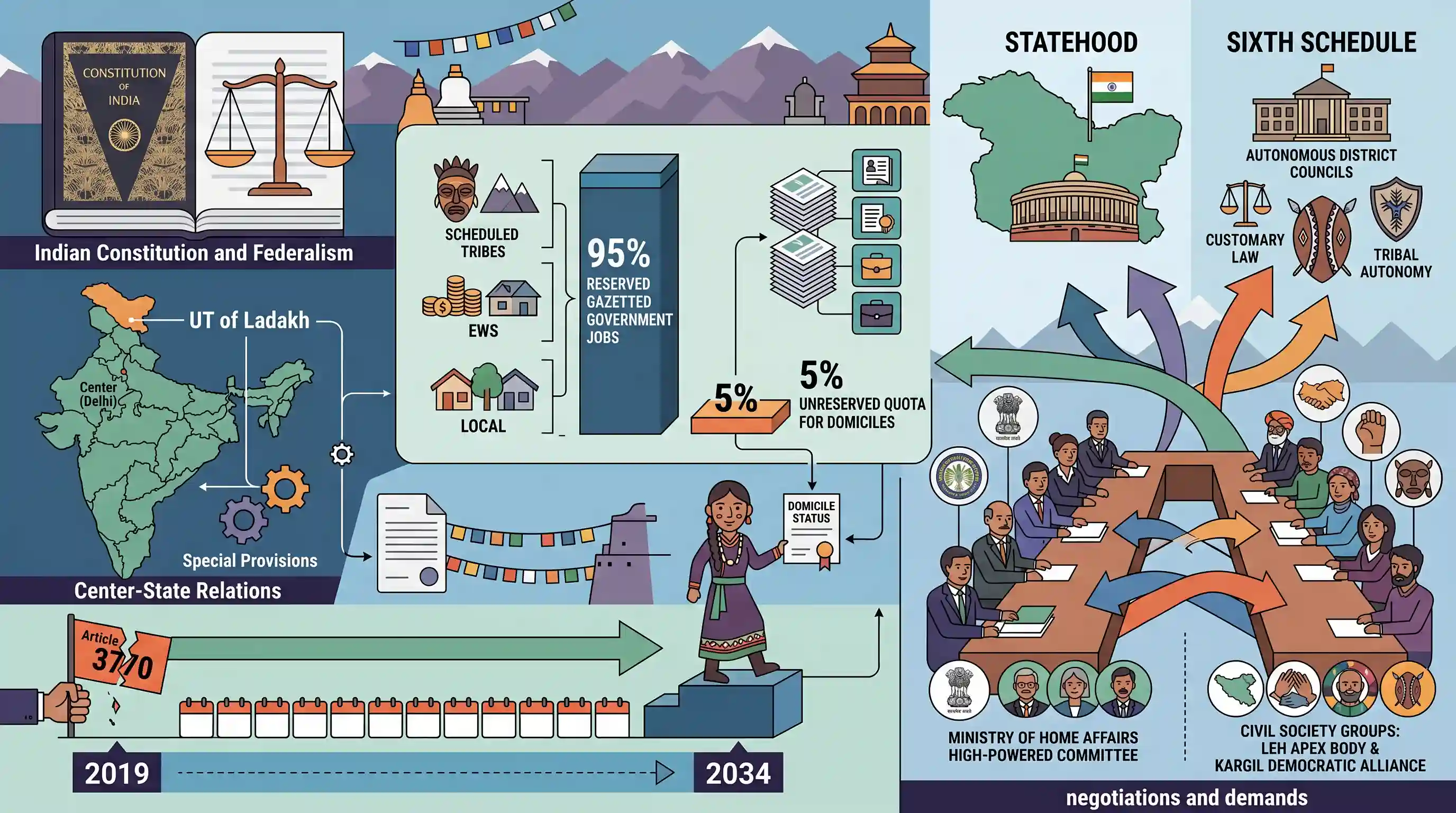
The Union Government is evaluating a new domicile policy for the Union Territory of Ladakh, proposing a 15-year continuous residency requirement starting from 2019. This means individuals settling in the region after the abrogation of Article 370 will only become eligible for domicile status in 2034. The policy aims to protect local employment, as domicile status will dictate eligibility for a 5% unreserved quota in gazetted government jobs, with 95% of positions already reserved for Scheduled Tribes, EWS, and other local groups. The framework emerges from ongoing negotiations between a Ministry of Home Affairs High-Powered Committee and civil society groups like the Leh Apex Body and Kargil Democratic Alliance, who continue to press for broader constitutional safeguards, including Statehood and inclusion in the Sixth Schedule.
Key Points
- The Union Government may introduce a 15-year continuous stay requirement from 2019 to grant domicile status in Ladakh, meaning new settlers will only qualify in 2034.
- Domicile status is crucial for competing for the 5% unreserved gazetted government vacancies in Ladakh, with 95% reserved for STs, EWS, and other local categories.
- The domicile proposal stems from negotiations between the Ministry of Home Affairs and civil society groups like the Leh Apex Body and Kargil Democratic Alliance.
- Since becoming a Union Territory without a legislature in 2019, Ladakh has witnessed protests demanding Statehood, Sixth Schedule inclusion for tribal autonomy, job protections, and parliamentary representation.
- Unlike the 2020 Jammu and Kashmir domicile policy which applied retrospectively, the proposed Ladakh policy uses a strict forward-looking cut-off date.
Important Terms
Sixth Schedule

Constitutional framework under Articles 244(2) and 275(1) providing autonomous district councils with legislative, judicial, and executive powers to protect tribal land, culture, and administrative identity.
UPSC context
GS Paper II: Indian Constitution/Federalism; crucial for questions on tribal autonomy and special provisions for specific regions.
Article 370
A constitutional provision that formerly gave Jammu and Kashmir special autonomous status; its 2019 abrogation led to the reorganization of the state into the Union Territories of J&K and Ladakh.
UPSC context
GS Paper II: Indian Constitution; tests understanding of federal restructuring, special status, and legislative changes in J&K.
Leh Apex Body (LAB) and Kargil Democratic Alliance (KDA)
Joint umbrella organizations representing civil society and political groups in Leh and Kargil, respectively, demanding statehood, Sixth Schedule inclusion, and job/land protections for the Ladakhi population.
UPSC context
GS Paper II: Governance; relevant for studying regional political movements and civil society negotiations with the Union Government.
Domicile Status
A status granted to residents fulfilling specific residency criteria (e.g., 15 years), determining eligibility for reserved government jobs and land ownership rights within a particular Union Territory or State.
UPSC context
GS Paper II: Polity; tests knowledge of residency-based reservations and their interaction with fundamental rights under Article 16.
High-Powered Committee (HPC)
An executive-led body chaired by the Minister of State for Home Affairs, established to negotiate constitutional and administrative safeguards with Ladakhi representatives.
UPSC context
GS Paper II: Governance; illustrates the mechanism of administrative dialogue and conflict resolution between the Center and UT stakeholders.
Article 16
Guarantees equality of opportunity in public employment and prohibits discrimination; it allows for residence-based preferences only if Parliament enacts specific laws (Article 16(3)).
UPSC context
GS Paper II: Fundamental Rights; central to understanding the legal limits of reservation and domicile-based employment policies.
Prelims Trap
The Ladakh administration or State legislatures can enact laws reserving government jobs based on residence.
Under Article 16(3), only the Parliament has the authority to prescribe residence as a condition for public employment in a State or UT, not local legislatures/administrations.
Static Concepts Connected
How does Article 16 handle 'residence' for public employment?
- General Rule: Article 16(2) explicitly prohibits discrimination in matters of public employment on the grounds of residence or place of birth.
- Parliamentary Exception: Article 16(3) allows Parliament—not State/UT legislatures—to mandate residence requirements for specific state, UT, or local authority jobs.
- Single Domicile: India recognizes only single citizenship and single domicile; states use 'residence' criteria legally, though 'domicile' is often colloquially used in state policy titles.
What defines Sixth Schedule administration?
- Current Scope: Currently applies exclusively to specific tribal areas in Assam, Meghalaya, Tripura, and Mizoram (AMTM) under Article 244(2) of the Constitution.
- Autonomous Councils: Establishes Autonomous District Councils (ADCs) granting indigenous groups legislative, judicial, and administrative powers over land, forests, and local customs.
- Governor's Authority: The State Governor holds discretionary power to create, alter, or dissolve ADCs without needing state legislative approval.
Cross-Topic Patterns
Sixth Schedule vs Article 371
Ladakh's demands highlight the policy tension between seeking deep territorial autonomy under the Sixth Schedule versus the bespoke, state-specific developmental safeguards typically granted under Article 371 (A-J).
Asymmetric Federalism in UTs
Contrasts Ladakh (UT without legislature) with J&K, Delhi, and Puducherry, illustrating India's asymmetric federal structure where Union Territory governance models vary drastically based on strategic and historical necessity.

Article 16(3) Parliament powers, UT administrative structures, and Sixth Schedule criteria will likely merge into a Prelims 2026 question.
Linked PYQs · 5
Linked PYQs · 5
- 2025MainsGS2
Discuss the nature of Jammu and Kashmir Legislative Assembly after the Jammu and Kashmir Reorganization Act, 2019. Briefly describe the powers and functions of the Assembly of the Union Territory of Jammu and Kashmir.
- 2016MainsGS2
To what extent is Article 370 of the Indian Constitution, bearing marginal note "Temporary provision with respect to the State of Jammu and Kashmir", temporary? Discuss the future prospects of this provision in the context of Indian polity.
- 2023PrelimsGS1
Consider the following statements: Statement-I: The Supreme Court of India has held in some judgements that the reservation policies made under Article 16(4) of the Constitution of India would be limited by Article 335 for maintenance of efficiency of administration. Statement-II: Article 335 of the Constitution of India defines the term 'efficiency of administration'. Which one of the following is correct in respect of the above statements?
- 2021PrelimsGS1
With reference to India, consider the following statements : 1. There is only one citizenship and one domicile. 2. A citizen by birth only can become the Head of State. 3. A foreigner once granted the citizenship cannot be deprived of it under any circumstances. Which of the statements given above is/are correct?
- 2015PrelimsGS1
The provisions in Fifth Schedule and Sixth Schedule in the Constitution of India are made in order to
