Militant attack kills security personnel in northwest Pakistan
Source:The Hindu ↗
Why It Matters
The persistent instability and militancy in the Af-Pak region have significant implications for regional security architecture. For India, understanding the trajectory of terror outfits like the TTP and the nature of state support or negligence by neighboring regimes is critical for formulating effective internal security and foreign policy strategies.
Summary
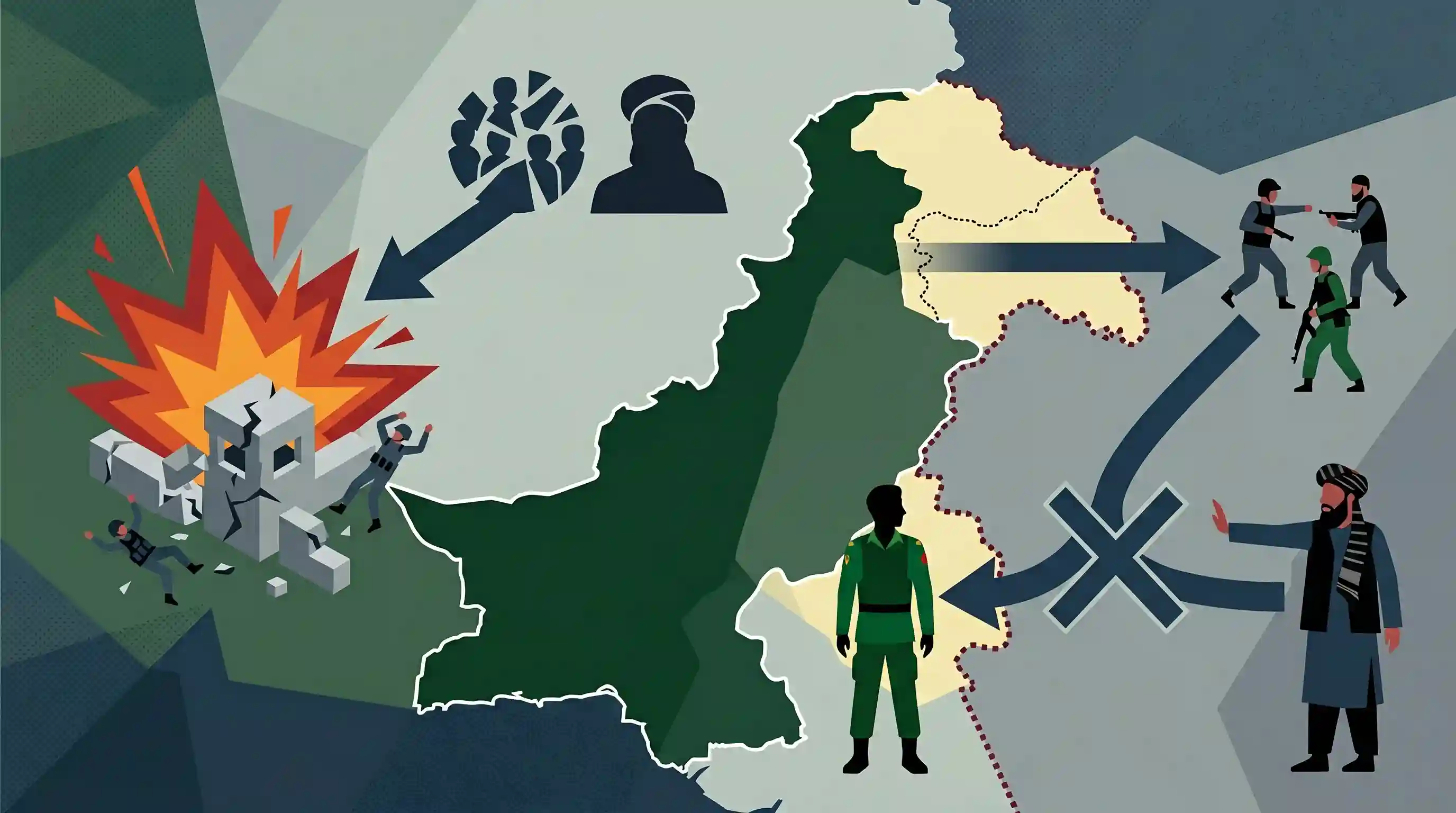
A devastating suicide bombing targeted a joint security post in the Bannu district of Khyber Pakhtunkhwa, Pakistan, resulting in the deaths of at least 15 security personnel. The attack, claimed by the Hafiz Gul Bahadur group (a splinter faction of the TTP), underscores the deteriorating internal security situation in Pakistan's northwestern frontier. The incident further highlights the volatile security dynamics of the Af-Pak region, with Pakistan repeatedly alleging that militant outfits are utilizing Afghan soil for cross-border terrorism—a claim denied by the Afghan Taliban.
Key Points
- 15 security officials were killed in a suicide bomb attack on a joint police and military post in the Bannu district of Pakistan's Khyber Pakhtunkhwa province.
- The Hafiz Gul Bahadur group, a breakaway faction of the Tehreek-e-Taliban Pakistan (TTP), claimed responsibility for the attack.
- The region has witnessed an upsurge in militant violence, particularly following the Taliban's takeover of Afghanistan in 2021.
- Pakistan frequently accuses the Afghan Taliban administration of harbouring anti-Pakistan militant groups, leading to strained bilateral relations.
Important Terms
Tehreek-e-Taliban Pakistan (TTP)

An umbrella organization of militant groups formed in 2007, aiming to overthrow the Pakistani state and enforce a strict interpretation of Sharia law.
UPSC context
GS Paper III (Internal Security) and Paper II (International Relations); tests understanding of non-state actors and cross-border terrorism in India's neighborhood.
Afghan Taliban
The Sunni Islamist movement governing Afghanistan since 2021; it shares ideological ties with the TTP but maintains a distinct political focus on Afghan governance.
UPSC context
GS Paper II (International Relations); critical for analyzing regional security dynamics, neighborhood policy, and the stability of the Af-Pak region.
Hafiz Gul Bahadur group
A powerful militant faction based in North Waziristan, led by Hafiz Gul Bahadur, which focuses on attacking Pakistani security forces from cross-border sanctuaries.
UPSC context
GS Paper III (Internal Security); tests awareness of specific splinter groups and the evolving nature of militant alliances in Pakistan.
Durand Line
The 2,640 km border between Pakistan and Afghanistan, historically contested by Kabul and a focal point for cross-border militancy and security tensions.
UPSC context
GS Paper II (International Relations); essential for understanding boundary disputes and their impact on South Asian regional security.
Ittehad-ul-Mujahideen Pakistan (IMP)
A newly emerged coalition of militant factions, including the Hafiz Gul Bahadur group, that claimed responsibility for the May 2026 attacks in Bannu.
UPSC context
GS Paper III (Internal Security); highlights the fluid and evolving nature of terrorist organizations in the region.
Khyber Pakhtunkhwa (KP)
A northwestern Pakistani province bordering Afghanistan, serving as a primary theatre for militant insurgencies and counter-terrorism operations.
UPSC context
GS Paper III (Internal Security); relevant for studying internal security challenges and the geography of terrorism in the neighborhood.
Prelims Trap
"The Durand Line is the mutually recognized and undisputed international border between Afghanistan and Pakistan."
Afghanistan historically, and currently under the Taliban, rejects the 1893 Durand Line as an arbitrary colonial division of Pashtun lands, causing constant border friction.
Static Concepts Connected
What is Pakistan's 'Strategic Depth' doctrine?
- Origin: Formulated by Pakistan's military to use Afghanistan as a strategic hinterland in the event of a conventional war with India.
- Execution: Involves installing a friendly or pliable regime (historically the Taliban) in Kabul to ensure western border security and deny India a footprint.
- Strategic Blowback: The doctrine has backfired, as a Taliban-controlled Afghanistan now provides safe havens for anti-Pakistan non-state actors like the TTP.
How does the volatile Af-Pak border dynamic impact India's internal security?
- Ungoverned Spaces: Persistent ungoverned spaces in Afghanistan and border regions allow anti-India groups (like LeT and ISKP) to operate with impunity.
- Weapons Proliferation: Porous borders and militant syndicates facilitate the smuggling of narcotics and abandoned NATO weaponry into Kashmir.
Cross-Topic Patterns
Af-Pak instability & ISKP expansion
The breakdown of Pakistani border control creates fertile ground for ISKP and other regional umbrellas, directly threatening Indian diplomatic and security interests in Central Asia and Kashmir.
Colonial cartography vs Ethnic realities
Similar to the Radcliffe and McMahon Lines, the 1893 Durand Line arbitrarily divided an ethnic group (Pashtuns), demonstrating how unresolved colonial cartography continues to fuel modern geopolitical violence.

Pakistan's 'Strategic Depth' blowback and Durand Line mapping (Bannu, Khyber) are high-probability targets for 2026 Prelims and Mains.
Linked PYQs · 3
Linked PYQs · 3
- 2021MainsGS3
Analyse the multidimensional challenges posed by external state and non-state actors, to the internal security of India. Also discuss measures required to be taken to combat these threats.
- 2016MainsGS2
Increasing cross-border terrorist attacks in India and growing interference in the internal affairs of several member-states by Pakistan are not conducive for the future of SAARC (South Asian Association for Regional Cooperation)." Explain with suitable examples.
- 2025MainsGS3
Terrorism is a global scourge. How has it manifested in India? Elaborate with contemporary examples. What are the counter measures adopted by the State? Explain.
