Congress 140th Foundation Day and Upcoming Historical Milestones
Source:The Hindu ↗
Why It Matters
Upcoming centenaries and anniversaries routinely form the basis of UPSC Prelims and Mains questions. The milestones associated with Dadabhai Naoroji (Drain Theory), Sarojini Naidu (first Indian woman to preside over INC at Kanpur), Mahatma Gandhi's sole INC presidency at Belgaum, and cultural milestones like Vande Mataram are highly probable areas for direct historical and cultural trivia testing.
Summary
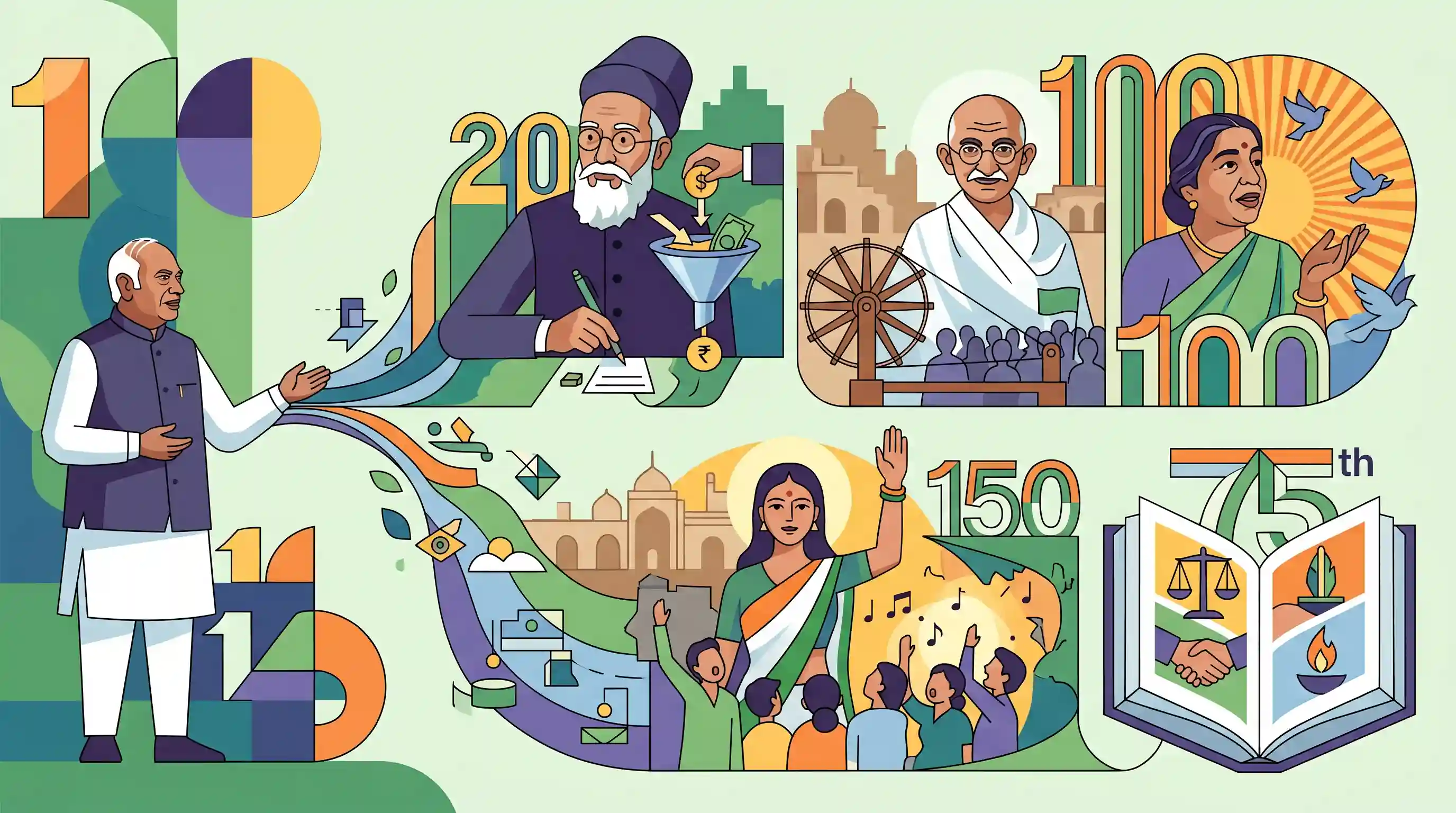
On its 140th Foundation Day, Congress President Mallikarjun Kharge reaffirmed the party's unwavering commitment to its core constitutional and ideological principles. He announced a series of upcoming historical commemorations for 2025 and 2026, marking centenaries and major anniversaries linked to key figures and symbols of the freedom struggle. These include the 200th birth anniversary of Dadabhai Naoroji, the centenary of Mahatma Gandhi's and Sarojini Naidu's respective tenures as Congress presidents, the 150th anniversary of Vande Mataram, and the 75th year of the adoption of the Indian Constitution.
Key Points
- The Indian National Congress celebrated its 140th Foundation Day, emphasizing its core ideological principles and historical legacy in India's freedom struggle.
- Congress president Mallikarjun Kharge highlighted that 2025 marks the centenary of Mahatma Gandhi's Congress presidency (Belgaum session) and the 150th anniversary of the national song Vande Mataram.
- The year 2025 also marks the 75th year of the adoption of the Indian Constitution.
- 2026 will commemorate the 200th birth anniversary of Dadabhai Naoroji, the centenary of Sarojini Naidu's Congress presidency (Kanpur session), and 100 years of the patriotic song 'Jhanda Uncha Rahe Hamara'.
Important Terms
Indian National Congress (INC)

Established on December 28, 1885, by A.O. Hume, it evolved from a platform for elite dialogue into the primary mass organization spearheading India's struggle for independence from British rule.
UPSC context
GS Paper I: Modern Indian History. Essential for understanding the institutional evolution of the national movement and various phases of the freedom struggle.
Constitution of India
The supreme law of India, adopted by the Constituent Assembly on November 26, 1949. It establishes the framework for political principles, procedures, and powers of government institutions and fundamental rights.
UPSC context
GS Paper II: Indian Constitution. Tests knowledge of historical underpinnings, evolution, features, and significant provisions like secularism and democracy.
Dadabhai Naoroji
Known as the 'Grand Old Man of India,' he was a pioneering nationalist, the first Indian MP in the British Parliament, and author of the 'Drain of Wealth' theory.
UPSC context
GS Paper I: Significant Personalities. Tests understanding of early nationalist thought, economic critique of colonialism, and the moderate phase of the INC.
Belgaum Session (1924)
The 39th session of the INC held in 1924, notable for being the only session presided over by Mahatma Gandhi, focusing on communal unity, khadi, and social reform.
UPSC context
GS Paper I: Indian National Movement. A major milestone marking Gandhi's direct leadership and his emphasis on the 'constructive program.'
Sarojini Naidu
A prominent poet and freedom fighter known as the 'Nightingale of India,' she became the first Indian woman to preside over an INC session (Kanpur, 1925).
UPSC context
GS Paper I: Personalities/Women in Freedom Struggle. Highlights the role of women in leadership and the inclusivity of the nationalist movement.
Vande Mataram
India's National Song, composed by Bankim Chandra Chatterjee in 1875. It became a powerful rallying cry during the Swadeshi movement and the anti-partition protests of 1905.
UPSC context
GS Paper I: Indian Culture and National Movement. Tests the significance of cultural symbols and literature in fostering national consciousness.
Prelims Trap
Sarojini Naidu was the first woman President of the Indian National Congress at the 1925 Kanpur session.
Aspirants often confuse the 'first woman' (Annie Besant, 1917) with the 'first Indian woman' (Sarojini Naidu, 1925) to preside over the INC. Exam questions exploit this missing keyword.
Static Concepts Connected
What are the key milestones of the 1924 Belgaum and 1925 Kanpur INC sessions?
- Belgaum (1924): It was the only INC session ever presided over by Mahatma Gandhi, emphasizing Khadi promotion, eradication of untouchability, and Hindu-Muslim unity.
- Kanpur (1925): Presided over by Sarojini Naidu, who became the first Indian woman to serve as the President of the INC.
What is the historical context of the national song Vande Mataram?
- Origins & Anandamath: Written by Bankim Chandra Chattopadhyay and featured in his 1882 novel Anandamath, which is set during the historical Sannyasi Rebellion in Bengal.
- First INC Singing: It was first sung in a political context by Rabindranath Tagore at the 1896 session of the Indian National Congress.
Cross-Topic Patterns
Anniversaries dictate History Prelims
UPSC frequently frames history questions around 100th, 150th, or 200th anniversaries. Expect statements on Naoroji's 'Drain of Wealth' and the Sannyasi Rebellion (linked to Vande Mataram) in upcoming exams.
75 Years: Polity meets History
The 75th anniversary of the Constitution's adoption bridges Modern History (Constituent Assembly debates) and Polity (Articles enforced on Nov 26, 1949 vs Jan 26, 1950).

Expect multi-statement Prelims questions in 2025/2026 linking Dadabhai Naoroji's drain theory, Belgaum session, and the Sannyasi revolt.
Linked PYQs · 5
Linked PYQs · 5
- 2015PrelimsGS1
Consider the following statements: 1. The first woman President of the Indian National Congress was Sarojini Naidu. 2. The first Muslim President of the Indian National Congress was Badruddin Tyabji. Which of the statements given above is/are correct?
- 2015PrelimsGS1
Who of the following was/were economic critic/critics of colonialism in India? 1. Dadabhai Naoroji 2. G. Subramania Iyer 3. R. C. Dutt Select the correct answer using the code given below.
- 2012PrelimsGS1
Consider the following statements: The most effective contribution made by Dadabhai Naoroji to the cause of Indian National Movement was that he: 1. exposed the economic exploitation of India by the British 2. interpreted the ancient Indian texts and restored the self-confidence of Indians 3. stressed the need for eradication of all the social evils before anything else Which of the statements given above is/are correct?
- 2008PrelimsGS1
Who among the following used the phrase 'Un-British' to criticize the English colonial control of India?
- 2003PrelimsGS1
Which one of the following statements is correct?
