Congress Party Registers Major Urban Comeback in Telangana Civic Polls
Source:Indian Express ↗
Why It Matters
It illustrates the shifting political landscape in urban areas and highlights the significance of Urban Local Body (ULB) elections in reflecting democratic decentralisation and grassroots governance as mandated by the 74th Amendment.
Summary
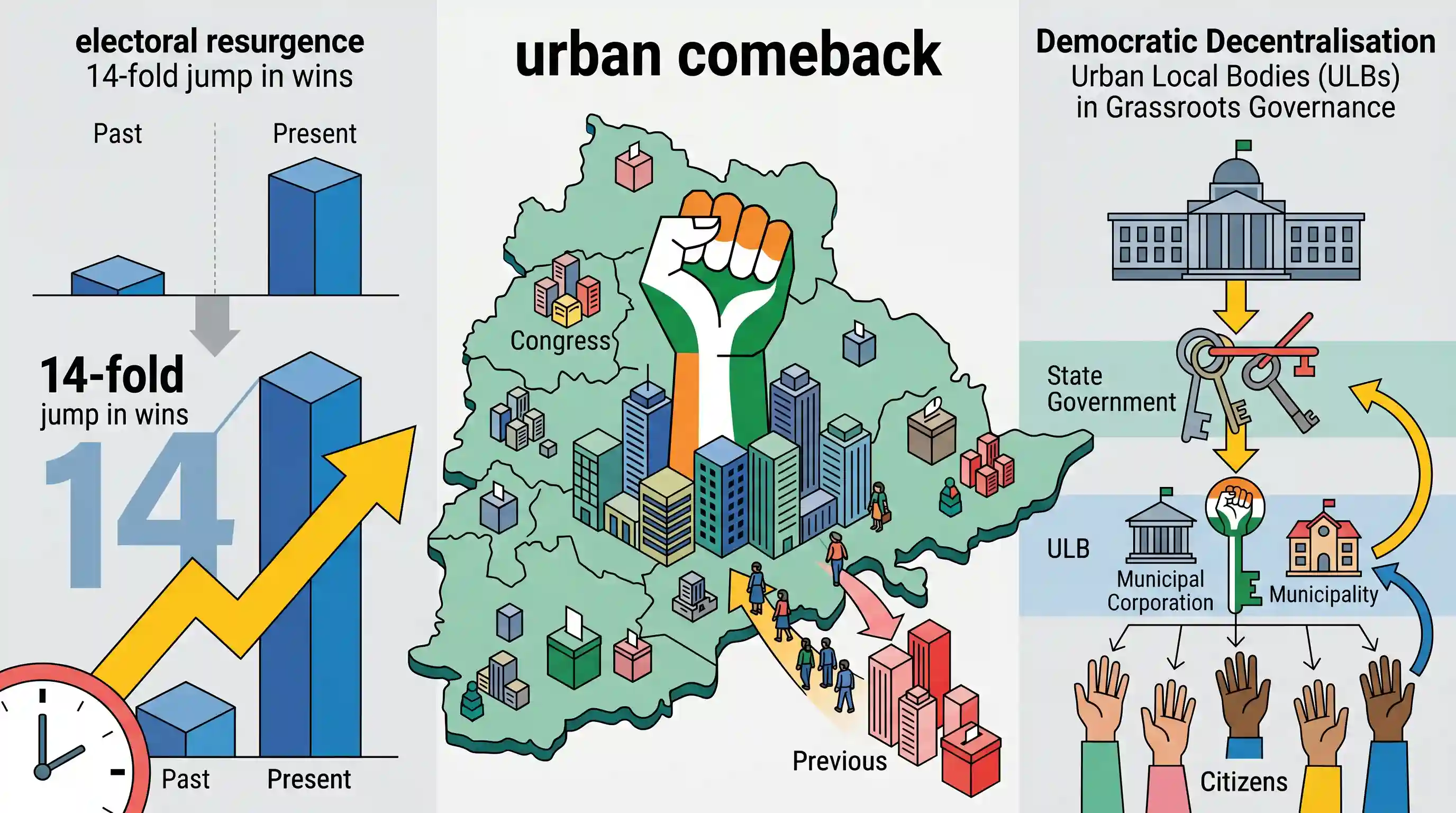
The article analyses the massive electoral resurgence of the Congress party in Telangana's urban civic bodies, where it recorded a 14-fold jump in wins. This victory signifies a major urban comeback for the party, reflecting shifting political dynamics and voter sentiments in the state's municipal areas. The results underscore the critical importance of Urban Local Bodies (ULBs) in grassroots governance and state-level political consolidation.
Key Points
- The Congress party experienced a massive 14-fold surge in victories during Telangana's urban local body (civic body) elections.
- This indicates a significant shift in urban voter sentiment, marking a major comeback for the party in urban demographics within the state.
- Elections to Urban Local Bodies (ULBs) are essential indicators of grassroots governance and public opinion regarding municipal administration.
- The results have broader implications for state politics, altering the power dynamics previously dominated by regional parties in Telangana's urban centres.
- Civic body elections and urban governance are structurally governed by the 74th Constitutional Amendment Act, highlighting the role of democratic decentralisation.
Important Terms
74th Constitutional Amendment Act

The 1992 legislation that granted constitutional status to urban local governments, inserting Part IXA (Articles 243P-243ZG) and the Twelfth Schedule into the Indian Constitution.
UPSC context
GS Paper 2: Polity/Governance. Tests understanding of the constitutional framework and legal mandate for urban local self-government.
Urban Local Bodies (ULBs)
The third tier of government in India comprising Municipal Corporations, Municipal Councils, and Nagar Panchayats, responsible for providing essential services and urban planning.
UPSC context
GS Paper 2: Governance/Decentralisation. Tests knowledge of the institutional structure and operational challenges of city governance.
Democratic Decentralisation
The devolution of political, administrative, and fiscal authority from central/state governments to local bodies to ensure citizen participation and grassroots accountability.
UPSC context
GS Paper 2: Polity. Foundational concept for 73rd/74th Amendments; tests understanding of power-sharing and local autonomy.
State Election Commission (SEC)
A constitutional body (Articles 243K/243ZA) established in each state to conduct and supervise elections for Panchayats and Urban Local Bodies.
UPSC context
GS Paper 2: Constitutional Bodies. Tests knowledge of independent election machinery at the local level.
Twelfth Schedule
A constitutional schedule listing 18 functional responsibilities of municipalities, such as urban planning, water supply, sanitation, and slum improvement.
UPSC context
GS Paper 2: Polity. Essential for understanding the functional jurisdiction and devolution of powers to urban bodies.
Municipal Corporation
The highest tier of urban local government in India, established for large metropolitan areas with populations typically exceeding one million.
UPSC context
GS Paper 2: Urban Governance. Tests understanding of municipal types and executive-political leadership roles (Mayor/Commissioner).
Ward Committees
Mandatory committees for municipalities with over 3 lakh people (Article 243S), designed to increase citizen engagement in local decision-making.
UPSC context
GS Paper 2: Participatory Governance. Tests knowledge of mechanisms for public participation in city administration.
Prelims Trap
"The Election Commission of India oversees elections to Municipal Corporations."
Under Article 243ZA, the superintendence, direction, and control of all municipal elections vest strictly in the State Election Commission (SEC), not the ECI.
Static Concepts Connected
What are the three types of municipalities mandated under Article 243Q?
- Nagar Panchayat: Constituted for a transitional area, meaning an area that is in transition from a rural area to an urban area.
- Municipal Council: Constituted for a smaller urban area, determined by the Governor based on population size, density, and local revenue generated.
- Municipal Corporation: Constituted for a larger urban area, usually major cities with high populations, significant economic activity, and non-agricultural employment.
How is the financial health of municipalities constitutionally safeguarded?
- State Finance Commission: Under Article 243Y, it reviews municipal financial positions and recommends principles for tax/toll devolution and grants-in-aid.
- Central Finance Commission: Recommends measures to augment a State's Consolidated Fund to supplement municipal resources, based on the State Finance Commission's recommendations.
- Legislative Devolution: State legislatures may by law authorize municipalities to levy, collect, and appropriate certain taxes, duties, and tolls.
Cross-Topic Patterns
ULBs & urban flooding management
Frequent urban flooding events connect the administrative limits of ULBs (12th Schedule) directly to GS-III Disaster Management, exposing the gaps between constitutional mandates and actual fiscal capacity.
SEC autonomy and federalism
Contested municipal polls often trigger debates on the independence of State Election Commissions, linking local governance disputes to broader Centre-State and institutional autonomy themes in GS-II.

Expect a 2026 prelims statement mixing Article 243Q municipality classifications with Cantonment Board administration or parastatal bodies.
Linked PYQs · 3
Linked PYQs · 3
- 2024PrelimsGS1
Which of the following statements are correct about the Constitution of India? 1. Powers of the Municipalities are given in Part IX A of the Constitution. 2. Emergency provisions are given in Part XVIII of the Constitution. 3. Provisions related to the amendment of the Constitution are given in Part XX of the Constitution. Select the answer using the code given below :
- 2017PrelimsGS1
Local self-government can be best explained as an exercise in
- 2024MainsGS2
Analyse the role of local bodies in providing good governance at local level and bring out the pros and cons merging the rural local bodies with the urban local bodies.
