Climate Action Co Benefits for Transboundary Air Pollution
Source:The Hindu ↗
Why It Matters
The study provides crucial data for arguments in GS-3 (Environment) and GS-2 (International Relations) on why global climate cooperation is a health imperative. It illustrates the limits of domestic policy in fighting transboundary PM2.5 pollution and reinforces the Global South's demand for equitable climate action.
Summary
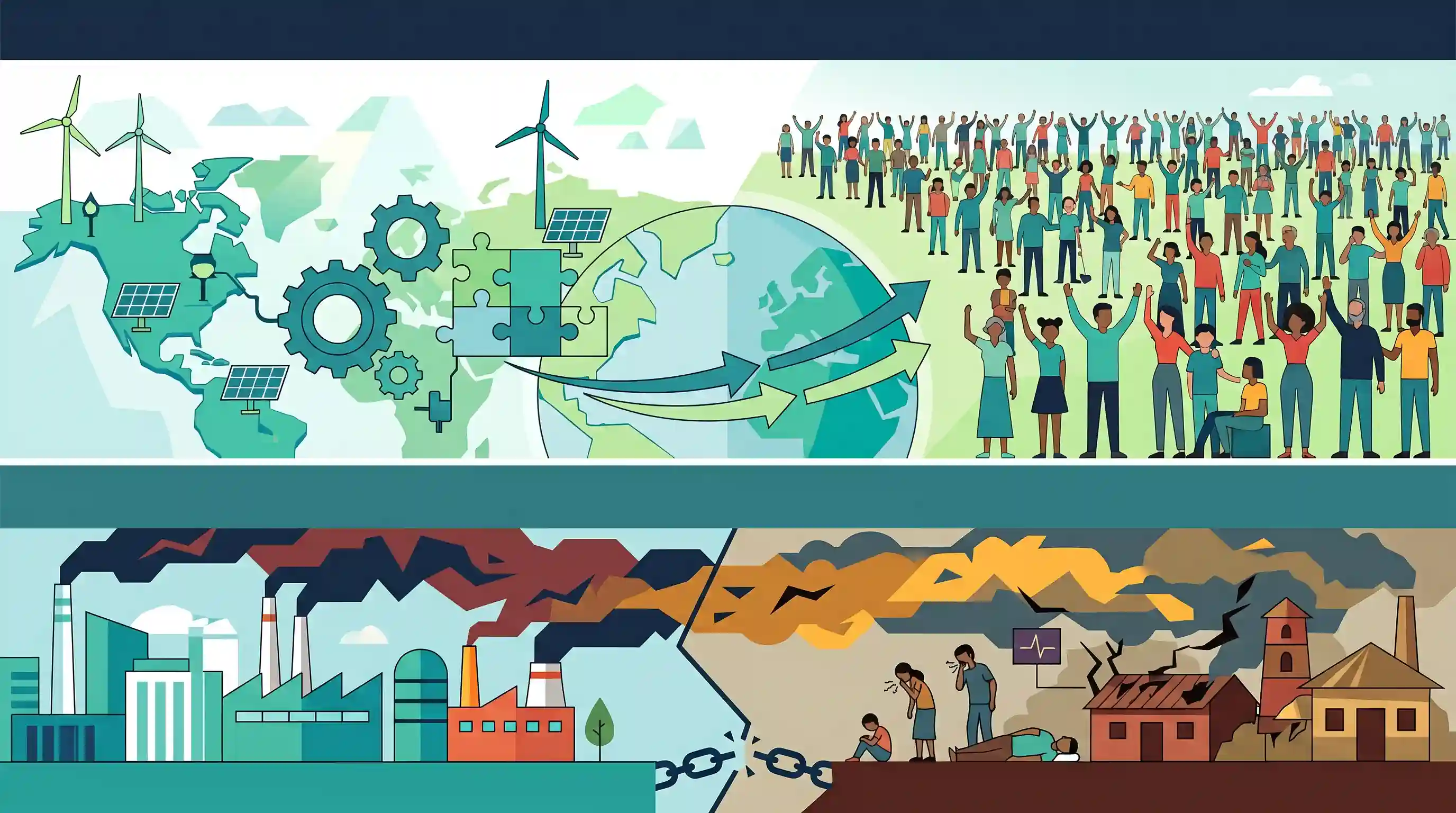
A new study published in Nature Communications highlights that ambitious, coordinated global climate action could save 1.32 million lives per year by 2040 by mitigating transboundary PM2.5 air pollution. The research emphasizes that developing nations, particularly in Africa and Asia, are disproportionately affected by pollution originating outside their borders. A fragmented approach to climate mitigation risks deepening health inequalities, making the Global South highly dependent on the emissions policies of wealthy nations.
Key Points
- Ambitious global climate action could save up to 1.32 million lives annually by 2040 through reductions in cross-border air pollution.
- Transboundary PM2.5 pollution severely impacts developing nations, making them highly dependent on international cooperation to improve their domestic air quality.
- A lack of collaborative climate mitigation will worsen health inequalities, with decisions made by wealthy nations directly affecting the health of populations in the Global South.
- Asian nations would see the highest total health benefits from coordinated action due to large populations, while African countries are the most reliant on external emissions reductions.
Important Terms
PM2.5

Atmospheric particulate matter with a diameter less than 2.5 micrometres. These fine particles can penetrate deep into the lungs and bloodstream, causing cardiovascular and respiratory diseases.
UPSC context
GS-III: Environment and Pollution. Crucial for understanding air quality standards (NAAQS), WHO guidelines, and health impacts in urban India.
Transboundary Air Pollution
Pollution that originates in one country but is transported across borders by air or water, causing environmental and health damage in neighboring or distant nations.
UPSC context
GS-II & GS-III: International Relations and Environment. Tests knowledge of regional cooperation, international law (no-harm rule), and conventions like CLRTAP.
Global South
A term broadly referring to developing and least developed nations in Africa, Asia, and Latin America, often characterized by high climate vulnerability and lower historical emissions.
UPSC context
GS-II: International Relations. Central to India's foreign policy (e.g., Voice of Global South Summit) and climate negotiations (North-South divide).
Climate Justice
A framework that views climate change through an ethical lens, highlighting that those least responsible for emissions often suffer the most from its effects.
UPSC context
GS-III & GS-IV: Environment and Ethics. Relevant to debates on equity, historical responsibility, and fair distribution of climate burdens.
Climate Change Mitigation
Actions or policies aimed at reducing or preventing the emission of greenhouse gases (GHGs) to limit the long-term effects of global warming.
UPSC context
GS-III: Environment. Key for understanding NDCs, renewable energy targets, and global agreements like the Paris Agreement.
Common But Differentiated Responsibilities (CBDR)
A principle under the UNFCCC acknowledging that all states have a shared obligation to address climate change but differing responsibilities based on historical contributions and wealth.
UPSC context
GS-II & GS-III: International Agreements. A cornerstone of India's stance in COP negotiations regarding finance and technology transfer.
Prelims Trap
Developing nations can achieve WHO Air Quality standards solely through stringent domestic emission control policies.
The study emphasizes PM2.5's long-range transboundary dispersion, meaning domestic efforts are fundamentally insufficient without coordinated global emission reductions.
Static Concepts Connected
What are the WHO Air Quality Guidelines for PM2.5 compared to India's NAAQS?
- WHO 2021 Guidelines: The updated 2021 WHO guidelines set the annual average limit at 5 µg/m³ and the 24-hour mean at 15 µg/m³.
- India's NAAQS: India's standards are significantly more relaxed, setting the annual average limit at 40 µg/m³ and the 24-hour mean at 60 µg/m³.
- PM2.5 Characteristics: Its microscopic size allows it to bypass the respiratory tract, enter the bloodstream, and travel vast atmospheric distances across international borders.
What is the major international framework addressing transboundary air pollution?
- CLRTAP: The 1979 Convention on Long-Range Transboundary Air Pollution (CLRTAP) under the UN Economic Commission for Europe (UNECE).
- Gothenburg Protocol: A key CLRTAP protocol setting emission ceilings for pollutants like sulfur dioxide, nitrogen oxides, and fine particulate matter (PM2.5).
- Geographic Limitation: CLRTAP primarily covers Europe and North America, leaving the Global South structurally vulnerable to transboundary pollution without a dedicated binding treaty.
Cross-Topic Patterns
Climate-Health Nexus at UNFCCC
Recent COP summits (e.g., COP28's Declaration on Climate and Health) officially institutionalized the climate-health nexus, linking global emission targets directly to reducing transboundary respiratory disease burdens in developing nations.
CBDR and Transboundary Health Impacts
The reliance of African and Asian nations on Western emission cuts reinforces CBDR-RC principles, expanding the climate justice argument from historical emissions to immediate transboundary health impacts.

Climate-health nexus + WHO PM2.5 guidelines + transboundary dispersion likely to form a combined multi-statement Prelims question.
Linked PYQs · 3
Linked PYQs · 3
- 2022MainsGS3
Discuss global warming and mention its effects on the global climate. Explain the control measures to bring down the level of greenhouse gases which cause global warming, in the light of the Kyoto Protocol, 1997.
- 2022MainsGS2
‘Clean energy is the order of the day.’ Describe briefly India's changing policy towards climate change in various international fora in the context of geopolitics.
- 2022PrelimsGS1
In the context of WHO Air Quality Guidelines, consider the following statements: 1. The 24-hour mean of PM2.5 should not exceed 15 µg/m³ and annual mean of PM2.5 should not exceed 5 µg/m³. 2. In a year, the highest levels of ozone pollution occur during the periods of inclement weather. 3. PM10 can penetrate the lung barrier and enter the bloodstream. 4. Excessive ozone in the air can trigger asthma. Which of the statements given above are correct?
