Mass Prison Break in Nepal Poses Border Security Risks
Source:Indian Express ↗
Why It Matters
The political collapse in Nepal presents critical geopolitical and internal security challenges for India. The open India-Nepal border means the mass escape of prisoners could lead to trans-border infiltration, requiring urgent border management interventions, while the regime change forces a recalibration of diplomatic ties.
Summary
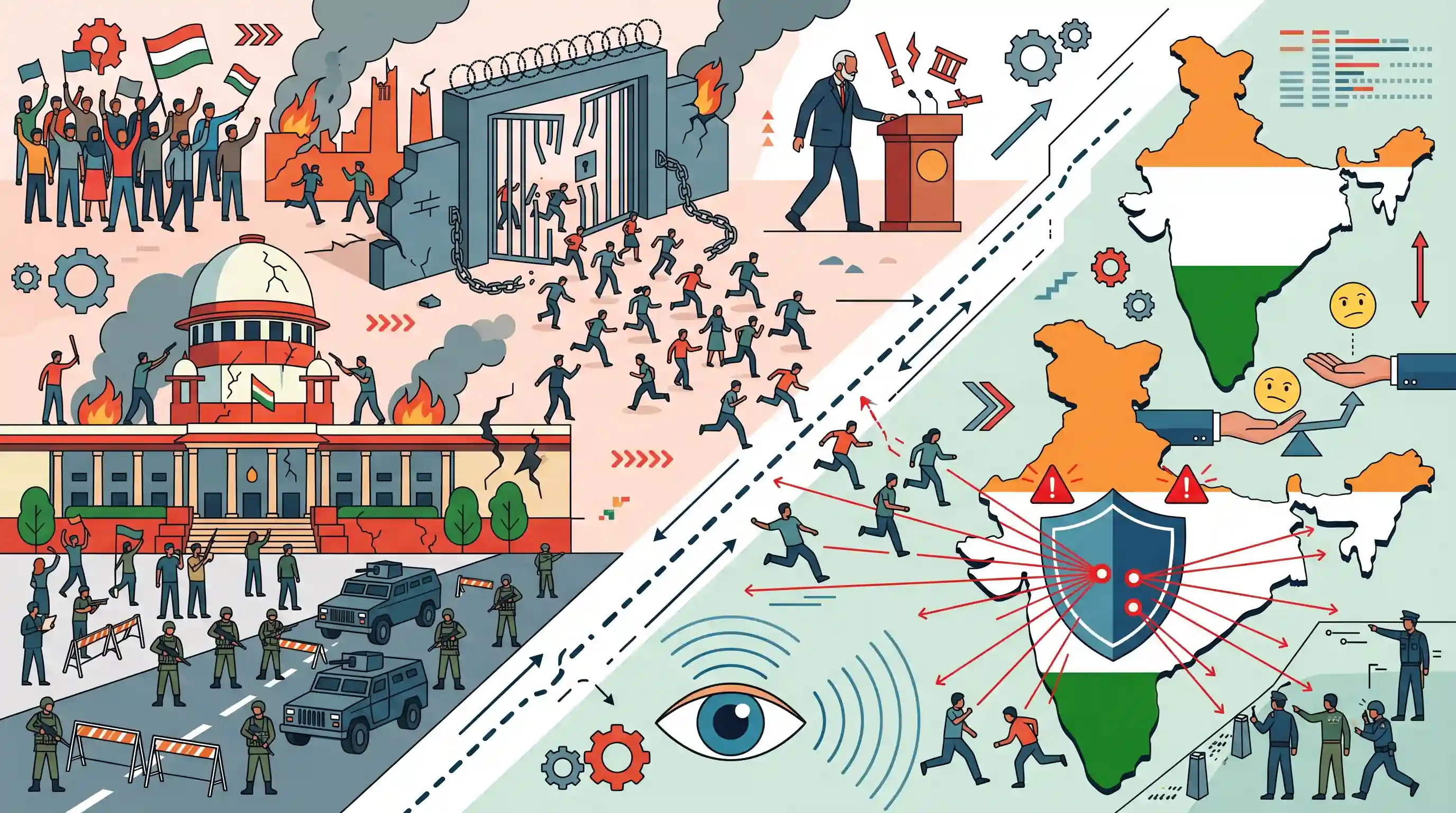
Amidst sweeping anti-government protests, Nepal is facing a severe political and security crisis. Over 13,000 prisoners escaped from jails across the country, and Prime Minister K.P. Sharma Oli was forced to resign. Critical government infrastructure, including the Supreme Court, has been targeted, leading the Nepal Army to impose nationwide curfews. For India, this breakdown of constitutional machinery in a neighbouring state not only tests its diplomatic approach but also poses an acute internal security challenge due to the open border shared with Nepal.
Key Points
- Violent anti-government protests in Nepal have led to a severe political crisis, culminating in the resignation of Prime Minister K.P. Sharma Oli.
- The breakdown of law and order saw state institutions, including the Supreme Court, subjected to arson, prompting the Nepal Army to enforce curfews.
- Approximately 13,000 prisoners escaped from jails across the country, creating an unprecedented domestic crisis.
- The mass prison break poses a significant security threat to India due to the porous, open border between India and Nepal, escalating risks of trans-border crime and infiltration.
- The events highlight a broader trend of regional instability in South Asia (following crises in Sri Lanka and Bangladesh), challenging India's foreign policy and regional security calculus.
Important Terms
Neighbourhood First Policy

India's foreign policy framework prioritizing relations with immediate neighbors. It focuses on regional connectivity, infrastructure, and mutual security to ensure a stable periphery and counter external influences like China.
UPSC context
GS-II (International Relations); tests understanding of regional diplomacy and India's strategic leadership in South Asia.
Indo-Nepal Open Border
A unique 1,751 km boundary governed by the 1950 Treaty of Peace and Friendship. It allows visa-free movement for citizens but presents challenges like smuggling and militant infiltration.
UPSC context
GS-III (Internal Security & Border Management); focuses on porous borders and transnational crime.
Nepal Army
The primary military force of Nepal responsible for national sovereignty and territorial integrity. During political crises, it is often mobilized for internal security and maintaining law and order.
UPSC context
GS-II (Bilateral Relations); examines the role of military institutions in neighboring democratic transitions.
Supreme Court of Nepal
The highest judicial authority in Nepal. It acts as the guardian of the constitution and has the power of judicial review to resolve political and constitutional impasses.
UPSC context
GS-II (Comparative Constitution); tests knowledge of judicial roles in safeguarding democracy during crises.
Sashastra Seema Bal (SSB)
A Central Armed Police Force (CAPF) under the Ministry of Home Affairs, specifically mandated to guard India's borders with Nepal and Bhutan.
UPSC context
GS-III (Security Forces); identifies specialized forces for specific border management challenges.
Prelims Trap
"The Border Security Force (BSF) is the primary agency responsible for guarding the open border between India and Nepal."
Under the "One Border, One Force" principle, the Sashastra Seema Bal (SSB) is the sole lead intelligence and border-guarding agency for the India-Nepal border, not the BSF.
Static Concepts Connected
How are India's land borders guarded under the "One Border, One Force" principle?
- Sashastra Seema Bal (SSB): Guards the borders with Nepal and Bhutan, focusing on preventing smuggling and unauthorized entry across open borders.
- Border Security Force (BSF): Secures the borders with Pakistan and Bangladesh, managing diverse terrains from deserts to riverine frontiers.
- Indo-Tibetan Border Police (ITBP): Guards the Line of Actual Control (LAC) with China in high-altitude, mountainous terrain.
- Assam Rifles: Responsible for the porous and insurgency-prone border with Myanmar.
What are the core provisions of the 1950 India-Nepal Treaty of Peace and Friendship?
- Open Border: Allows reciprocal free movement of people and goods across the border without passports or visas.
- National Treatment: Grants citizens of both countries reciprocal rights regarding residence, property ownership, and participation in trade/commerce.
- Mutual Security: Mandates that neither government shall tolerate any threat to the security of the other by a foreign aggressor.
Cross-Topic Patterns
Open Borders vs Internal Security
The mass prison break highlights the 'open border paradox', directly linking foreign regime collapse to India's internal security threats like FICN smuggling, fugitive transit, and human trafficking.
South Asian Regime Instability
Nepal joins Bangladesh, Sri Lanka, and Myanmar in facing recent regime collapses or severe civic unrest, heavily straining India's "Neighbourhood First" policy and requiring agile border management.

Expect a GS-3 Mains question in 2026 on how regime instability in neighboring states amplifies India's border management challenges.
Linked PYQs · 3
Linked PYQs · 3
- 2022MainsGS2
India is an age-old friend of Sri Lanka.’ Discuss India's role in the recent crisis in Sri Lanka in the light of the preceding statement.
- 2016MainsGS3
Border management is a complex task due to difficult terrain and hostile relations with some countries. Elucidate the challenges and strategies for effective border management.
- 2020MainsGS3
Analyze internal security threats and transborder crimes along Myanmar, Bangladesh and Pakistan borders including Line of Control (LoC). Also discuss the role played by various security forces in this regard.
