Madhya Pradesh Approves Sentence Reduction for 124 Prisoners
Source:newsonair ↗
Why It Matters
Highlights the executive power of remission granted to State Governments and Governors regarding prisoners' sentences, which connects directly to constitutional provisions (Articles 72 and 161) and governance topics in the state syllabus.
Summary
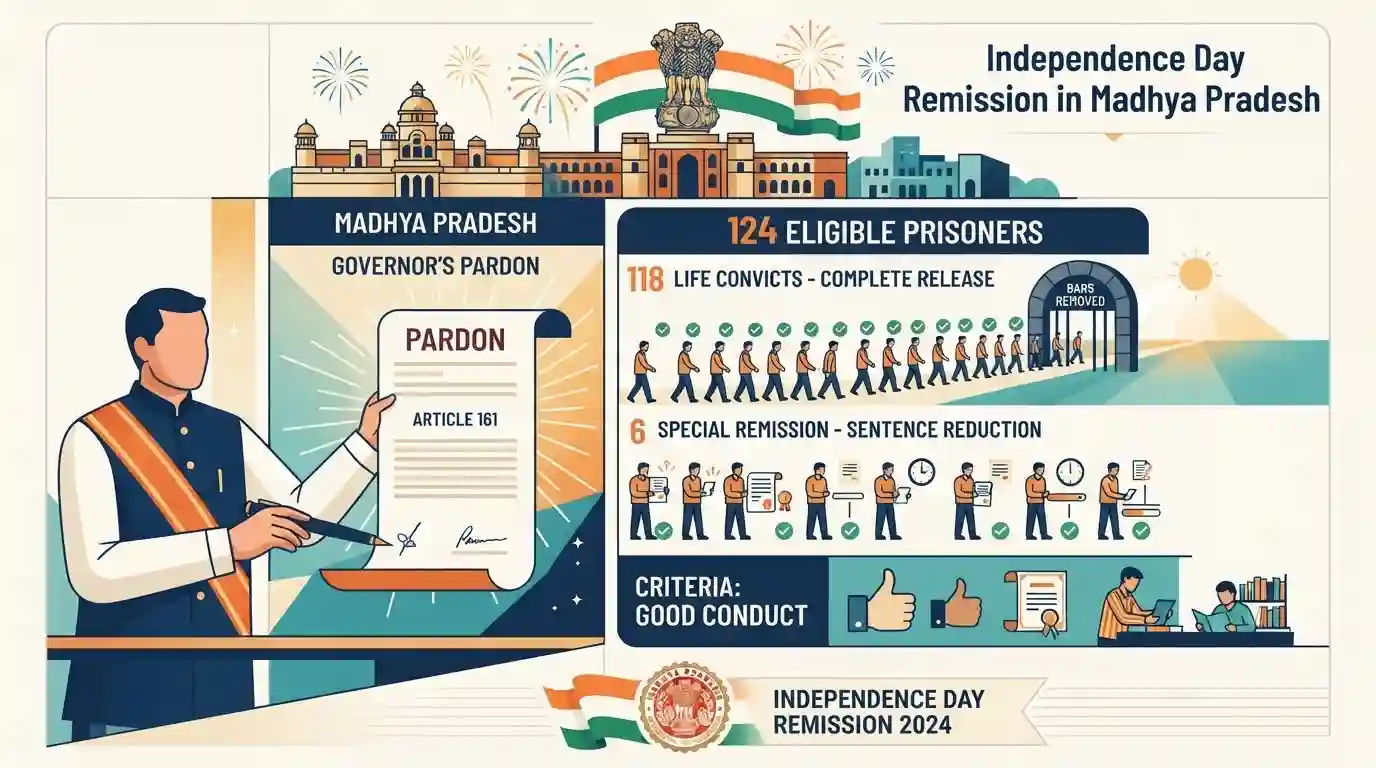
The Madhya Pradesh state government has announced the early release or reduction in the sentences of 124 eligible prisoners on the occasion of Independence Day. This includes the complete release of 118 life convicts and special remission for six others, based on their good conduct during their time in prison.
Key Points
- The Madhya Pradesh government has approved the sentence reduction or early release of 124 eligible prisoners on Independence Day.
- Out of the total, 118 prisoners serving life sentences will be released entirely based on good conduct in jail.
- The remaining six eligible prisoners will be granted special remission of their sentences.
Important Terms
Prison Administration (State List)

The state's exclusive legislative and administrative domain over prisons, placed under List II of the Seventh Schedule. This means states run daily jail operations and set distinct prison manuals.
UPSC context
GS Paper 2 (Polity). Explains why jail reforms and release policies vary state-by-state despite central advisories.
Pardoning Powers of the Governor (Article 161)
A constitutional provision granting a state Governor the power to pardon, reprieve, respite, remit, or commute the sentences of individuals convicted under state laws.
UPSC context
GS Paper 2 (Executive Powers). Tests knowledge of Governor's clemency powers vs. the President's (Article 72).
Remission of Sentence
The reduction of the duration of a prison sentence without changing its fundamental character or erasing the original conviction. Often granted for good behavior.
UPSC context
GS Paper 2 (Polity/Judiciary). Highly relevant for questions on premature release policies and criminal justice reform.
Commutation of Sentence
The substitution of a more severe punishment with a lighter form of punishment, such as changing a death sentence to life imprisonment.
UPSC context
GS Paper 2 (Polity). Contrasted with Remission/Pardon; commonly tested in MCQs regarding executive powers.
Prelims Trap
"The Governor possesses absolute discretionary power to grant complete remission to life convicts under Article 161."
The Governor's clemency power is not discretionary; it requires the aid and advice of the State Council of Ministers and is subject to statutory minimums.
Static Concepts Connected
How do the pardoning powers of the President and Governor differ?
- Death sentences: Only the President can pardon a death sentence. The Governor can only suspend, remit, or commute a death sentence.
- Court Martial: The President can pardon sentences handed down by a Court Martial; the Governor possesses no such power.
- Scope of law: The President's power applies to offences against Union laws, whereas the Governor's applies to offences against State laws.
What are the key terms in executive clemency under Articles 72 and 161?
- Commutation: Substitutes a harsher punishment with a lighter form (e.g., converting rigorous imprisonment to simple imprisonment).
- Remission: Reduces the period of a sentence without changing its fundamental character.
- Respite: Awards a lesser sentence in place of one originally awarded due to special facts (e.g., physical disability, pregnancy).
Cross-Topic Patterns
Remission limits & judicial review
Remission powers are frequently tested alongside recent SC judgments (e.g., Bilkis Bano case), emphasizing that the "appropriate government" for remission is where the offender was sentenced.
Prison reforms + State List dynamics
Link this to the Model Prisons Act, 2023. Though prisons are strictly in the State List (Entry 4, List II), the Centre is pushing model legislation for uniform reform.

Expect a multi-statement question contrasting the Governor's Article 161 constitutional powers with BNSS 2023 statutory remission limits.
Linked PYQs · 3
Linked PYQs · 3
- 2022MPPSC_PRELIMSGS1
From which Article does the President of India derive his/her pardoning power?
- 2018MPPSC_PRELIMSGS1
Under which Article of the Constitution of India, the Governor has the power to promulgate ordinances during recess of Legislature?
- 2019MPPSC_PRELIMSGS1
Chairperson and Members of the State Human Rights Commission are appointed by
