Gujarat High Court Demands Complete Ban on Manual Scavenging
Source:gujarat-samachar ↗
Why It Matters
This article highlights the persistent implementation gaps of the 2013 Manual Scavenging Act and illustrates the critical intervention of the judiciary (via PILs) in enforcing constitutional rights (Article 21) and holding urban local bodies accountable for sanitation and social justice.
Summary
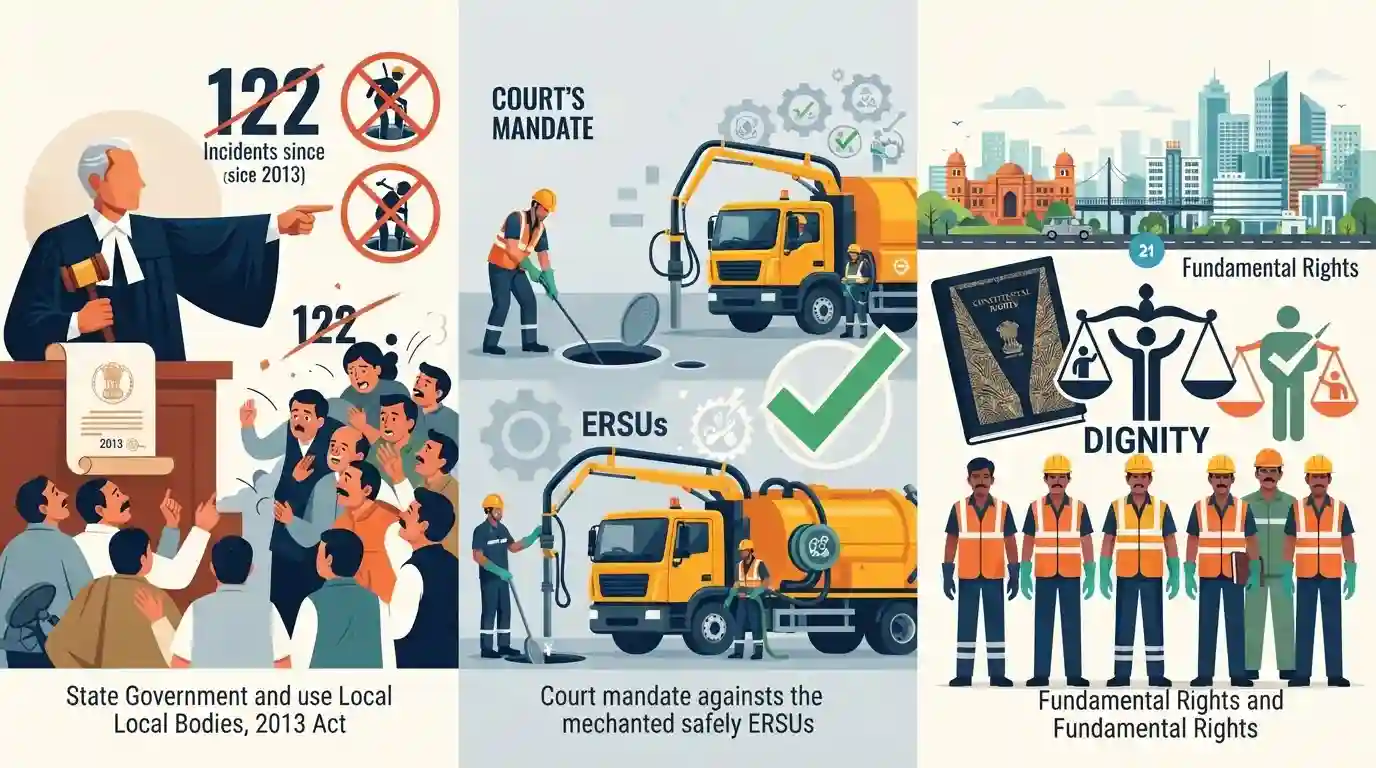
The Gujarat High Court has sharply rebuked the state government for its failure to eradicate manual scavenging, citing 122 reported incidents since the enactment of the Prohibition of Employment as Manual Scavengers and their Rehabilitation Act in 2013. In response to a recent incident at an Ahmedabad hospital, the court mandated strict enforcement of the ban, emphasizing that local municipal corporations must establish Emergency Response Sanitation Units with modern machinery. The ruling underscores the judiciary's proactive role in enforcing Article 21 by ensuring marginalized workers are protected from hazardous labor and can live with dignity.
Key Points
- The Gujarat High Court severely criticized the state government over the persistence of manual scavenging, noting 122 reported cases since 2013.
- The court found the state's mere financial penalization of a private contractor for an incident at the U.N. Mehta Institute to be inadequate.
- Municipal corporations and local civic bodies were directed to take accountability by setting up and effectively operating Emergency Response Sanitation Units (ERSUs) equipped with modern machinery.
- The judiciary underscored the need for a complete ban on hazardous manual sewer cleaning to protect human rights and ensure a life of dignity.
Important Terms
Prohibition of Employment as Manual Scavengers and their Rehabilitation Act, 2013

A landmark Indian law criminalizing manual scavenging and hazardous sewer cleaning without protective gear. It mandates the demolition of unsanitary latrines and comprehensive rehabilitation for affected sanitation workers.
UPSC context
GS Paper 2 (Social Justice). Tests knowledge of statutory protections, vulnerable sections, and implementation gaps regarding Dalit and worker rights.
Emergency Response Sanitation Units (ERSUs)
Professional, well-equipped units mandated in urban centers to handle severe drainage blockages safely. They ensure that exceptional manual sewer cleaning is done only by trained professionals using specialized safety equipment.
UPSC context
GS Paper 2 (Governance). Important for topics on urban local bodies, the NAMASTE scheme, and occupational safety of sanitation workers.
Gujarat High Court
The highest appellate court in Gujarat, possessing constitutional authority under Article 226 to issue writs protecting citizens' fundamental rights, such as holding civic bodies accountable for hazardous labor practices.
UPSC context
GS Paper 2 (Polity/Judiciary). Tests understanding of judicial review, proactive judicial intervention, and the enforcement of Article 21 (Right to Life).
Prelims Trap
The 2013 Act provides an absolute, unconditional ban on any manual entry into sewers.
Manual entry is permitted in rare, exceptional cases IF the employer provides mandatory protective gear and safety equipment. The Act bans *hazardous* (unequipped) cleaning, not all manual entry absolutely.
Static Concepts Connected
Which Fundamental Rights protect citizens from manual scavenging?
- Article 17: Abolishes untouchability, striking at the historical caste-based enforcement and social sanction of manual scavenging.
- Article 21: Guarantees the right to life with dignity, a principle repeatedly invoked by the Supreme Court in the Safai Karamchari Andolan judgment.
- Article 23: Prohibits forced labor (begar), providing a constitutional shield against systemic and occupational exploitation of marginalized communities.
What are the core mandates of the NAMASTE Central Sector Scheme?
- Zero Fatalities: Aims to eliminate all deaths in sanitation work by ensuring zero human contact with hazardous waste.
- 100% Mechanization: Ensures all sewer and septic tank sanitation work is performed entirely by machines across all Urban Local Bodies.
- Enterprise Empowerment: Formalizes sanitation workers into Self Help Groups (SHGs) and empowers them to own and run mechanized sanitation enterprises.
Cross-Topic Patterns
74th Amendment + Municipal Capacity
Connects Schedule 12 (public health and sanitation) to municipal obligations. The court's demand for Emergency Response Sanitation Units (ERSUs) directly tests the executive capacity and accountability of Urban Local Bodies.
Judicial Activism & Continuing Mandamus
The Gujarat HC's monitoring of state non-compliance (122 cases since 2013) reflects a 'continuing mandamus' approach, often used by constitutional courts to enforce Article 21 for marginalized populations.

Statements testing the NAMASTE scheme alongside Article 17 and the 2013 Act's definition of "hazardous cleaning" are highly probable.
Linked PYQs · 3
Linked PYQs · 3
- 2017GPSC_PRELIMSGS1
District planning Committees have been constituted as mandated by
- 2020GPSC_PRELIMSGS1
Which of the following cases/areas will not be entertained as Public Interest Litigation (PIL)? 1. Landlord-Tenant Matters 2. Service Matter and those pertaining to pension and gratuity of an Individual 3. Complaints against central/state government departments and local bodies 4. Petition for early hearing of cases pending in High Courts and Subordinate courts
- 2025GPSC_PRELIMSGS1
The concept of Public Interest Litigation (PIL) in India was introduced to: 1. Allow the courts to take suo motu cognizance of matters affecting the public interest. 2. Ensure legal representation for the economically weaker sections of society. 3. Enable NGOs and activists to file petitions on behalf of affected communities. 4. Restrict the judiciary's power to interfere in government policy decisions. Select the correct answer using the codes given below:
