Dhar Tribal Students March To Protest Alleged Caste Discrimination
Source:freepressjournal ↗
Why It Matters
This incident underscores the ongoing social and administrative challenges faced by tribal students in educational institutions. It highlights the relevance of constitutional safeguards for Scheduled Tribes and the practical implementation of laws like the Scheduled Castes and Scheduled Tribes (Prevention of Atrocities) Act in Madhya Pradesh.
Summary
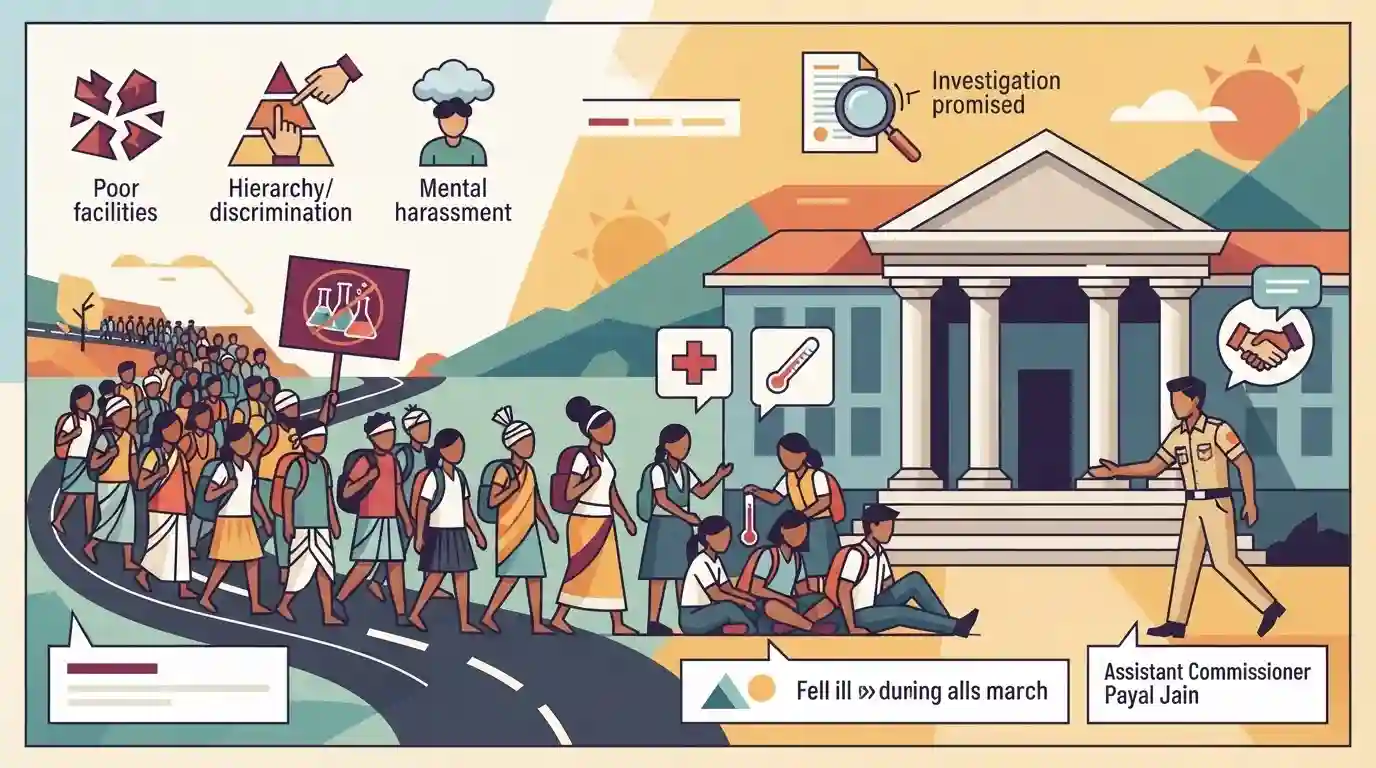
120 tribal students from Sandipani Government Higher Secondary School in Tirla marched 10 kilometers to the Dhar Collectorate in Madhya Pradesh to protest against alleged caste-based discrimination, mental harassment, and poor hostel facilities. The students primarily complained about their chemistry teacher, Deepika Shaktawat, and the hostel administration. Four students fell ill during the march, and Assistant Commissioner of Tribal Development Payal Jain met them to assure an investigation.
Key Points
- 120 tribal students marched 10 km from Tirla to the Dhar Collectorate to protest against caste-based discrimination and mental harassment.
- The students alleged that chemistry teacher Deepika Shaktawat made derogatory remarks about their caste and discouraged them from studying.
- Complaints were also raised regarding poor hostel facilities and substandard food provided under the administration of Principal Seema Mishra.
- Assistant Commissioner of Tribal Development, Payal Jain, met the students, promised an investigation into the allegations, and addressed the health of four girls who fell ill during the march.
Important Terms
Scheduled Castes and Scheduled Tribes (Prevention of Atrocities) Act

A landmark 1989 Indian legislation enacted to prevent caste-based discrimination, violence, and humiliation against members of SC and ST communities by non-marginalized individuals.
UPSC context
GS Paper II (Social Justice/Polity); tests constitutional safeguards, welfare mechanisms, and legislative protections for vulnerable sections.
Scheduled Areas (Fifth Schedule)
Regions designated by the President under Article 244(1) of the Indian Constitution, where tribal populations predominate, requiring special administrative protections and governance mechanisms.
UPSC context
GS Paper II (Polity and Governance); examines administrative divisions under the Fifth/Sixth Schedules and the Governor’s special responsibilities.
Tribal Welfare Administration
The administrative framework comprising specialized departments, policies, and personnel dedicated to improving the socio-economic development and physical infrastructure in tribal-dominated areas.
UPSC context
GS Paper II (Welfare Schemes & Governance); assesses public service delivery, policy implementation, and administrative accountability.
Tribal Development Department
State-level administrative bodies responsible for running welfare programs, managing tribal hostels and educational institutions, and executing social justice schemes locally.
UPSC context
GS Paper II (Vulnerable Sections & Administration); tests state-level decentralized welfare execution, administrative responsiveness, and tribal interests.
Prelims Trap
Section 18 of the SC/ST Act places an absolute bar on anticipatory bail, preventing courts from granting it under any circumstance.
Courts can grant anticipatory bail if they find, prima facie, that no offense under the SC/ST Act is disclosed in the complaint.
Static Concepts Connected
What are the structural and functional attributes of the National Commission for Scheduled Tribes?
- Establishment: Article 338A, created via the 89th Constitutional Amendment Act of 2003 by bifurcating the joint commission.
- Powers: Holds civil court powers to summon persons, requisition public records, and receive evidence on affidavits during investigations.
- Advisory Role: Advises on the planning process of socio-economic development of STs, reporting annually to the President.
What administrative machinery does the Fifth Schedule of the Constitution provide?
- Applicability: Governs tribal-dominated areas in 10 states under Article 244(1), excluding Northeast states under the Sixth Schedule.
- Tribes Advisory Council: Mandates establishing a TAC in each state with Scheduled Areas to advise on ST welfare, comprising up to 20 members.
- Governor's Power: Empowered to direct that parliamentary or state laws do not apply or apply with modifications to Scheduled Areas.
Cross-Topic Patterns
Article 21A + Tribal Residential Infrastructure
Hostel quality directly impacts educational retention. True execution of the Right to Education requires integrating non-discriminatory social environments with basic public lodging infrastructure.
SC/ST Act + Judicial Interpretation
Balancing stringent protection laws with fundamental liberties, Supreme Court judgments regularly calibrate Section 18 of the SC/ST Act to prevent abuse while safeguarding vulnerable groups.

Constitutional powers of NCST vs NCSC and recent judicial exceptions to the SC/ST Act's anticipatory bail bar are high-yield 2026 areas.
Linked PYQs · 4
Linked PYQs · 4
- 2016MPPSC_PRELIMSGS1
Under which of the following sections the scheduled castes and the scheduled tribes act, 1989 is anticipatory bail prohibited?
- 2019MPPSC_PRELIMSGS1
When the Court, under Section 12 of the Protection of Civil Rights Act, 1955, shall presume that the offence is committed on the ground of "untouchability"?
- 2013MPPSC_PRELIMSGS1
A court can presume that any act constituting offence was committed on the ground of 'untouchability'- if such offence is committed in relation to
- 2025MPPSC_PRELIMSGS1
In which Article of the Indian Constitution is there a provision of reservation of seats for Scheduled Tribes in the State Assembly?
