Make in India: Evaluating Twelve Years of Industrial Policy Impact
Source:The Hindu ↗
Why It Matters
It provides a comprehensive empirical critique of India's flagship industrial policy ('Make in India') over a 12-year horizon, offering valuable insights for GS3 questions on manufacturing growth, employment, and industrial policy evaluation.
Summary
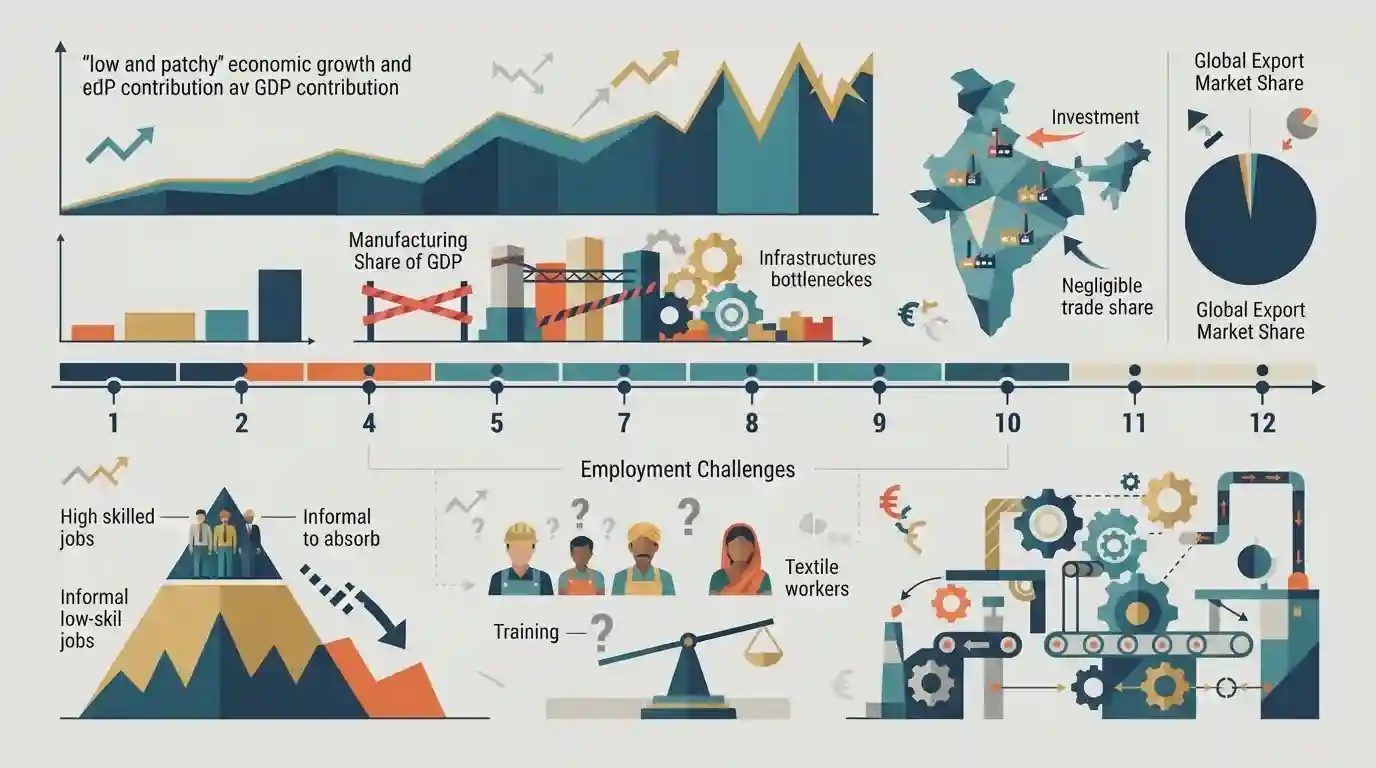
The article critically assesses 12 years of the 'Make in India' initiative through 12 key metrics, concluding that its impact on economic growth, manufacturing employment, and global trade share has been low and patchy. It highlights ongoing structural challenges in boosting the manufacturing sector's share in GDP and creating sustainable employment.
Key Points
- An evaluation of 12 years of the 'Make in India' initiative across 12 metrics reveals a low and patchy impact on economic growth, employment generation, and global export share.
- The manufacturing sector's share in India's GDP has largely stagnated rather than achieving the targeted ambitious growth, raising concerns about structural transformation.
- Employment generation within the organized manufacturing sector has lagged behind expectations, impeding the absorption of the demographic dividend.
- Global manufacturing share and export integration show limited progress, pointing to structural bottlenecks such as regulatory hurdles, logistics costs, and technology adoption gaps.
Important Terms
Make in India initiative

A flagship national program launched in 2014 to transform India into a global manufacturing hub by attracting foreign investment, enhancing domestic manufacturing capabilities, and fostering innovation across key sectors.
UPSC context
UPSC Paper III (Indian Economy): Essential for evaluating industrial policy, manufacturing growth, employment generation, and structural reforms in the economy.
Static Concepts Connected
What are the key objectives and targets originally envisaged under the Make in India initiative?
- GDP Target: Target share: Increase manufacturing sector's share in GDP to 25% by 2022 (later timeline adjusted).
- Employment Goal: Job creation: Create 100 million additional manufacturing jobs by 2022.
- FDI & Ease: FDI facilitation: Ease of doing business, opening key sectors to foreign direct investment (FDI).
- Sectoral Focus: Focus sectors: Initially identified 25 manufacturing sectors ranging from automobiles to biotechnology.
Cross-Topic Patterns
Make in India + PM Gati Shakti Logistics
While Make in India targets 25% GDP share, India's broader industrial growth is severely hampered by logistics inefficiencies addressed via PM Gati Shakti and National Logistics Policy.
Make in India + Demographic Dividend Paradox
Stagnant manufacturing employment despite 12 years of Make in India directly challenges the core premise of reaping India's demographic dividend through labour-intensive industrialization.

Make in India's 12-year review + PLI nuance likely tested as a statement-based question on structural manufacturing bottlenecks.
Linked PYQs · 2
Linked PYQs · 2
- 2023MainsGS3
Faster economic growth requires increased share of the manufacturing sector in GDP, particularly of MSMEs. Comment on the present policies of the Government in this regard.
- 2017MainsGS3
Industrial growth rate has lagged-behind in the overall growth of Gross-Domestic-Product (GDP) in the post-reform period." Give reasons. How far the recent changes in Industrial-Policy are capable of increasing the industrial growth rate?
