Counter insurgency operations and recovery of Maoist bunkers
Source:The Hindu ↗
Why It Matters
This development is a practical example of internal security operations and highlights the evolving nature of Left Wing Extremism (e.g., bunker infrastructure, solar panels). It showcases the critical role of specialized Central Armed Police Forces (like CoBRA) in combating LWE, which is directly relevant to the GS3 syllabus on security challenges and forces.
Summary
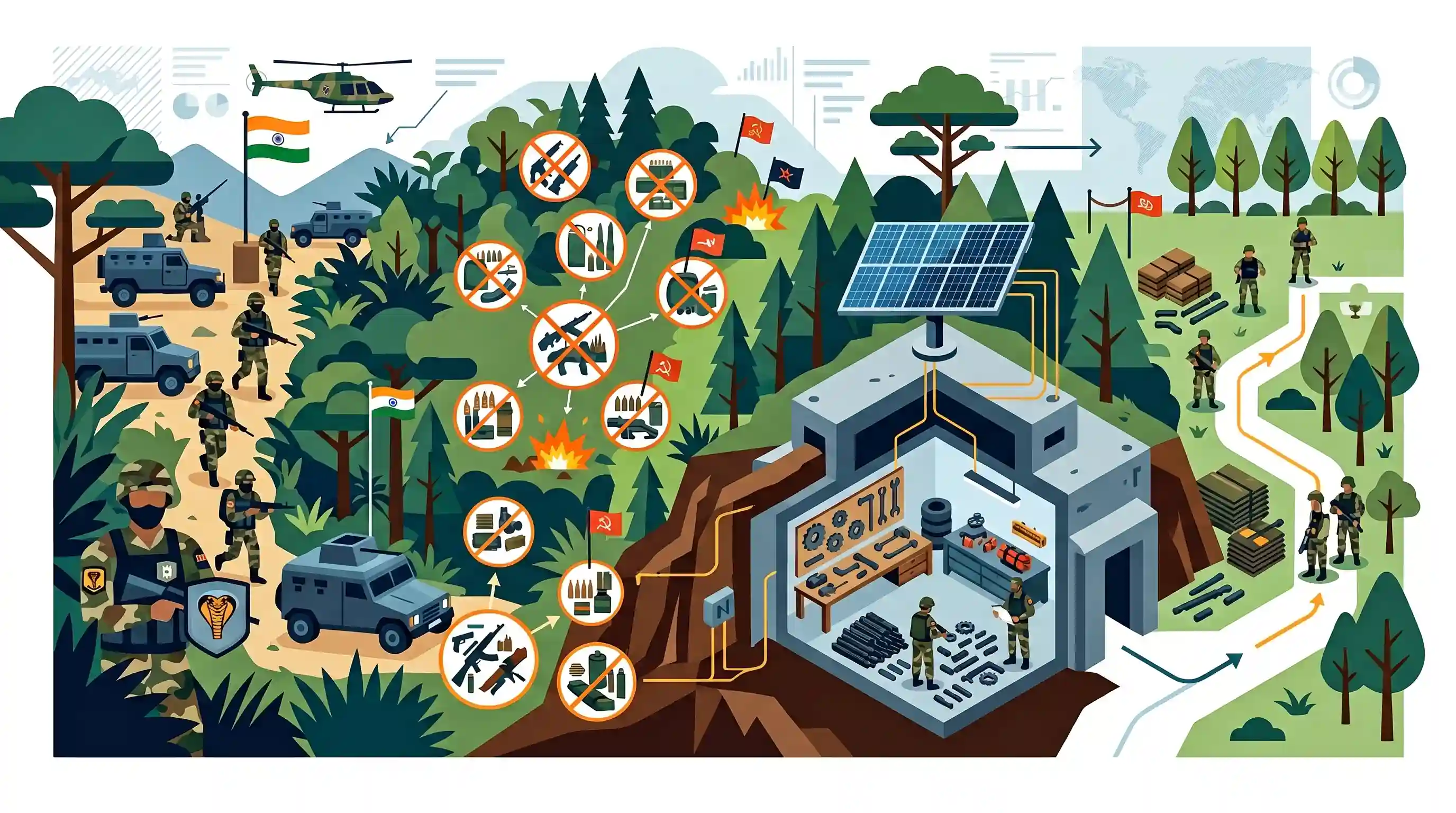
Security forces, led by the elite CoBRA unit of the CRPF, successfully uncovered and destroyed 12 Maoist dumps in Chhattisgarh's Bijapur district. The operation revealed sophisticated insurgent infrastructure, including a concrete bunker equipped with solar panels, and recovered arms manufacturing materials. This highlights ongoing and intensive counter-insurgency operations aimed at neutralizing Left Wing Extremism and restoring state authority in affected forest regions.
Key Points
- The 208th battalion of the elite CoBRA unit (CRPF) destroyed 12 Maoist dumps in Bijapur, Chhattisgarh.
- One of the hideouts featured a concrete bunker equipped with solar panels and ceiling fans, indicating the use of advanced infrastructure by Maoists.
- Earlier operations in the Komatpalli and Tumrel forests led to the recovery of arms manufacturing equipment and explosives.
- The operation reflects continuous area domination and counter-insurgency efforts by security forces in Left Wing Extremism (LWE) affected zones.
Important Terms
CoBRA (Commando Battalion for Resolute Action)

Specialized CRPF unit trained in guerrilla tactics and jungle warfare. Established in 2008, it is primarily deployed to track and neutralize Naxalite groups in India’s most difficult forest terrains.
UPSC context
GS-III (Internal Security); tests knowledge of specialized forces and their mandate in handling asymmetric warfare/LWE.
CRPF (Central Reserve Police Force)
India's largest Central Armed Police Force (CAPF) under the Ministry of Home Affairs. It assists states in maintaining law and order, conducting counter-insurgency, and neutralizing Left Wing Extremism.
UPSC context
GS-III (Internal Security); fundamental for understanding "Various Security Forces and their Mandate" and internal security management.
Left Wing Extremism (LWE)
An armed Maoist/Naxalite insurgency seeking to overthrow the state through violent revolution. It thrives in underdeveloped, forested regions (Red Corridor) by exploiting socio-economic grievances and tribal alienation.
UPSC context
GS-III (Internal Security); a primary threat involving the linkage between lack of development and the spread of extremism.
SAMADHAN Framework
A multi-pronged strategy by the Ministry of Home Affairs to combat LWE. It integrates Smart leadership, Aggressive operations, Actionable intelligence, and Choking financing into a unified counter-insurgency doctrine.
UPSC context
GS-III (Security); tests awareness of government policies and integrated operational strategies to resolve internal security crises.
Bijapur District
A district in Chhattisgarh’s Bastar division and a critical Maoist stronghold. It is currently classified as one of the few remaining "Most Affected Districts" under the government's revised LWE categorization.
UPSC context
GS-III (Internal Security); relevant for geography-based questions on LWE and understanding the shrinking footprint of the Red Corridor.
Central Armed Police Forces (CAPF)
A group of seven security organizations (e.g., CRPF, BSF, CISF) under the Ministry of Home Affairs. They handle internal security, border guarding, and assist civil power during emergencies.
UPSC context
GS-III (Internal Security); foundational for understanding the institutional framework of India’s internal security and border management.
Counter-Insurgency (COIN)
Comprehensive political and military efforts taken to simultaneously defeat and contain an insurgency while addressing its root causes. It involves a "Clear, Hold, Build" approach to restore governance.
UPSC context
GS-III (Internal Security); tests strategies to neutralize non-state actors while restoring state authority in conflict zones.
Prelims Trap
CoBRA is a specialized unit of the Indian Army deployed for counter-insurgency in LWE areas.
CoBRA (Commando Battalion for Resolute Action) is a specialized unit of the CRPF (a Central Armed Police Force under MHA), not the Indian Army or MoD.
Static Concepts Connected
What are the core components of the SAMADHAN doctrine?
- S-A-M-A: Smart Leadership, Aggressive Strategy, Motivation and Training, Actionable Intelligence.
- D-H-A-N: Dashboard based KPIs, Harnessing Technology, Action plan for each Theatre, No access to Financing.
What is the operational mandate of the CRPF and its special units?
- Nodal Agency: CRPF is the lead Central Armed Police Force (CAPF) under the MHA for maintaining internal security and counter-insurgency.
- Specialized Wings: It comprises specialized wings like CoBRA for guerrilla/jungle warfare against Maoists and the Rapid Action Force (RAF) for riot control.
- State Assistance: Since 'Public Order' is a State subject, CAPFs are deployed primarily to assist State Police forces, not to replace them.
Cross-Topic Patterns
Militancy adopting off-grid renewable tech
The use of solar panels to power concrete bunkers highlights how extremist groups leverage off-grid renewable technology to sustain deep-jungle logistical hubs independent of state infrastructure.
Dandakaranya's geography and LWE logistics
The dense tropical forests and hilly terrain of the Dandakaranya region (Bastar, Bijapur) span multiple state borders, creating natural safe havens that complicate inter-state joint policing operations.

Mains GS-3 2026 will likely test the evolving tactical nature of LWE (solar-powered bunkers) against the state's SAMADHAN doctrine.
Linked PYQs · 4
Linked PYQs · 4
- 2022MainsGS3
Naxalism is a social, economic and developmental issue manifesting as a violent internal security threat. In this context, discuss the emerging issues and suggest a multilayered strategy to tackle the menace of Naxalism.
- 2018MainsGS3
Left Wing Extremism (LWE) is showing a downward trend, but still affects many parts of the country. Briefly explain the Government of India's approach to counter the challenges posed by LWE.
- 2023MainsGS3
What are the internal security challenges being faced by India? Give out the role of Central Intelligence and Investigative Agencies tasked to counter such threats.
- 2020MainsGS3
Analyze internal security threats and transborder crimes along Myanmar, Bangladesh and Pakistan borders including Line of Control (LoC). Also discuss the role played by various security forces in this regard.
