Uttarakhand Electoral Rolls Revised Under Special Intensive Revision
Source:thestatesman ↗
Why It Matters
This article highlights crucial administrative and electoral roll processes in Uttarakhand, such as the Special Intensive Revision (SIR) and specific ECI administrative forms (Forms 6, 7, 8). These procedures are central to democratic governance, state-specific demographics, and the functioning of the Election Commission, which are core topics in UKPSC PCS Prelims.
Summary
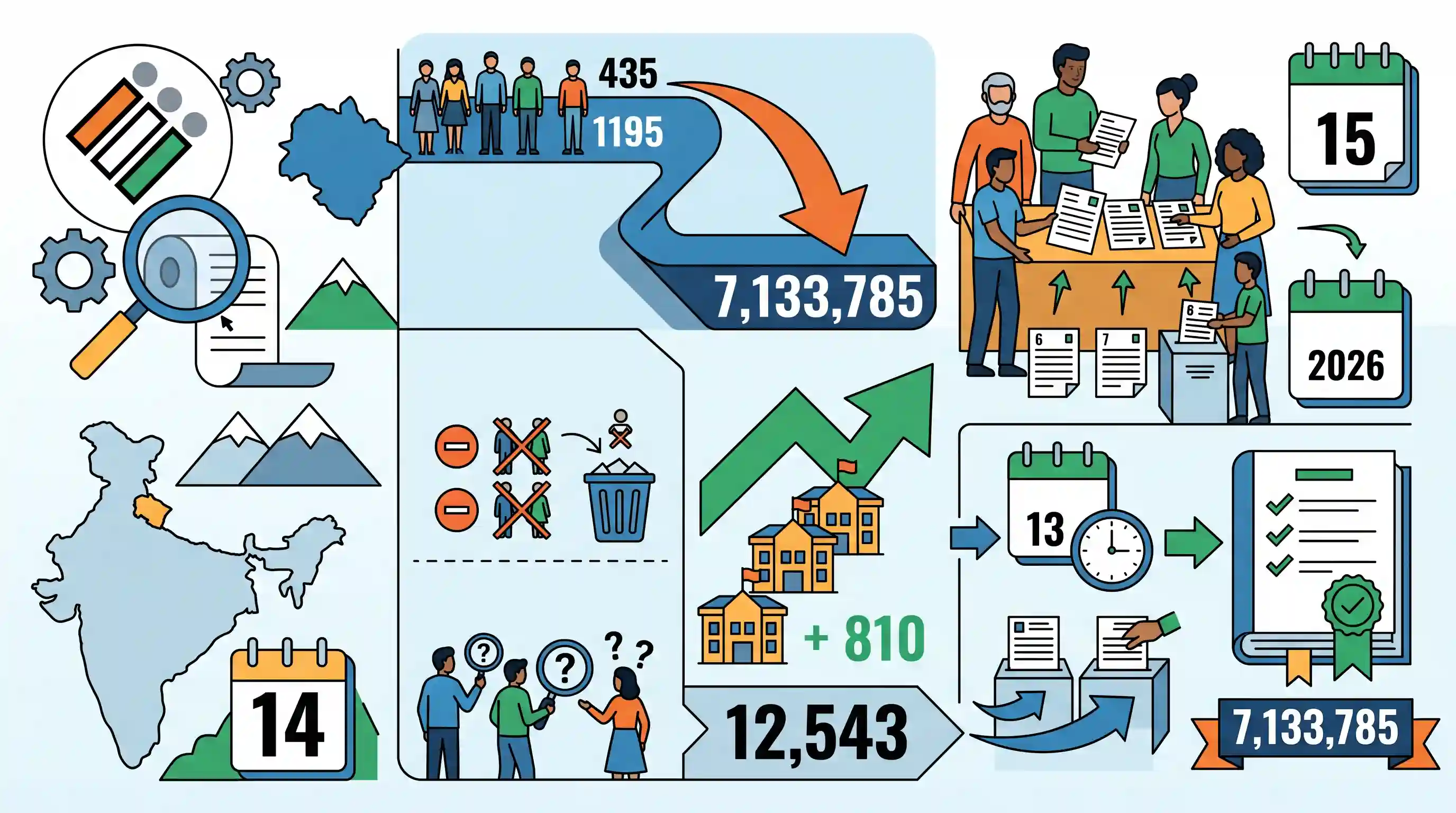
Following the first phase of the Special Intensive Revision (SIR) by the Election Commission of India, Uttarakhand's draft electoral roll was published on July 14, 2026, showing a drop in the electorate from over 83 lakh to 71,33,785, with 12 lakh voters removed and 19 lakh under scrutiny for discrepancies. Paradoxically, the state's total polling stations increased by 810 to reach 12,543. Affected citizens can use ECI Forms 6, 7, and 8 until August 13, 2026, to resolve corrections and registration issues before the final roll is published on September 15, 2026.
Key Points
- Around 12 lakh voters were removed from Uttarakhand's draft electoral roll following the completion of the first phase of the Special Intensive Revision (SIR).
- Discrepancies have been identified in the records of another 19 lakh electors, who have been placed under scrutiny.
- The state's total electorate was reduced from over 83 lakh (during the 2022 Assembly elections and local body polls) to 71,33,785.
- Despite the drop in electorate size, the number of polling stations in Uttarakhand increased by 810, rising from 11,733 to 12,543.
- The qualifying date for the Special Intensive Revision in Uttarakhand was July 1, 2026.
- Electors can resolve discrepancies or apply for registration between July 14 and August 13, 2026, using ECI Forms 6 (new registration), 7 (deletion), and 8 (correction), ahead of the final electoral roll publication on September 15, 2026.
Important Terms
Election Commission of India (ECI)

A permanent, independent constitutional body established under Article 324 of the Constitution of India, responsible for administering national and state election processes to ensure free and fair elections.
UPSC context
GS Paper II (Polity & Governance), focusing on constitutional bodies, electoral reforms, and the conduct of democratic elections.
Special Intensive Revision (SIR)
An extraordinary administrative exercise conducted by the Election Commission of India involving door-to-door verification to update electoral rolls, correct systemic inaccuracies, and eliminate duplicate, deceased, or ineligible voter entries.
UPSC context
GS Paper II (Elections & RPA), testing knowledge of electoral governance, database cleaning, and citizens' voting rights.
Form 6
The official application form prescribed by the Election Commission of India for the registration of a new general elector or voter in the electoral roll.
UPSC context
GS Paper II (Electoral Processes), testing understanding of procedural mechanisms for civic participation and voter registration.
Form 7
The official form issued by the Election Commission of India used by citizens to raise objections against a proposed voter inclusion or to seek deletion of an existing name.
UPSC context
GS Paper II (Polity/Elections), testing awareness of mechanisms designed to prevent fraudulent entries in the voter list.
Form 8
The official application form under the Election Commission of India utilized for correcting existing electoral roll details, shifting of residence, replacement of voter ID, or marking persons with disabilities.
UPSC context
GS Paper II (Electoral Governance), evaluating procedural knowledge regarding correction and updation of voter identities.
Prelims Trap
The preparation, revision, and maintenance of electoral rolls are statutory mandates carried out under the Representation of the People Act, 1951.
Electoral roll preparation, revision, and voter qualifications are governed by the RPA 1950, whereas RPA 1951 regulates actual election conduct and candidate disqualifications.
Static Concepts Connected
How do the Representation of the People Acts of 1950 and 1951 differ?
- RPA 1950: Focuses on seat allocation, delimitation of constituencies, voter qualification criteria, and electoral roll preparation/revision.
- RPA 1951: Regulates the actual conduct of elections, qualifications/disqualifications of representatives, electoral offenses, and dispute resolution.
What are the key voter registration reforms under the Election Laws (Amendment) Act, 2021?
- Quarterly qualifying dates: Introduced four qualifying dates (Jan 1, Apr 1, Jul 1, Oct 1) instead of just January 1 to accelerate youth registration.
- Aadhaar-voter link: Permitted voluntary linking of Aadhaar numbers with electoral rolls to weed out duplicate and phantom entries.
Cross-Topic Patterns
Electoral Roll Purging vs. Right to Vote
Connects Article 326 (adult suffrage) with administrative law, testing how massive automated deletions to prevent voter duplication must safeguard against the arbitrary disenfranchisement of genuine citizens.
Demographics, Migration, and Delimitation
Connects regional migration in hill states like Uttarakhand to electoral geography, where depopulation alters voter-to-booth ratios and drives complex administrative restructuring of polling stations.

A 2026 MCQ may test the exact statutory divide between RPA 1950 and 1951, alongside ECI's voter-per-booth limits and qualifying dates.
Linked PYQs · 3
Linked PYQs · 3
- 2011UKPSC_PRELIMSGS1
The Chief Election Commissioner of India is appointed by
- 2021UKPSC_PRELIMSGS1
How many Lok Sabha members are elected from Uttarakhand?
- 2016UKPSC_PRELIMSGS1
How many members of Lok Sabha are elected from Uttarakhand?
