Himalayan Infrastructure Vulnerability and Hydropower Project Risks
Source:The Hindu ↗
Why It Matters
The recurrent accidents at hydropower sites in Uttarakhand are highly relevant for GS-3 (Disaster Management & Environment) and GS-1 (Geography). It touches upon the debate around the carrying capacity of the Himalayas, the viability of run-of-the-river projects, and the need for robust hazard zonation and environmental impact assessments.
Summary
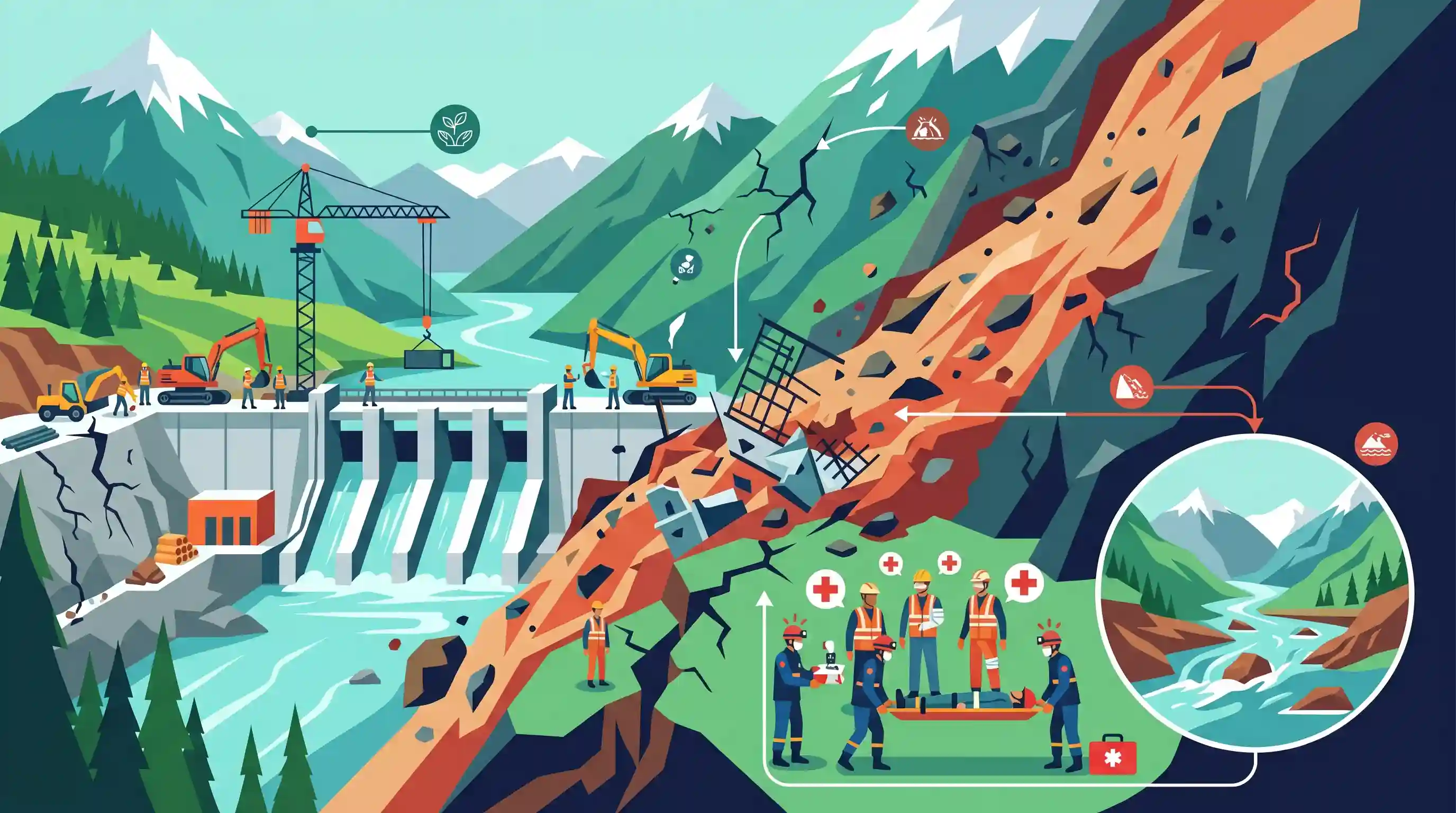
A landslide at the under-construction Vishnugad hydroelectric project in Uttarakhand's Chamoli district injured 12 labourers, halting work and triggering an SDRF response. The incident underscores the persistent environmental and safety risks associated with large-scale infrastructure and run-of-the-river hydropower projects in the ecologically fragile and disaster-prone Himalayan region, which previously witnessed severe flooding in the same area in 2021.
Key Points
- A landslide struck the THDC Vishnugad hydroelectric project site near Helang in Chamoli, injuring 12 labourers out of about 300 present.
- The incident prompted the suspension of work and the deployment of the State Disaster Response Force (SDRF).
- The project involves building a barrage to regulate the Alaknanda river's water, diverting it through a tunnel to Pipalkoti for electricity generation.
- This exact barrage site was previously damaged by floods in the Alaknanda river in 2021, highlighting the region's high vulnerability to natural disasters.
Important Terms
Tapovan Vishnugad Hydroelectric Project

A 520 MW run-of-the-river project on the Dhauliganga River, Uttarakhand. It was severely damaged by the 2021 Chamoli flash floods.
UPSC context
GS3: Environment & Disaster Management. Tests knowledge of infrastructure risks in fragile Himalayan ecosystems and flash flood history.
THDC India Limited
A Mini-Ratna Category-I PSU under the Ministry of Power, primarily owned by NTPC Limited. It manages the Tehri Dam and other Himalayan projects.
UPSC context
GS3: Infrastructure. Relevant for PSUs in the energy sector and their role in regional development and environment.
State Disaster Response Force (SDRF)
A state-level specialized rescue force constituted under the Disaster Management Act, 2005, for immediate response to disasters.
UPSC context
GS3: Disaster Management. Tests understanding of India’s institutional framework for relief and rescue operations at the state level.
Vishnugad Pipalkoti Hydro Electric Project (VPHEP)
A 444 MW run-of-the-river project being developed by THDC on the Alaknanda River in Uttarakhand's Chamoli district.
UPSC context
GS3: Infrastructure/Environment. Key for understanding specific major projects and their environmental/social impacts in the Himalayas.
Run-of-the-river (ROR) Project
A type of hydroelectric generation where little or no water storage is provided, relying instead on the natural flow of the river.
UPSC context
GS3: Environment & Science. Tests technical understanding of 'clean' energy alternatives and their geological impact on river morphology.
Prelims Trap
Run-of-the-River (RoR) projects require zero dams or barrages and pose no risk of triggering landslides.
RoR projects typically still require small barrages/weirs to divert water into extensive underground tunnels. This heavy tunneling and blasting severely destabilize fragile Himalayan slopes.
Static Concepts Connected
What are Run-of-the-River (RoR) Hydroelectric Projects?
- Definition: Generates electricity using the natural flow and elevation drop of a river, minimizing the need for massive water storage reservoirs.
- Infrastructure: Involves constructing a small barrage/weir, desilting chambers, and extensive diversion tunnels to route water to the powerhouse.
- Ecological impact: Though submergence is minimal, heavy underground blasting and tunneling alter subsurface aquifers and frequently trigger slope instability in fragile mountains.
Why is the Himalayan region highly susceptible to landslides?
- Geological factors: They are young fold mountains experiencing active tectonic uplift and fall under high seismic zones (Zone IV and V), making rocks inherently unstable.
- Climatic factors: Steep gradients combined with heavy monsoonal rainfall cause rapid toe-erosion and mass wasting along river valleys.
- Anthropogenic triggers: Unscientific road cutting, deforestation, and massive blasting for dams and tunnels act as direct catalysts for slope failure.
Cross-Topic Patterns
Carrying Capacity vs. Infrastructure
The Chamoli incident mirrors the Joshimath land subsidence crisis, linking unchecked RoR dam construction (specifically underground tunneling) to the broader debate on the Himalayan ecosystem's carrying capacity.
Cascading Hazards & GLOFs
Connects to the 2021 Chamoli disaster and Sikkim's Teesta dam breach. Cascading hazards (avalanches or GLOFs triggering downstream dam failures) represent a major shift in NDMA's risk mapping.

Expect a Mains question linking Himalayan carrying capacity to RoR hydro projects, or a Prelims mapping item on Alaknanda's tributaries.
Linked PYQs · 4
Linked PYQs · 4
- 2021MainsGS3
Describe the various causes and the effects of landslides. Mention the important components of the National Landslide Risk Management Strategy.
- 2019MainsGS3
Disaster preparedness is the first step in any disaster management process. Explain how hazard zonation mapping will help disaster mitigation in the case of landslides.
- 2016MainsGS1
The Himalayas are highly prone to landslides. Discuss the causes and suggest suitable measures of mitigation.
- 2019MainsGS3
Define the concept of carrying capacity of an ecosystem as relevant to an environment. Explain how understanding this concept is vital while planning for sustainable development of a region.
