Natural disasters and heavy rains claim lives in Himachal Pradesh
Source:theprint ↗
Why It Matters
The recurring natural disasters in Himachal Pradesh highlight the state's extreme ecological vulnerability to cloudbursts and landslides. It serves as a practical case study for disaster management frameworks, specifically the utilization of NDRF and SDRF, which are frequent subjects in HPAS Prelims Geography and Governance sections.
Summary
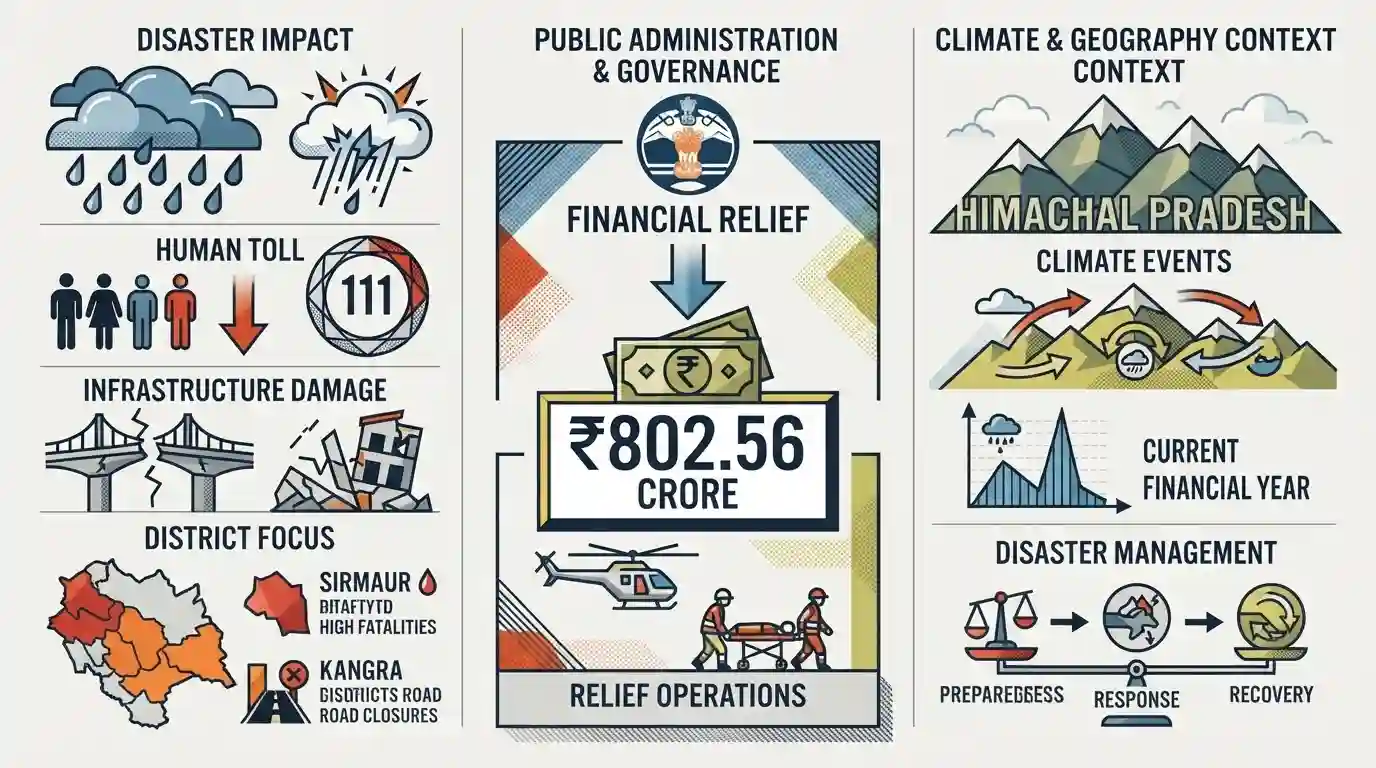
Himachal Pradesh experienced severe natural disasters in the current financial year, primarily driven by heavy rains and cloudbursts, resulting in 111 fatalities and massive infrastructure damage. Sirmaur was the worst-affected district in terms of human lives lost, while Kangra faced significant road closures. In response to the crisis, the central government has disbursed ₹802.56 crore through disaster response and mitigation funds to support relief operations.
Key Points
- A total of 111 lives have been lost in Himachal Pradesh during the current financial year due to heavy rains and associated natural disasters.
- Sirmaur district recorded the highest number of fatalities (87), followed by Lahaul-Spiti (16).
- Three severe cloudburst incidents were reported in Kullu and Lahaul-Spiti districts.
- Extensive infrastructure damage was noted, with Kangra district being the worst hit regarding road closures (736 roads blocked).
- The state received a total of ₹802.56 crore from the central government under disaster response and mitigation funds (NDRF, SDRF, NDMF, SDMF).
Important Terms
National Disaster Response Fund (NDRF)

Managed by the Central Government under the Disaster Management Act, 2005, it supplements State Disaster Response Funds for emergency response, relief, and rehabilitation during severe natural or man-made calamities.
UPSC context
Crucial for GS Paper 3 (Disaster Management), illustrating the Centre's role in providing supplemental relief funds during severe crises.
State Disaster Response Fund (SDRF)
The primary fund available to state governments under the DM Act 2005 for providing immediate emergency relief to victims of notified natural disasters, financed jointly by the Centre and States.
UPSC context
Essential for GS Paper 3 to understand sub-national disaster financing and cooperative federalism in crisis management.
National Disaster Mitigation Fund (NDMF)
Constituted under the DM Act 2005 based on the 15th Finance Commission's recommendations, this central fund exclusively supports long-term disaster risk reduction and structural mitigation projects at a national level.
UPSC context
Highlights the shift from reactive relief to proactive disaster mitigation; highly relevant for GS Paper 3 (Disaster Management).
State Disaster Mitigation Fund (SDMF)
Established by states following the 15th Finance Commission's advice, this fund finances localized risk prevention measures and community-based interventions to improve long-term disaster resilience.
UPSC context
Tests GS Paper 3 concepts on decentralized disaster preparedness and the separation of mitigation from response funding.
Prelims Trap
"Kangra recorded the highest number of human casualties due to its status as the rainiest district in Himachal."
While Kangra is the rainiest and saw the most road closures, Sirmaur actually recorded the highest human casualty toll (87 deaths) this cycle.
Static Concepts Connected
How is disaster management funded for special category states like Himachal Pradesh?
- NDRF and SDRF: Established under the Disaster Management Act 2005 primarily for emergency response, relief, and immediate rehabilitation.
- 15th Finance Commission: The 15th FC recommended parallel Mitigation Funds (NDMF/SDMF) to shift focus toward proactive local-level preparedness and climate resilience.
- Funding Ratio: For special category Himalayan states like HP, the Central Government contributes 90% to the SDRF/SDMF, while the state provides 10%.
What defines the Frigid Aridic Zone (Zone IV) in Himachal Pradesh geography?
- Coverage: Comprises Lahaul-Spiti, Pangi (Chamba), and Kinnaur districts, broadly characterized as dry temperate cold deserts.
- Climate Profile: Traditionally receives very low annual rainfall (averaging 250 mm), with precipitation historically occurring mostly as winter snow.
- Recent Shifts: Rising instances of monsoon cloudbursts in this zone indicate severe climatic shifts, challenging the traditional 'low-rainfall' geographical classification.
Cross-Topic Patterns
Cold Deserts + Climate Shifts
Cloudbursts in Lahaul-Spiti disrupt the traditional geographic classification of HP's Zone IV (Dry Temperate) as a low-rainfall area, highlighting climate change impacts on micro-climates.
15th FC + DM Architecture
The disbursement across NDRF, SDRF, NDMF, and SDMF practically reflects the 15th Finance Commission's structural shift from purely response-based funding to inclusive mitigation and preparedness.

Expect multi-statement questions mixing HP's agro-climatic zones (Lahaul's low rainfall) with disaster stats and 15th FC funding ratios.
Linked PYQs · 3
Linked PYQs · 3
- 2023HPAS_PRELIMSGS1
Consider the following statements : (1) The rainiest district in Himachal Pradesh is Kangra. (2) Rainfall in the Alpine region of Himachal Pradesh varies between 300-600 mm. (3) Winter season in Himachal Pradesh extends from October to March. (4) Mandi is the hottest place in Himachal Pradesh. Choose the correct answer from the options given below :
- 2024HPAS_PRELIMSGS1
Arrange the following climatic zones of Himachal Pradesh according to rainfall amount from lowest to highest : (1) Frigid aridic zone (2) Wet temperate zone (3) Humid sub-tropical zone (4) Sub-humid sub-tropical zone Choose the correct answer from the options given below :
- 2025HPAS_PRELIMSGS1
When was the National Centre for Disaster Management established in India ?
