IMD issues heavy rainfall alert for districts in Kerala
Source:The Hindu ↗
Why It Matters
The article provides a real-world example of IMD's color-coded warning system and the formation of low-pressure weather systems in the Arabian Sea, which are directly relevant to Geography and Disaster Management syllabi.
Summary
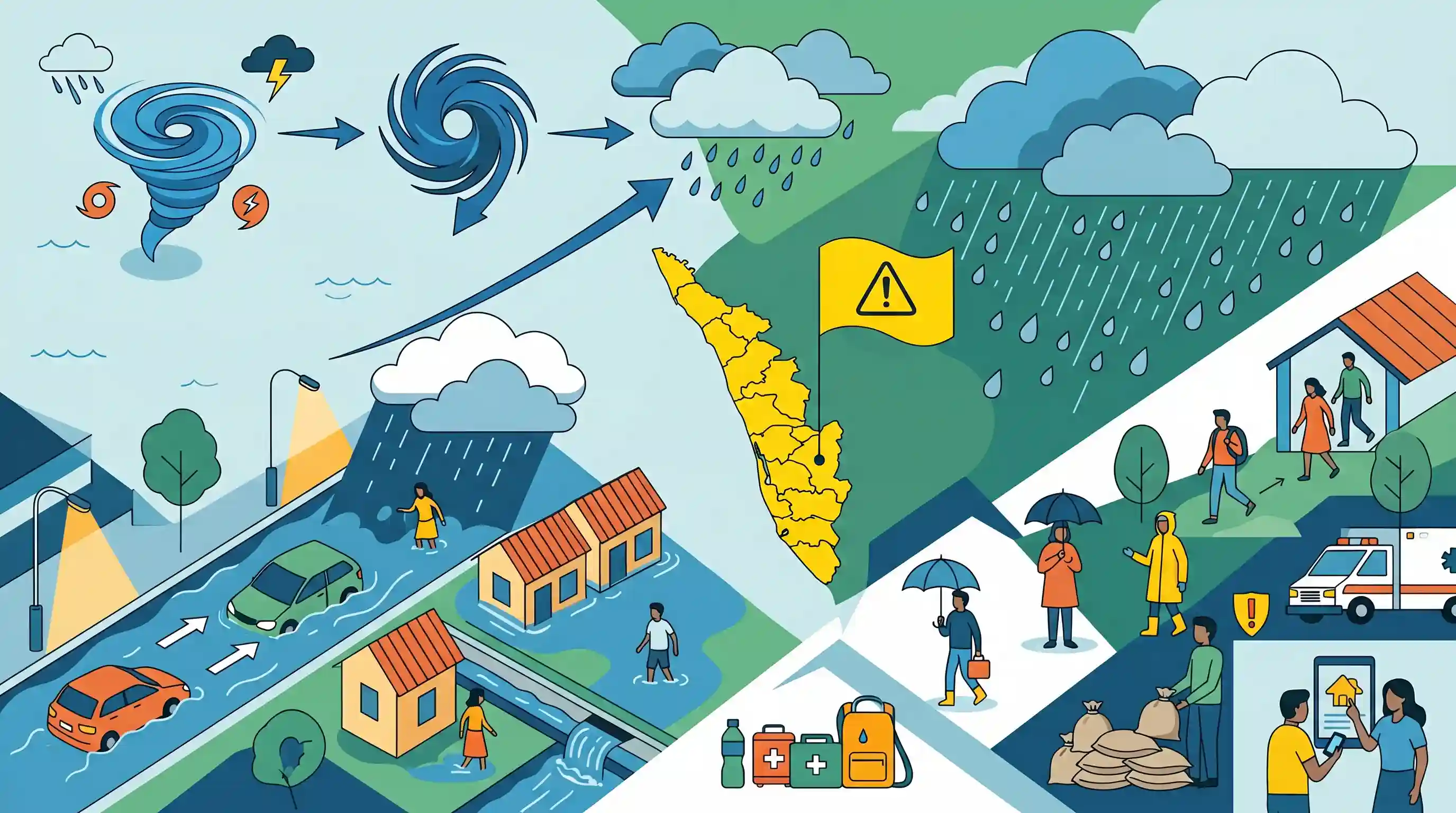
The India Meteorological Department (IMD) has issued a yellow alert for 11 districts in Kerala in anticipation of intense rainfall. The heightened precipitation is triggered by an intensifying low-pressure system over the southeast Arabian Sea, which threatens to evolve into a depression. This weather event will likely intensify the northeast monsoon over the state. Authorities have warned of potential waterlogging and minor flooding, urging residents to exercise caution.
Key Points
- The IMD issued a yellow alert for 11 districts in Kerala for October 21 due to anticipated heavy rainfall.
- The rainfall is driven by an intensified low-pressure area over the southeast Arabian Sea and Lakshadweep, which may develop into a depression.
- The northeast monsoon is expected to intensify over Kerala in the coming days.
- Authorities have warned of potential waterlogging, minor floods, and traffic disruptions, advising residents to stay away from vulnerable areas.
Important Terms
India Meteorological Department (IMD)

The principal government agency under the Ministry of Earth Sciences responsible for meteorological observations, weather forecasting, and seismology.
UPSC context
GS Paper I (Geography) & III (Disaster Management); tests institutional frameworks for weather monitoring.
Yellow Alert
A color-coded warning signifying 'Be Aware.' It indicates potentially bad weather that may worsen, causing minor disruptions like localized flooding or traffic congestion.
UPSC context
GS Paper III (Disaster Management); tests understanding of early warning protocols and risk communication.
Northeast Monsoon
A seasonal wind reversal (October–December) bringing rainfall to southeastern India and Kerala as moisture-laden winds blow from the Bay of Bengal.
UPSC context
GS Paper I (Geography); tests knowledge of seasonal wind patterns and their socio-economic impacts.
Low-Pressure System
A weather disturbance where atmospheric pressure is lower than its surroundings, causing air to rise, cool, and form clouds and precipitation.
UPSC context
GS Paper I (Geography); tests fundamental concepts of climatology and atmospheric circulation.
Depression (Meteorological)
An intensified low-pressure system with sustained wind speeds between 31–49 km/h, often serving as a precursor to more severe tropical cyclones.
UPSC context
GS Paper I (Geography) & III (Disaster Management); tests classification of weather disturbances.
Disaster Preparedness
Systematic planning and actions (e.g., evacuations, resource mobilization) taken to mitigate the impact of hazards like flooding and landslides.
UPSC context
GS Paper III (Disaster Management); tests knowledge of NDMA guidelines and resilience planning.
Prelims Trap
The Northeast monsoon brings rainfall exclusively to the Coromandel coast and Tamil Nadu.
While Tamil Nadu gets its major share from the NE monsoon, Kerala, coastal Andhra Pradesh, and south interior Karnataka also receive substantial rainfall from it.
Static Concepts Connected
What drives the Northeast Monsoon in the Indian subcontinent?
- Wind Reversal: The seasonal shift of the ITCZ southwards during autumn causes pressure changes, driving winds from land to sea (northeast to southwest).
- Moisture Pick-up: As these continental winds cross the Bay of Bengal, they pick up moisture before hitting the eastern coast of India.
- Beneficiary States: Tamil Nadu, coastal Andhra Pradesh, Rayalaseema, Kerala, and south interior Karnataka are the primary beneficiaries of this winter rain.
How does the IMD's colour-coded weather warning system work?
- Yellow Alert: 'Be updated' - signifies watchful anticipation for severe weather that may worsen over several days.
- Orange Alert: 'Be prepared' - warns of extremely bad weather with potential for transport disruptions and power cuts.
- Red Alert: 'Take action' - indicates extreme weather conditions causing significant risk to life and widespread disruption.
Cross-Topic Patterns
Arabian Sea warming & cyclogenesis
Historically, the Bay of Bengal hosted most post-monsoon depressions, but rising sea surface temperatures are increasingly fueling autumn cyclonic activity in the Arabian Sea.
Short-burst rain & urban flooding
Links intense, localized precipitation with poor municipal drainage, bridging Physical Geography (extreme weather) with Disaster Management and Urban Governance (NDMA guidelines).

Expect a multi-statement Prelims question comparing Southwest and Northeast monsoon dynamics, focusing on minor beneficiary states.
Linked PYQs · 2
Linked PYQs · 2
- 2022MainsGS1
Discuss the meaning of colour-coded weather warnings for cyclone prone areas given by India Meteorological Department.
- 2024MainsGS3
Flooding in urban areas is an emerging climate-induced disaster. Discuss the causes of this disaster. Mention the features of two such major floods in the last two decades in India. Describe the policies and frameworks in India that aim at tackling such floods.
