Chhattisgarh Left Wing Extremism Surrender and Rehabilitation
Source:The Hindu ↗
Why It Matters
The mass surrender of Maoists highlights the practical effectiveness of surrender-cum-rehabilitation policies combined with security operations and development initiatives. It is highly relevant for GS Paper 3 questions on strategies to combat Left Wing Extremism (LWE), internal security challenges, and the integration of state and central approaches to resolving long-standing insurgencies.
Summary
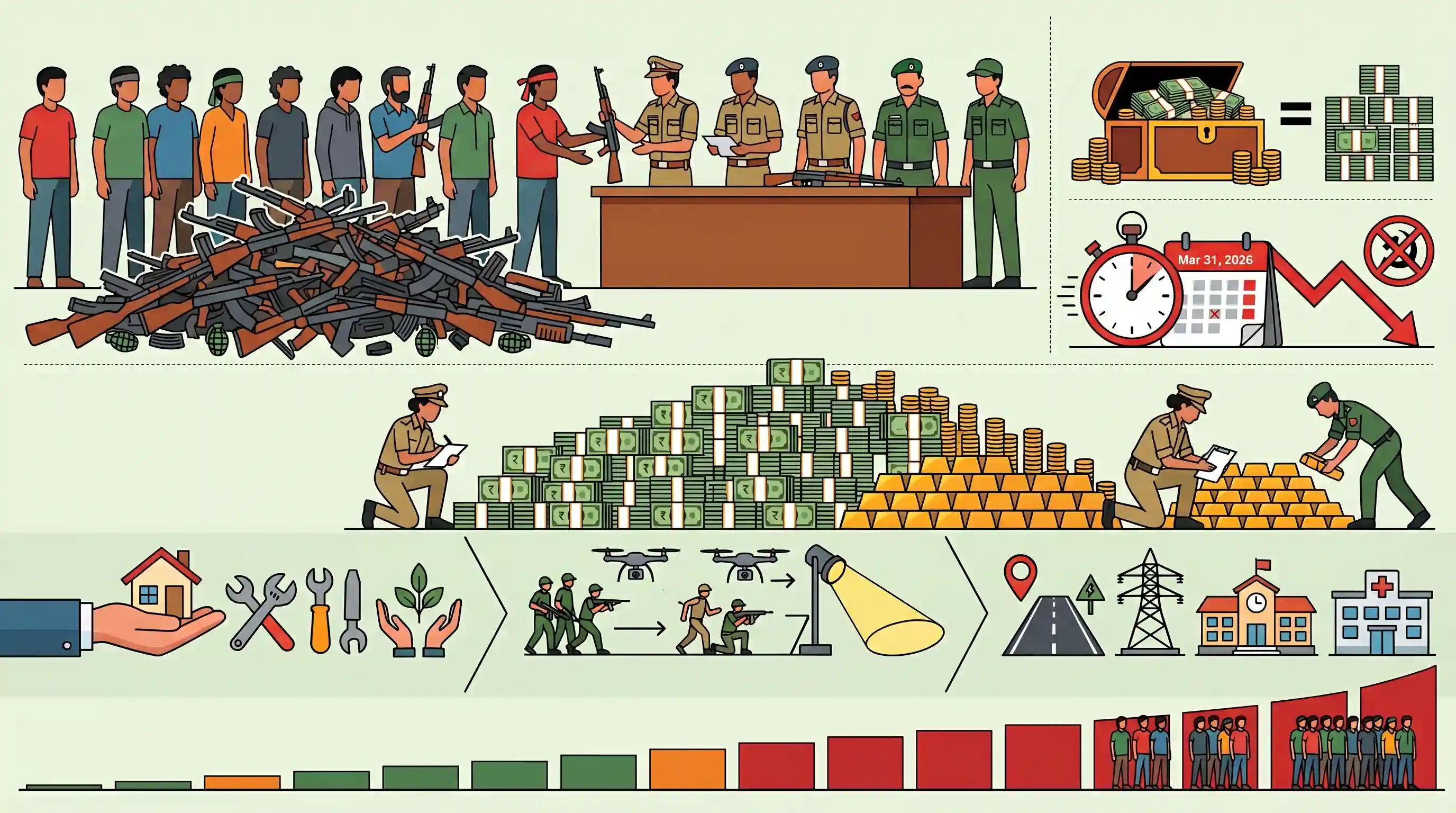
As many as 108 Maoists carrying a combined reward of ₹3.29 crore surrendered in Jagdalpur, Chhattisgarh, just ahead of the Centre's March 31, 2026 deadline to eliminate Left Wing Extremism. The surrendered cadres, belonging to the Dandakaranya Special Zonal Committee, handed over more than 100 weapons and provided intelligence that led to the largest single-location recovery of Maoist cash (₹3.61 crore) and gold in anti-Naxal history. Authorities credit the state's robust rehabilitation policy, coordinated security operations, and ongoing development for the surrender of over 1,500 Maoists in the region over the past 15 months.
Key Points
- 108 Maoists from the Dandakaranya Special Zonal Committee (DKSZC) surrendered in Chhattisgarh's Jagdalpur, submitting over 100 weapons including AK-47s.
- The surrendered cadres provided intelligence leading to a record recovery of ₹3.61 crore in cash and 1 kg of gold from a Maoist dump in the Indravati area.
- The surrenders occurred just 20 days prior to the Centre's March 31, 2026 deadline for the elimination of Maoism in the country.
- Chhattisgarh Chief Minister Vishnu Deo Sai attributed the surrender of over 1,500 Maoists in the past 15 months to the state's rehabilitation policies, coordinated security efforts, and regional development.
Important Terms
Left Wing Extremism (LWE)

An armed insurgency based on Maoist ideology aiming to overthrow the State through violent revolution. In India, it is also known as Naxalism.
UPSC context
GS Paper III: Internal Security. Tests understanding of the single biggest internal security threat and the development-extremism link.
Dandakaranya Special Zonal Committee (DKSZC)
The primary organizational wing of the CPI (Maoist) operating in the Bastar region, coordinating guerrilla warfare, taxation, and political recruitment across state borders.
UPSC context
GS Paper III: Internal Security. Relevant for studying the structure and regional spread of insurgent groups in Central India.
Surrender and Rehabilitation Policy (Chhattisgarh)
A state framework providing cash incentives, land, housing, and vocational training to facilitate the transition of Maoist cadres into the social mainstream.
UPSC context
GS Paper III: Internal Security. Evaluates the efficacy of soft-power state responses vs. purely militaristic approaches to insurgency.
Red Corridor
A strategic geographical belt in central and eastern India (including Chhattisgarh and Jharkhand) where Maoist influence and violence have historically been concentrated.
UPSC context
GS Paper I & III: Geography and Internal Security. Tests knowledge of the spatial distribution of security threats and regional developmental deficits.
People's Liberation Guerrilla Army (PLGA)
The armed wing of the CPI (Maoist), responsible for carrying out military operations, ambushes on security forces, and sabotage of public infrastructure.
UPSC context
GS Paper III: Internal Security. Pertains to the nature of armed threats from non-state actors in India's hinterland.
SAMADHAN Framework
The Ministry of Home Affairs' 2017 multi-pronged strategy focusing on Smart policing, Actionable intelligence, and Dashboard-based KPIs to eliminate Naxalism.
UPSC context
GS Paper III: Internal Security. Key for questions on government strategies, administrative reforms, and technological interventions in security.
Prelims Trap
"The Surrender-cum-Rehabilitation scheme for LWE extremists is exclusively funded and implemented by the Union Ministry of Home Affairs."
Surrender and rehabilitation policies are State-specific and implemented by State governments. The Centre only provides reimbursement for specific components under the Security Related Expenditure (SRE) scheme.
Static Concepts Connected
What is the core strategy of the National Policy and Action Plan (2015) against LWE?
- Holistic approach: A multi-pronged strategy integrating security operations, development initiatives, and the protection of the rights of local communities.
- Development push: Initiatives like the Special Central Assistance (SCA) and Road Requirement Plan (RRP) aim to build physical and social infrastructure in highly affected districts.
- Ensuring Rights: Strict implementation of the Forest Rights Act (FRA) and PESA to address the root grievances of tribal alienation and land deprivation.
What is the Security Related Expenditure (SRE) Scheme?
- Nodal framework: A sub-scheme under the umbrella 'Modernisation of Police Forces' scheme aimed at capacity building in LWE-affected states.
- Reimbursement mechanism: The Centre reimburses state governments for expenses like training, ex-gratia payments to victims, and the rehabilitation of surrendered LWE cadres.
Cross-Topic Patterns
LWE shadow economy & PMLA
The massive cash and gold recovery exposes the LWE shadow economy (extortion/levies). Tracking these funds links directly to the Prevention of Money Laundering Act (PMLA) and NIA's terror-funding mandate.
Geography's role in guerrilla warfare
The Dandakaranya region spans the borders of Chhattisgarh, Odisha, Maharashtra, and AP. Insurgents exploit these forested, rugged tri-junctions to evade state police, highlighting the role of geography in internal security.

Expect a 2026 GS3 Mains question evaluating State surrender/rehab policies against the Centre's March 2026 LWE elimination deadline.
Linked PYQs · 3
Linked PYQs · 3
- 2022MainsGS3
Naxalism is a social, economic and developmental issue manifesting as a violent internal security threat. In this context, discuss the emerging issues and suggest a multilayered strategy to tackle the menace of Naxalism.
- 2018MainsGS3
Left Wing Extremism (LWE) is showing a downward trend, but still affects many parts of the country. Briefly explain the Government of India's approach to counter the challenges posed by LWE.
- 2020MainsGS3
What are the determinants of left-wing extremism in Eastern part of India? What strategy should Government of India, civil administration and security forces adopt to counter the threat in the affected areas?
