Bihar Cyber Unit Arrests Individuals Over Social Media Misuse
Source:timesofindia ↗
Why It Matters
Highlights the active enforcement of cyber laws at the state level using new statutory frameworks (BNS, 2023) to tackle digital-era security threats like deepfakes, online communal disharmony, and gender-based cybercrime.
Summary
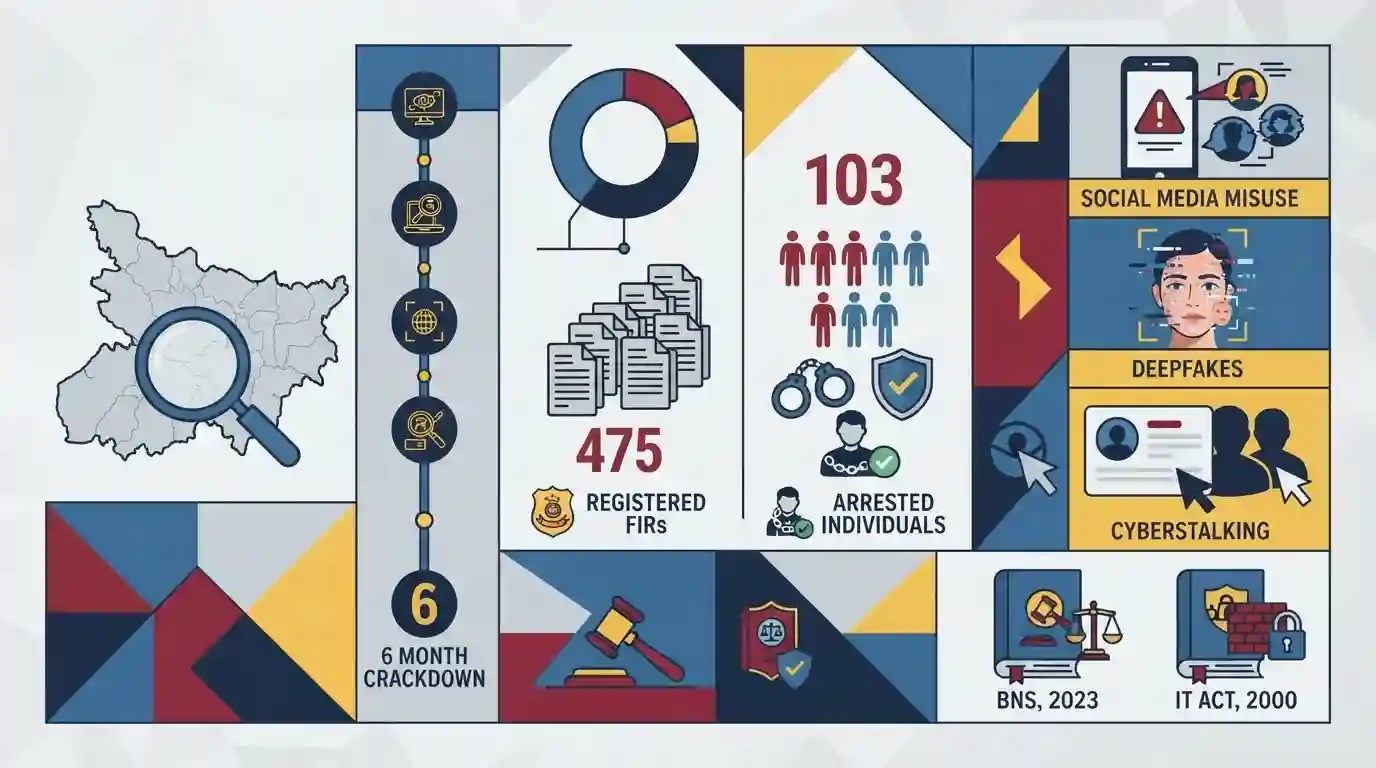
Bihar's Cybercrime and Security Unit (CCSU) arrested 103 individuals and registered 475 FIRs under the BNS, 2023 and the IT Act, 2000, during a major six-month crackdown in 2026 targeting social media misuse, deepfakes, and cyberstalking.
Key Points
- Bihar's Cybercrime and Security Unit (CCSU) registered 475 FIRs and arrested 103 individuals in the first six months of 2026 to curb social media misuse.
- A total of 1,320 objectionable posts/URLs were removed, and 529 fake or offensive social media accounts were deactivated or deleted.
- The CCSU issued 692 legal notices to social media platforms, acting on digital evidence and technical analysis.
- Enforcement actions targeted AI-generated deepfakes, cyberstalking, online harassment of women, fake news, and communal content endangering public order.
- Action was taken under the newly enacted Bharatiya Nyaya Sanhita (BNS), 2023, and the Information Technology Act, 2000.
Important Terms
Information Technology Act, 2000

India’s primary legislation governing cyber activities, electronic commerce, and digital signatures. It penalizes cybercrimes, protects online data, regulates social media intermediaries, and provides the legal basis for cybersecurity frameworks.
UPSC context
Crucial for GS Paper 3 (Internal Security, Cyber Security) and GS Paper 2 (Governance) regarding online content regulation and rights.
Bharatiya Nyaya Sanhita, 2023
India's modernized criminal code, replacing the colonial-era Indian Penal Code (IPC), 1860. It codifies contemporary offenses like terrorism, organized crime, and digital exploitation while prioritizing citizen-centric justice and victim rehabilitation.
UPSC context
Highly relevant for GS Paper 2 (Polity) and GS Paper 3 (Internal Security) to understand modern judicial reforms.
Cybercrime and Security Unit (CCSU)
A specialized law enforcement unit established by the Bihar Police to tackle digital offenses. It handles cybercrime investigations, operates AI-enabled fraud helplines, and prosecutes widespread social media misuse.
UPSC context
Serves as a vital state-level case study for GS Paper 3 (Cyber Security) on institutional mechanisms against digital crimes.
Deepfakes
Highly realistic synthetic media, including videos, audio, or images, manipulated using Artificial Intelligence and deep learning models (like GANs). They are often misused to deceive, impersonate, or spread misinformation.
UPSC context
Essential for GS Paper 3 (Science & Technology, Cyber Security) when analyzing AI threats, misinformation campaigns, and cybersecurity risks.
Prelims Trap
State police departments hold the statutory power to issue binding URL blocking orders under Section 69A of the Information Technology Act.
Section 69A of the IT Act strictly empowers the Central Government (or its designated officer), not state police, to issue binding website and URL blocking orders.
Static Concepts Connected
How does the Indian legal framework tackle malicious deepfakes?
- IT Act 2000: Sections 66E (privacy violation) and 67/67A (transmitting obscene material) penalize the creation and distribution of morphed, malicious digital content.
- IT Rules 2021: Mandates significant social media intermediaries to take down non-consensual artificially morphed images within 24 hours of a user or law enforcement complaint.
- BNS 2023: Applies updated penal provisions for forgery, defamation, and outraging the modesty of a woman to digital contexts, covering offenses executed via AI.
What is the role of social media in internal security challenges?
- Public Order Threats: Platforms are exploited by malicious actors for rapid dissemination of fake news and communal propaganda, triggering immediate offline public order crises.
- Radicalization: Terrorist outfits and extremist groups utilize echo chambers and targeted algorithms to radicalize youth, fundraise, and recruit without physical borders.
Cross-Topic Patterns
AI Ethics + Public Order threats
Deepfakes are transitioning from theoretical GS4 AI ethics debates into concrete GS3 internal security threats, triggering hard enforcement under the BNS and IT Act to prevent communal flare-ups.
Intermediary Liability + Enforcement
State police crackdowns test the practical efficacy of the IT Rules 2021, specifically how swiftly social media intermediaries comply with local law enforcement notices for content takedowns.

Expect a GS3 Mains question evaluating the adequacy of BNS 2023 alongside the IT Act in tackling AI-driven deepfakes and cyberstalking.
Linked PYQs · 1
Linked PYQs · 1
- 2023BPSC_PRELIMSGS1
Which of the following technologies will be enabled by the 5G mobile communication networks? 1. Internet of Things 2. Edge Computing 3. Network Slicing Select the correct answer using the codes given below.
