Thalliki Vandanam financial assistance sanctioned for students
Source:The Hindu ↗
Why It Matters
Questions regarding flagship welfare schemes of the Andhra Pradesh government (eligibility, funding, provisions) are a staple in APPSC Group 1 Prelims (e.g., Rythu Bharosa, Aarogyasri). The Thalliki Vandanam scheme represents a major investment in the state's education sector.
Summary
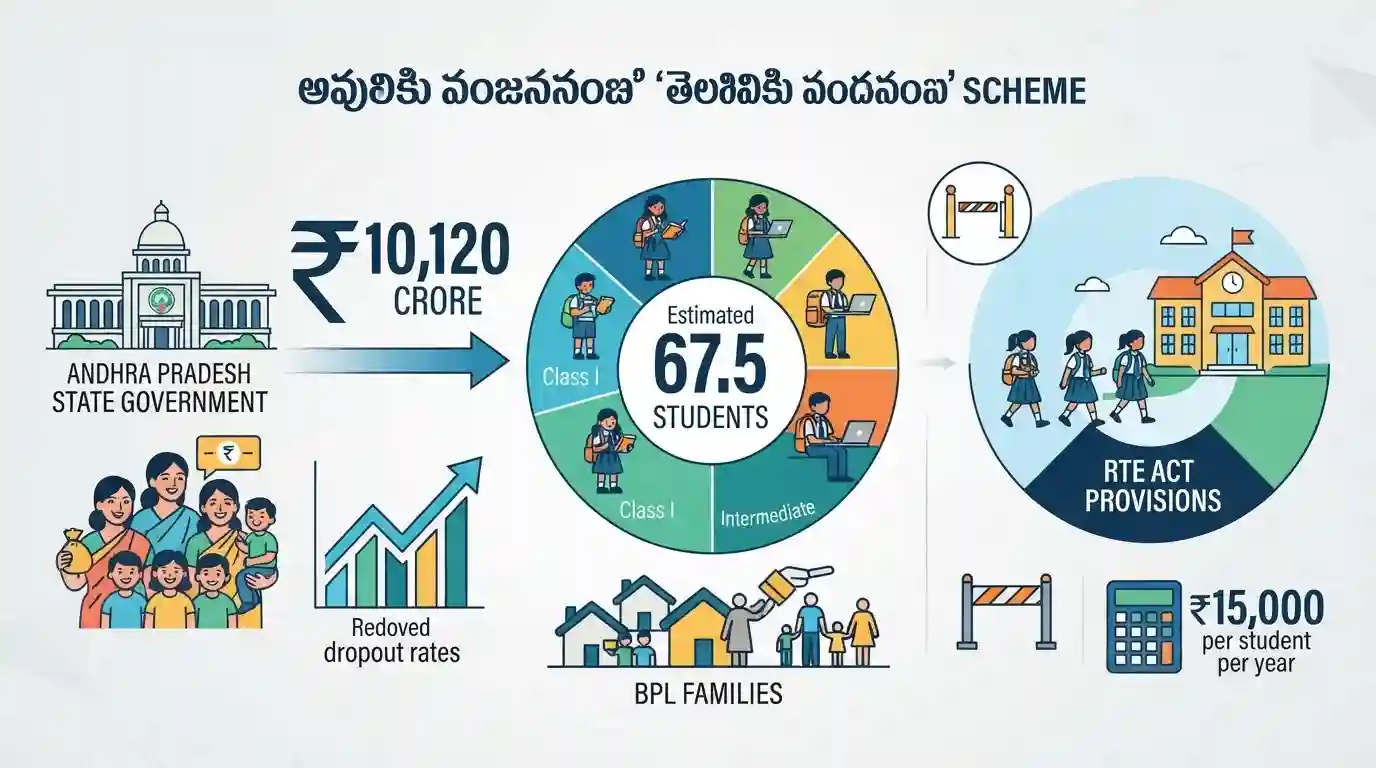
The Andhra Pradesh state government has issued administrative sanctions to release ₹10,120 crore for the implementation of the 'Thalliki Vandanam' scheme. Aimed at curbing dropout rates and improving educational outcomes, the scheme guarantees financial assistance of ₹15,000 per year to eligible mothers or guardians from Below Poverty Line (BPL) families. The aid will benefit an estimated 67.5 lakh students enrolled from Class I to Intermediate. The scheme also includes specific provisions for students admitted in private schools under the Right to Education (RTE) Act.
Key Points
- The Andhra Pradesh government has sanctioned ₹10,120 crore for the 'Thalliki Vandanam' scheme for the 2024-25 academic year.
- The scheme provides ₹15,000 per annum to eligible mothers or guardians of students studying from Class I to Intermediate (Class 12).
- It targets BPL families, and the benefit is applicable irrespective of the number of school-going children in the family.
- Around 67.5 lakh students will benefit from the scheme.
- For students in private schools under the 25% RTE quota, if the school fee exceeds the government reimbursement, parents can use this financial aid to cover the difference.
Important Terms
Thalliki Vandanam Scheme

An Andhra Pradesh government welfare initiative providing ₹15,000 annually to eligible mothers or guardians of school-going children (Class I to Intermediate) to curb dropout rates.
UPSC context
Relevant for GS Paper 2 (Social Justice). Evaluates knowledge of state-level welfare initiatives, education policy, and Direct Benefit Transfers.
Right to Education (RTE) Act
A landmark 2009 legislation enforcing Article 21A, making free and compulsory education a fundamental right for children aged 6–14. It notably mandates a 25% reservation for disadvantaged students in private schools.
UPSC context
Essential for GS Paper 2 (Polity, Education). Tests comprehension of Fundamental Rights, statutory frameworks for universal education, and social inclusion mandates.
Below Poverty Line (BPL)
An economic threshold used by the government to identify disadvantaged households, serving as the primary eligibility criterion for targeted public welfare schemes and state financial assistance.
UPSC context
Crucial for GS Paper 2 and 3 (Poverty, Governance). Tests understanding of poverty targeting, inclusive growth, and welfare scheme delivery mechanisms.
Prelims Trap
The Thalliki Vandanam scheme restricts educational financial assistance to a maximum of two school-going children per eligible household.
Unlike typical central and state welfare initiatives that cap benefits at two children, this scheme provides cash transfers irrespective of the number of school-going children.
Static Concepts Connected
What is the 25% reservation under Section 12(1)(c) of the RTE Act, 2009?
- Mandate: Private, unaided, non-minority schools must reserve 25% of entry-level seats for children from EWS and disadvantaged groups.
- Reimbursement: States reimburse schools based on either the state's per-child expenditure or the school's actual fee, whichever is lower.
- Exemptions: Under Article 30(1) of the Constitution, minority educational institutions (both aided and unaided) are exempt from this mandatory reservation.
How do Conditional Cash Transfers (CCTs) address development deficits?
- Mechanism: CCTs make monetary transfers conditional on beneficiaries undertaking specific actions, such as minimum school attendance or regular healthcare checkups.
- Gender Targeting: Targeting women minimizes intra-household diversion of funds, leading to disproportionately higher household investments in child nutrition and education.
- Opportunity Cost: Direct financial aid offsets the economic opportunity cost of keeping children in school rather than sending them to work.
Cross-Topic Patterns
Direct Cash vs. In-kind educational welfare
Analyses how state transitions from physical provisions to conditional cash transfers impact targeted household expenditure and human development index outcomes.
RTE litigation and private-school friction
Connects state funding delays in EWS reimbursements to legal disputes over school autonomy, highlighting the limits of state-mandated private sector public service delivery.

RTE Section 12(1)(c) structural gaps and state-level cash top-ups will likely feature in a 2026 Mains question on educational equity.
Linked PYQs · 3
Linked PYQs · 3
- 2023APPSC_PRELIMSGS1
Government of Andhra Pradesh is implementing YSR Rythu Bharosa - PM Kisan Scheme for the benefit of farmers of Andhra Pradesh. Which of the following statements are correct about the above scheme ?
- 2024APPSC_PRELIMSGS1
Which of the following statements are valid regarding the interventions of the Government of Andhra Pradesh in the context of Healthcare ? I. Telemedicine facility is available in all Ayushman Bharat Health and Wellness Centres (AB-HWCs) to avail specialist services through district hub. II. The Family Doctor Programme has been planned to be implemented as a standalone project without the need to be integrated with Primary Health Centres (PHCs). III. Dr. YSR Aarogyasri Scheme has been revamped, by increasing the income limit from ₹ 2.5 lakh to ₹ 5 lakh per annum per family. IV. 'Aarogya Aasara' Scheme is intended to provide post-operative sustenance allowance with certain eligible conditions complied with. Select the correct answer using the codes given below :
- 2023APPSC_PRELIMSGS1
With child labour being made illegal and right to education becoming a fundamental right for children, this right against exploitation has become more meaningful. Which of the following pairs of Articles provide for right to education and prohibition of child labour respectively?
