Radio Ceylon marks centenary of shaping South Asian cultural diplomacy
Source:Indian Express ↗
Why It Matters
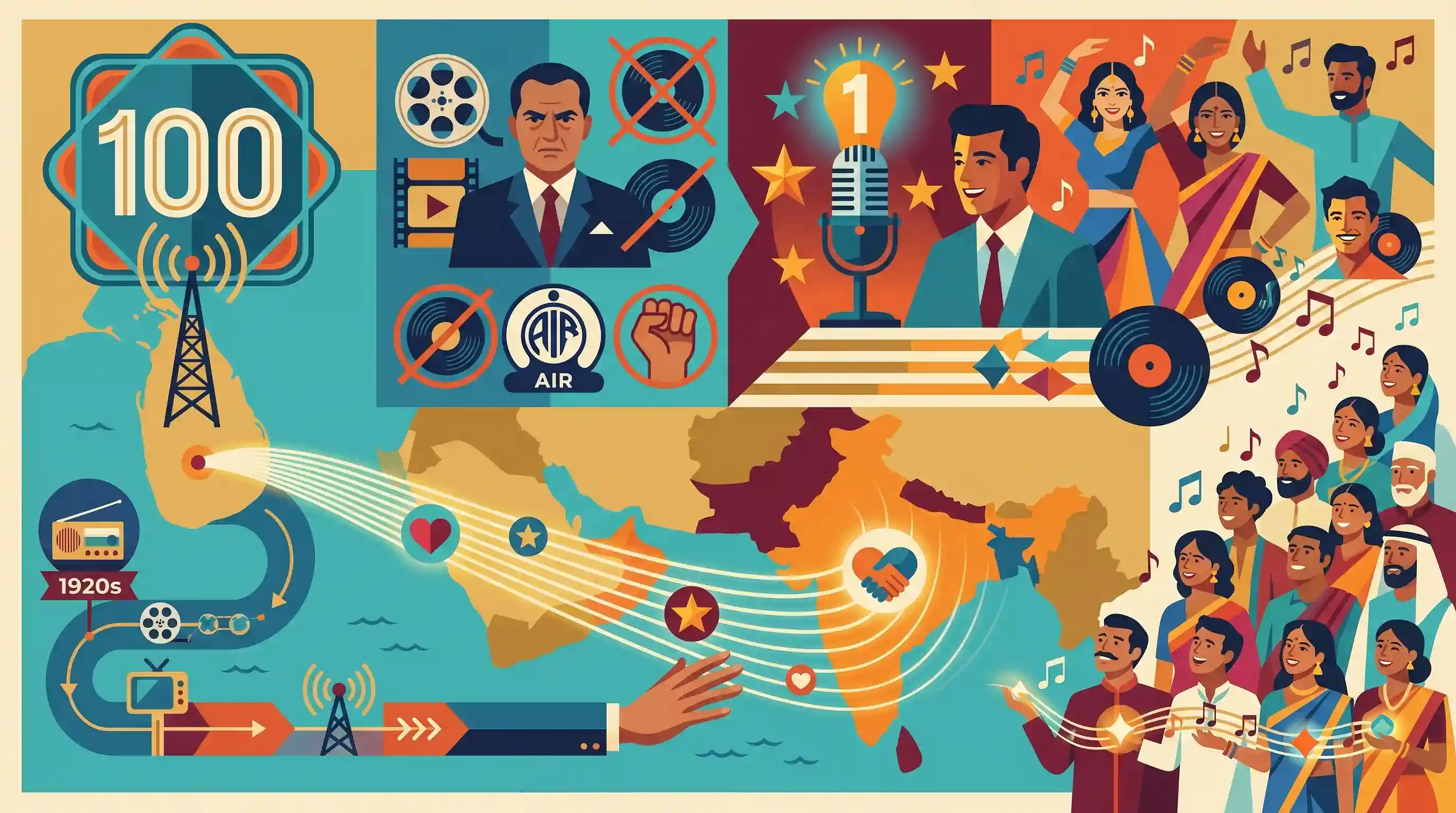
Radio Ceylon represents a seminal case study of soft power and cultural diplomacy in South Asia. Its history illustrates how popular culture—specifically cinema and music broadcasted over the radio—can bridge geopolitical divides, foster regional goodwill, and transcend national borders, which is highly relevant to GS2 (International Relations/Soft Power) and GS1 (Post-Independence History).
Summary
The article marks the centenary of Radio Ceylon, South Asia's oldest radio broadcaster, highlighting its historical and cultural significance. It details how the station acted as a powerful instrument of soft power, transcending the post-colonial borders of the Indian subcontinent by broadcasting Hindi film music. When All India Radio restricted film music in the 1950s under B.V. Keskar, Radio Ceylon filled the void, cultivating a massive pan-South Asian audience through legendary shows like Ameen Sayani's 'Binaca Geetmala', and proving the unifying potential of shared cultural frequencies.
Key Points
- Radio Ceylon, the oldest radio station in South Asia, completes 100 years, tracing its roots to experimental broadcasts in 1923 and regular services by 1925.
- The station became highly popular across the subcontinent by broadcasting Hindi film music, effectively uniting the politically fractured region through shared culture.
- Shows like Binaca Geetmala, hosted by iconic broadcaster Ameen Sayani, achieved pan-South Asian popularity and cult status.
- Radio Ceylon capitalized on the policies of All India Radio (AIR) in the 1950s, when the then I&B Minister B.V. Keskar banned or severely restricted Hindi film music, pushing Indian listeners to tune into the Ceylon frequencies.
- The legacy of Radio Ceylon underscores the efficacy of mass media and popular culture as potent instruments of soft power and cultural diplomacy.
Important Terms
Radio Ceylon

Asia's oldest radio broadcaster (est. 1925), originally the Ceylon Wireless Club. It became a legendary trans-border cultural force in South Asia by broadcasting Hindi film music when India's AIR restricted it.
UPSC context
GS Paper 1 (Modern Indian History) and Paper 2 (India-Sri Lanka). Tests cultural soft power and media history in South Asia.
All India Radio (AIR)
India’s national public broadcaster, officially known as Akashvani since 1956. It played a pivotal role in post-independence nation-building, though its 1950s policies under B.V. Keskar famously restricted popular film music.
UPSC context
GS Paper 1 (Post-Independence History). Tests knowledge of state-led cultural initiatives and the evolution of public broadcasting.
Soft Power
A nation’s ability to influence others through attraction and persuasion—using culture, political values, and foreign policies—rather than coercion (hard power). It is a core pillar of modern Indian diplomacy.
UPSC context
GS Paper 2 (International Relations). Essential for analyzing India’s global influence and non-military foreign policy tools.
Cultural Diplomacy
The exchange of ideas, information, art, and language to foster mutual understanding. In India, this is largely operationalized through the Indian Council for Cultural Relations (ICCR).
UPSC context
GS Paper 2 (International Relations). Tests knowledge of foreign policy tools and institutional mechanisms for building international goodwill.
Binaca Geetmala
A revolutionary weekly Hindi film music countdown hosted by Ameen Sayani on Radio Ceylon (1952–1994). It became a landmark of pan-South Asian cultural integration, bypassing post-partition political borders.
UPSC context
GS Paper 1 (Post-Independence History/Society). Illustrates popular culture's role in social integration and regional connectivity.
Vividh Bharati
A commercial radio service launched by All India Radio in 1957 to regain listeners lost to Radio Ceylon. It focused on popular film music and became India's most popular radio network.
UPSC context
GS Paper 1 (Modern Indian History). Tests evolution of mass media and the state's response to commercial competition.
Prelims Trap
"All India Radio (AIR) is the oldest radio broadcasting station in South Asia."
Radio Ceylon (started 1925) predates the official launch of All India Radio (1936), making the Sri Lankan station the oldest in the region.
Static Concepts Connected
How did radio broadcasting evolve in pre-independence India?
- Early clubs: Radio broadcasting began privately with experimental broadcasts by the Bombay Presidency Radio Club in 1923.
- IBC to ISBS: The Indian Broadcasting Company started in 1927, later taken over by the state in 1930 as the Indian State Broadcasting Service (ISBS).
- All India Radio: The ISBS was officially renamed All India Radio (AIR) in 1936, coming under the Department of Communications.
What are the key instruments of India's cultural diplomacy?
- Institutional nodes: The Indian Council for Cultural Relations (ICCR), founded in 1950, formulates and implements policies relating to India's external cultural relations.
- Popular culture: Bollywood, classical arts, diaspora networks, and initiatives like the International Day of Yoga project India's soft power globally.
Cross-Topic Patterns
State media regulation vs. Soft power
AIR's 1950s restriction on Hindi film music shows how state attempts to enforce 'classical culture' often fail against transnational mass media, eventually forcing institutional adaptation (Vividh Bharati).
India-Sri Lanka cultural diplomacy
While modern bilateral discourse centers on Katchatheevu and maritime security, historical cultural nodes like Radio Ceylon highlight the deep people-to-people ties uniting the subcontinent.

Expect a chronological Prelims question on the evolution of Indian mass media: IBC (1927) -> AIR (1936) -> Vividh Bharati (1957).
Linked PYQs · 2
Linked PYQs · 2
- 2015MainsGS2
Terrorist activities and mutual distrust have clouded India-Pakistan relations. To what extent the use of soft power like sports and cultural exchanges could help generate goodwill between the two countries? Discuss with suitable examples.
- 2022MainsGS2
India is an age-old friend of Sri Lanka.’ Discuss India's role in the recent crisis in Sri Lanka in the light of the preceding statement.
