Rajasthan Farmer Exposure Tour for Agricultural Technology
Source:The Hindu ↗
Why It Matters
Highlights the role of state interventions in capacity building for farmers through international exposure. It serves as a practical example for GS3 answers concerning the adoption of modern agricultural technology, the empowerment of FPOs, and the role of cooperatives in rural development.
Summary
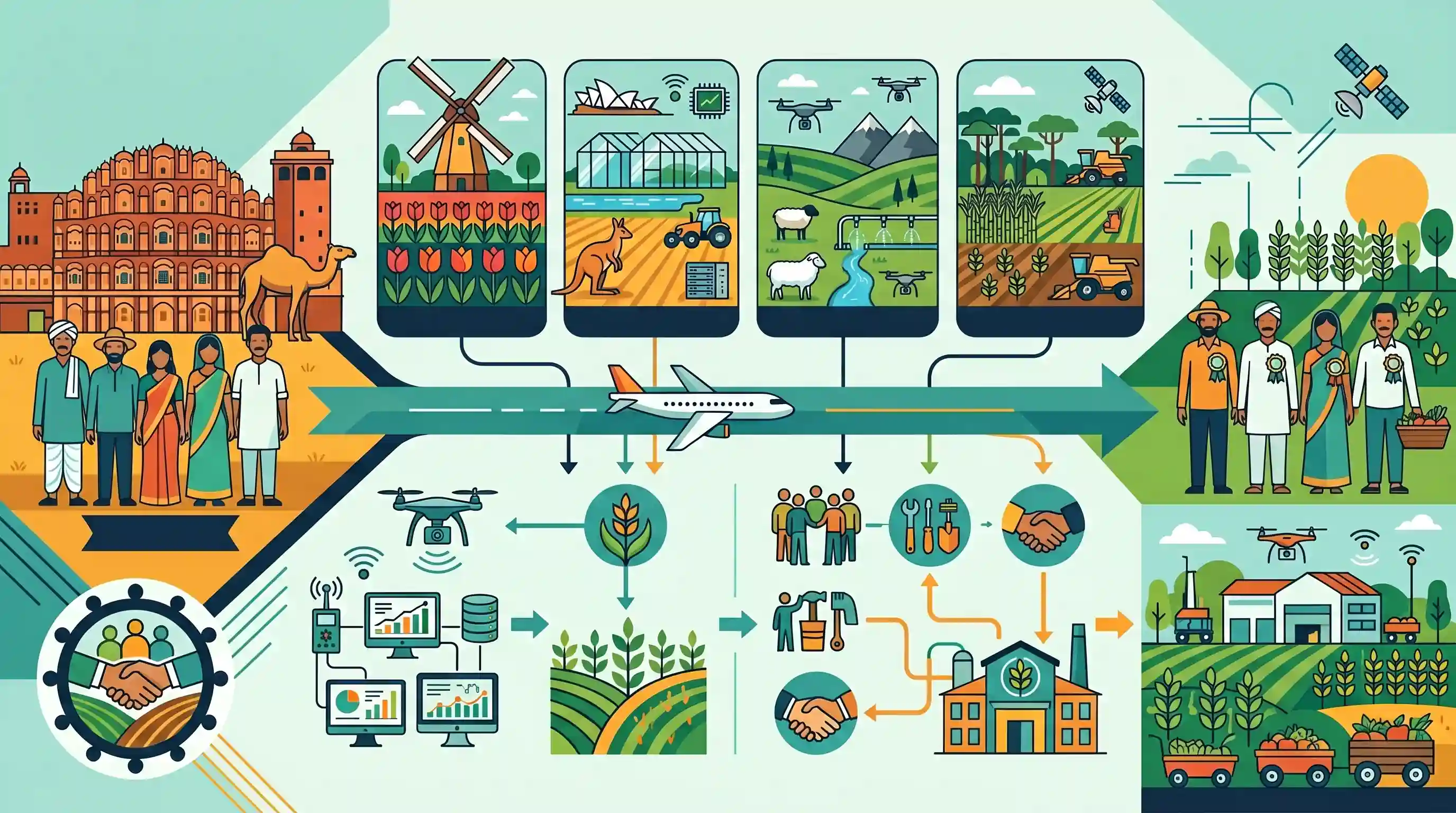
The Rajasthan government is sending 100 farmers associated with Farmer Producer Organisations (FPOs) on a knowledge enhancement programme to the Netherlands, Australia, New Zealand, and Brazil. Between November 2025 and March 2026, these farmers will undertake seven-day tours to learn about advanced agricultural technologies aimed at improving crop yields. The initiative also focuses on studying successful international agricultural cooperatives to draw operational insights applicable to Indian FPOs.
Key Points
- 100 farmers from Rajasthan attached to Farmer Producer Organisations (FPOs) will visit four countries for agri-tech exposure.
- The selected countries include the Netherlands, Australia, New Zealand, and Brazil, with tours taking place between November 2025 and March 2026.
- The state government's knowledge enhancement programme aims to expose farmers to advanced technologies and innovations to boost crop yields.
- Farmers will also study the operation of successful agricultural cooperatives in these nations, which structurally mirror Indian FPOs.
Important Terms
Farmer Producer Organisations (FPOs)

Collectives of small and marginal farmers (registered as companies or societies) that provide end-to-end services like input supply and marketing to leverage economies of scale.
UPSC context
GS3 (Agriculture); crucial for institutional reforms and doubling farmers' income through collective bargaining power.
Agricultural Cooperatives
Member-owned organizations where farmers pool resources for shared production, supply, or marketing to reduce transaction costs and mitigate individual risks.
UPSC context
GS3 (Agriculture and Cooperatives); tests understanding of rural development models and collective resource management.
Technology Missions in Agriculture
Time-bound government initiatives with clearly defined objectives and measurable outcomes that integrate modern technology to modernize specific agricultural sectors like oilseeds or cotton.
UPSC context
GS3 (Technology Missions); tests knowledge of strategic government interventions for food security and sector-specific productivity.
E-technology in the aid of farmers
The application of ICT (Information and Communication Technology), such as mobile apps, GPS, and digital platforms, to aid farmers in production, marketing, and weather forecasting.
UPSC context
GS3 (E-tech/Digital Agriculture); high-priority topic for productivity improvements and direct market access.
Agricultural Extension Services
A professional system of knowledge transfer to farmers through training and demonstrations to bridge the gap between agricultural research and field application.
UPSC context
GS3 (Agriculture Extension); essential for 'Lab-to-Land' knowledge transfer and adoption of new technologies.
Prelims Trap
"Farmer Producer Organisations (FPOs) must be registered strictly under the Cooperative Societies Act."
While FPOs mirror cooperative principles, they are primarily registered as Producer Companies under the Companies Act to ensure corporate governance, not just under the Cooperative Societies Act.
Static Concepts Connected
What is the structural difference between FPOs and traditional Cooperatives?
- Legal Framework: FPOs are typically registered as Producer Companies under the Companies Act, whereas traditional cooperatives fall under state or multi-state Cooperative Societies Acts.
- Governance: Both follow the cooperative principle of 'one member, one vote', but FPOs are bound by stricter corporate compliance and auditing standards.
- Hybrid Nature: FPOs combine cooperative farmer-centric welfare with the professional management, capital access, and market orientation of private limited companies.
How does Controlled Environment Agriculture (CEA) enhance crop yield?
- Resource Efficiency: CEA utilizes hydroponic or aeroponic systems enclosed in greenhouses, cutting agricultural water consumption by up to 90% compared to open fields.
- Climate Resilience: By isolating crops from external weather anomalies, CEA ensures year-round production, heavily utilized by nations like the Netherlands.
- Precision Nutrition: Integrating sensors and AI allows precise nutrient delivery, drastically minimizing fertilizer runoff and maximizing plant growth rates.
Cross-Topic Patterns
Agri-Tech Diplomacy & SPS Compliance
Linking FPO tech-exposure (like Netherlands' CEA tech) with India's macro agri-export targets, focusing on meeting global Sanitary and Phytosanitary (SPS) standards for export parity.
Economies of Scale via Aggregation
Contrasts controversial corporate farming with the FPO model, which allows small and marginal farmers to achieve economies of scale and access deep-tech without relinquishing land titles.

Expect a 2026 GS3 question contrasting FPO legal structures (Companies Act) with traditional cooperatives and their tech-adoption limits.
Linked PYQs · 4
Linked PYQs · 4
- 2023MainsGS3
How does e-Technology help farmers in production and marketing of agricultural produce? Explain it.
- 2014MainsGS3
In the villages itself no form of credit organization will be suitable except the cooperative society. -All India Rural Credit Survey. Discuss this statement in the background of agricultural finance in India. What constraints and challenges do financial institutions supplying agricultural finance face? How can technology be used to better reach and serve rural clients?
- 2025MainsGS3
How does nanotechnology offer significant advancements in the field of agriculture? How can this technology help to uplift the socio-economic status of farmers?
- 2019MainsGS3
How can biotechnology help to improve the living standards of farmers?
