Legal and Political Debate on Tribal Reservation
Source:Indian Express ↗
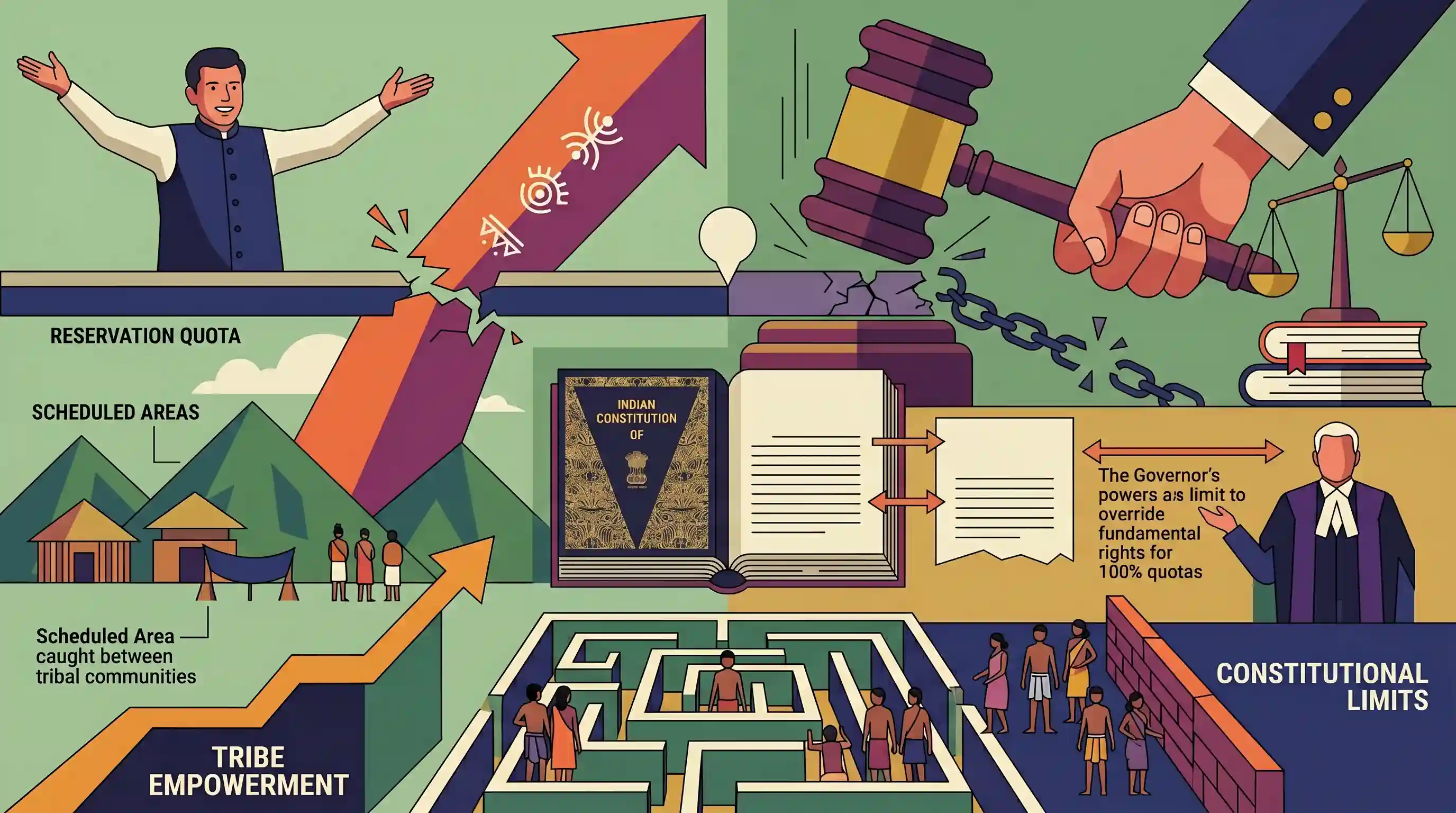
Why It Matters
The topic is highly relevant for GS-2 as it sits at the intersection of fundamental rights (Articles 14, 15, 16), tribal governance under the Fifth Schedule, and landmark judicial precedents (Indra Sawhney cap). It offers an excellent case study on the limits of political promises in the face of constitutional jurisprudence.
Summary
The article analyzes the legal and political complexities surrounding Andhra Pradesh Chief Minister Chandrababu Naidu's promise to restore 100% reservation for Scheduled Tribes in specific government jobs within Scheduled Areas. This pledge directly challenges the Supreme Court's 2020 judgment in the Chebrolu Leela Prasad Rao case, which struck down a previous 100% tribal quota by citing violations of the 50% reservation cap (Indra Sawhney case) and fundamental rights. The piece highlights the tension between political commitments for tribal empowerment, the strict limits of the Governor's powers under the Fifth Schedule to override fundamental rights, and the future of affirmative action in India's tribal regions.
Key Points
- Historical Context: A 2000 Government Order in Andhra Pradesh provided 100% reservation for STs in teaching posts in Scheduled Areas to promote tribal education and localized governance.
- Judicial Precedent: In 2020, a Constitution Bench of the Supreme Court struck down this order, ruling that 100% reservation violates the equality clauses of Articles 14 and 16 and breaches the 50% upper limit established in the Indra Sawhney case.
- Fifth Schedule Limitations: The Supreme Court clarified that the Governor's special powers under the Fifth Schedule to modify laws for Scheduled Areas cannot override Part III (Fundamental Rights) of the Constitution.
- Political Ramifications: Chief Minister Chandrababu Naidu's renewed political promise to reinstate this reservation highlights the ongoing tension between electoral commitments to tribal empowerment and established constitutional boundaries.
- Future Pathways: Reinstating the 100% quota would require navigating a complex legal impasse, potentially involving constitutional amendments or attempting to shield the legislation under the Ninth Schedule.
Important Terms
Fifth Schedule of the Constitution

Found in Article 244(1), this schedule provides a special administrative framework for 'Scheduled Areas' and Tribes in ten Indian states, excluding the four North-Eastern states governed by the Sixth Schedule.
UPSC context
Crucial for GS II (Polity/Governance); tests knowledge of tribal rights and the Union-State administrative balance in tribal regions.
Indra Sawhney Case (1992)
Landmark 1992 judgment that upheld 27% OBC reservation but established a 50% ceiling on total reservations and introduced the 'creamy layer' concept to ensure merit-cum-equity.
UPSC context
Essential for GS II (Social Justice/Polity); tests the constitutional boundaries of affirmative action and the 'equality of opportunity' (Article 16).
Chebrolu Leela Prasad Rao Case (2020)
A 2020 Supreme Court ruling that quashed the Andhra Pradesh government's 100% reservation for ST teachers in Scheduled Areas, reaffirming that the 50% cap cannot be breached.
UPSC context
Relevant for GS II (Judiciary/Vulnerable Sections); highlights the limitations of the Governor's discretionary powers versus fundamental rights.
Scheduled Areas
Geographic regions notified by the President under the Fifth Schedule that require special protection of tribal interests, land, and culture through tailored governance and restricted land transfers.
UPSC context
Tested in Prelims and GS II; involves understanding Article 244 and the roles of the President and Governor in tribal administration.
Ninth Schedule of the Constitution
Created by the 1st Amendment (1951), it protects included laws from judicial review, though the SC later ruled (I.R. Coelho) that such laws can still be challenged if they violate basic structure.
UPSC context
Key for GS II (Polity); tests the 'Basic Structure' doctrine and the tension between legislative promises and judicial oversight.
Governor’s powers (Fifth Schedule)
Under Paragraph 5 of the Fifth Schedule, the Governor can direct that specific laws do not apply to Scheduled Areas or apply with modifications to protect tribal interests.
UPSC context
Important for GS II; examines the unique 'discretionary' legislative authority of the Governor in tribal governance compared to general administration.
Prelims Trap
Governor's notification under the Fifth Schedule can override Fundamental Rights to protect Scheduled Tribes.
The Supreme Court explicitly ruled in 2020 that a Governor's power to modify laws in Scheduled Areas under the Fifth Schedule cannot override Part III (Fundamental Rights) of the Constitution.
Static Concepts Connected
What are the Governor's legislative powers under the Fifth Schedule?
- Law Modification: Can direct that any Act of Parliament or the State Legislature shall not apply to a Scheduled Area, or apply with specific modifications.
- Special Regulations: Can make regulations for the peace and good government of the area, notably to restrict land transfer or regulate money-lending to STs.
- Constitutional Limits: These special powers are subject to the Constitution and cannot breach Fundamental Rights guaranteed under Part III.
What is the constitutional standing of the 50% reservation ceiling?
- Indra Sawhney (1992): Established that total reservations under Article 16(4) should not exceed 50%, balancing affirmative action with administrative efficiency.
- Rare Exceptions: Allowed only in "far-flung and remote areas" under extraordinary situations, but not as a blanket rule for entire districts.
- 103rd Amendment: The SC upheld the 10% EWS quota in 2022, ruling it forms a separate category that does not breach the 50% cap for socially/educationally backward classes.
Cross-Topic Patterns
Ninth Schedule & Judicial Review limit
Political promises to bypass the 50% cap often cite the 9th Schedule. However, post-I.R. Coelho (2007), laws added after April 24, 1973, are subject to judicial review if they violate the basic structure.
Local domicile quotas vs Right to Equality
The 100% ST teaching quota mirrors recent state-level attempts (like Haryana's private sector quota) to reserve jobs for locals, which courts consistently strike down for violating Articles 14 and 16.

Expect a multi-statement Prelims question testing whether the Governor's Fifth Schedule powers can override Articles 14 and 16.
Linked PYQs · 4
Linked PYQs · 4
- 2022PrelimsGS1
If a particular area is brought under the Fifth Schedule of the Constitution of India, which one of the following statements best reflects the consequence of it ?
- 2015PrelimsGS1
The provisions in Fifth Schedule and Sixth Schedule in the Constitution of India are made in order to
- 2025PrelimsGS1
Consider the following statements : With reference to the Constitution of India, if an area in a State is declared as Scheduled Area under the Fifth Schedule I. the State Government loses its executive power in such areas and a local body assumes total administration II. the Union Government can take over the total administration of such areas under certain circumstances on the recommendations of the Governor Which of the statements given above is/are correct?
- 2018MainsGS2
Whether National Commission for Scheduled Castes (NCSC) can enforce the implementation of constitutional reservation for the Scheduled Castes in the religious minority institutions? Examine.
