US India Bilateral Ties Under Trump Administration Trade Policies
Source:Indian Express ↗
Why It Matters
Understanding the continuity of India-US ties under differing political administrations is crucial for analyzing India's foreign policy maneuvering (GS2) and assessing the impacts of global protectionism and changing trade regimes on broader economic interests (GS3).
Summary
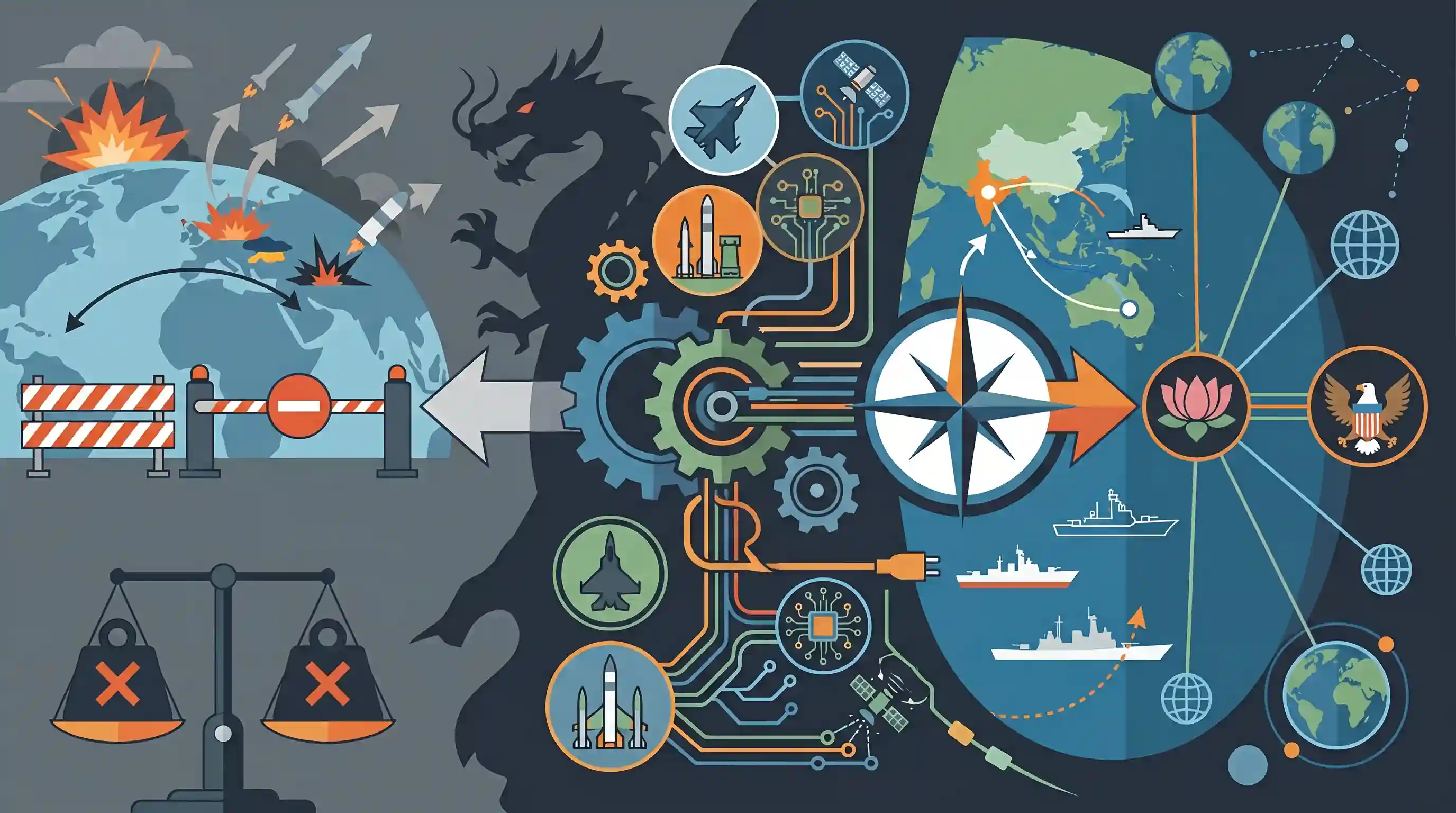
The article analyzes the trajectory of US-India relations during the first 100 days of Donald Trump's administration. Despite the disruptive nature of Trump's 'America First' policies and a volatile global order characterized by ongoing conflicts in Ukraine and the Middle East, bilateral ties between the US and India have remained remarkably stable. This resilience is attributed to shared structural interests—primarily countering China's assertiveness in the Indo-Pacific—alongside robust defense and technology partnerships. India's effective use of strategic autonomy allows it to engage pragmatically with Washington, compartmentalizing divergences on trade and tariffs while solidifying its position as a stabilizing force in a multipolar world.
Key Points
- Resilience of US-India Ties: Unlike the turbulence experienced by traditional US allies due to Trump's transactional diplomacy, the India-US partnership has demonstrated stability and continuity across administrations.
- Shared Strategic Imperatives: The mutual necessity to counterbalance China's expanding influence in the Indo-Pacific serves as the structural anchor of the bilateral relationship.
- Pragmatic Engagement: India's strategic autonomy aligns surprisingly well with Trump's 'America First' framework, allowing both to focus on mutually beneficial defense and technology cooperation (e.g., iCET) without the burden of formal alliance expectations.
- Managing Trade and Protectionism: Divergences exist on issues like trade tariffs, but both countries have managed to compartmentalize these frictions to protect broader strategic interests amidst global protectionist trends.
- Global Turbulence: Against the backdrop of global instability in Eastern Europe and West Asia, the US increasingly views India as an indispensable partner in maintaining regional security and multipolarity.
Important Terms
TRUST (Transforming the Relationship Utilizing Strategic Technology)

A strategic framework (formerly iCET) rebranded under the Trump administration in 2025 to deepen bilateral cooperation in AI, semiconductors, space, and critical minerals through NSA-level steering.
UPSC context
GS Paper II: Bilateral relations and technology diplomacy; tests understanding of India-US strategic technology shifts.
Quad (Quadrilateral Security Dialogue)
A diplomatic and security initiative between India, US, Japan, and Australia focused on maintaining a 'free and open Indo-Pacific' and countering maritime assertiveness.
UPSC context
GS Paper II: Important International groupings; tests knowledge of multilateral security architectures in Asia.
Strategic Autonomy
A core pillar of Indian foreign policy emphasizing independent decision-making and 'multi-alignment' with global powers without entering formal military alliances or surrendering sovereignty.
UPSC context
GS Paper II: Foreign policy and global world order; tests conceptual clarity on India's non-aligned evolution.
Indo-Pacific
A vast geopolitical region spanning the Indian and Pacific Oceans, viewed as the center of global trade, maritime security, and strategic competition between major powers.
UPSC context
GS Paper II: Regional and global groupings; critical for questions on maritime security and regional stability.
U.S.-India Interim Trade Agreement (2026)
A landmark 2026 de-escalation pact where the US reduced tariffs on Indian goods to 18% in exchange for India's commitment to stop purchasing Russian oil.
UPSC context
GS Paper II: Effect of policies of developed countries; tests understanding of transactional diplomacy and trade-energy linkages.
Reciprocal Tariffs
A trade policy tool used by the Trump administration to impose duties on partner nations matching their own tariff levels, aimed at achieving market reciprocity.
UPSC context
GS Paper III: Indian Economy and issues relating to planning and growth; tests knowledge of global protectionist trends.
Prelims Trap
"Under the Major Defence Partner framework, India and the US share a formal military treaty alliance."
India is uniquely designated a "Major Defence Partner" for tech-transfer benefits, but remains non-aligned. It is explicitly NOT a formal mutual-defense treaty ally.
Static Concepts Connected
What are the four foundational defense agreements between India and the US?
- GSOMIA: General Security of Military Information Agreement (2002) allows sharing of classified military information.
- LEMOA: Logistics Exchange Memorandum of Agreement (2016) enables mutual logistics support, supplies, and refueling at each other's bases.
- COMCASA: Communications Compatibility and Security Agreement (2018) permits the transfer of encrypted communication equipment to India.
- BECA: Basic Exchange and Cooperation Agreement (2020) facilitates the sharing of advanced geospatial intelligence and maps.
What is the Initiative on Critical and Emerging Technology (iCET)?
- NSC Leadership: It is directly spearheaded by the National Security Councils of both India and the US, bypassing traditional bureaucratic channels.
- Core Domains: Focuses on co-development in AI, quantum computing, semiconductors, 6G, and defense space (including INDUS-X).
- Strategic Shift: Aims to transition the partnership from a purely buyer-seller dynamic to joint technology development and strategic tech alignment.
Cross-Topic Patterns
Tariffs vs. Export-led Growth strategies
Trump’s "America First" tariff walls collide with India’s PLI-driven export ambitions, requiring aspirants to link GS-2 bilateral trade frictions directly with GS-3 manufacturing strategies and macroeconomic stability.
Tech Autonomy via Bilateral Frameworks
iCET is not just diplomacy (GS-2); it acts as a catalyst for GS-3 indigenization goals (semiconductors, quantum) by leveraging US R&D to bypass structural dependencies on Chinese tech supply chains.

Expect a 2026 prelims multi-statement question contrasting India's 'Major Defence Partner' status with formal 'Treaty Ally' obligations.
Linked PYQs · 4
Linked PYQs · 4
- 2020MainsGS2
What is the significance of Indo-US defence deals over Indo-Russian defence deals? Discuss with reference to stability in the Indo-Pacific region.
- 2023MainsGS2
‘The expansion and strengthening of NATO and a stronger US-Europe strategic partnership works well for India.’ What is your opinion about this statement ? Give reasons and examples to support your answer.
- 2025MainsGS3
What are the challenges before the Indian economy when the world is moving away from free trade and multilateralism to protectionism and bilateralism? How can these challenges be met?
- 2018MainsGS3
How would the recent phenomena of protectionism and currency manipulations in world trade affect macroeconomic stability of India?
