West Bengal Government Completes First Hundred Days in Office
Source:theweek ↗
Why It Matters
The article showcases the implementation of state and central schemes at the regional level, such as Ayushman Bharat and mid-day meals, which are essential topics for GS-II (Governance and Social Justice). It also highlights ongoing socio-political challenges regarding reservation lists and law-and-order governance that often form the basis of WBCS Prelims and Mains questions.
Summary
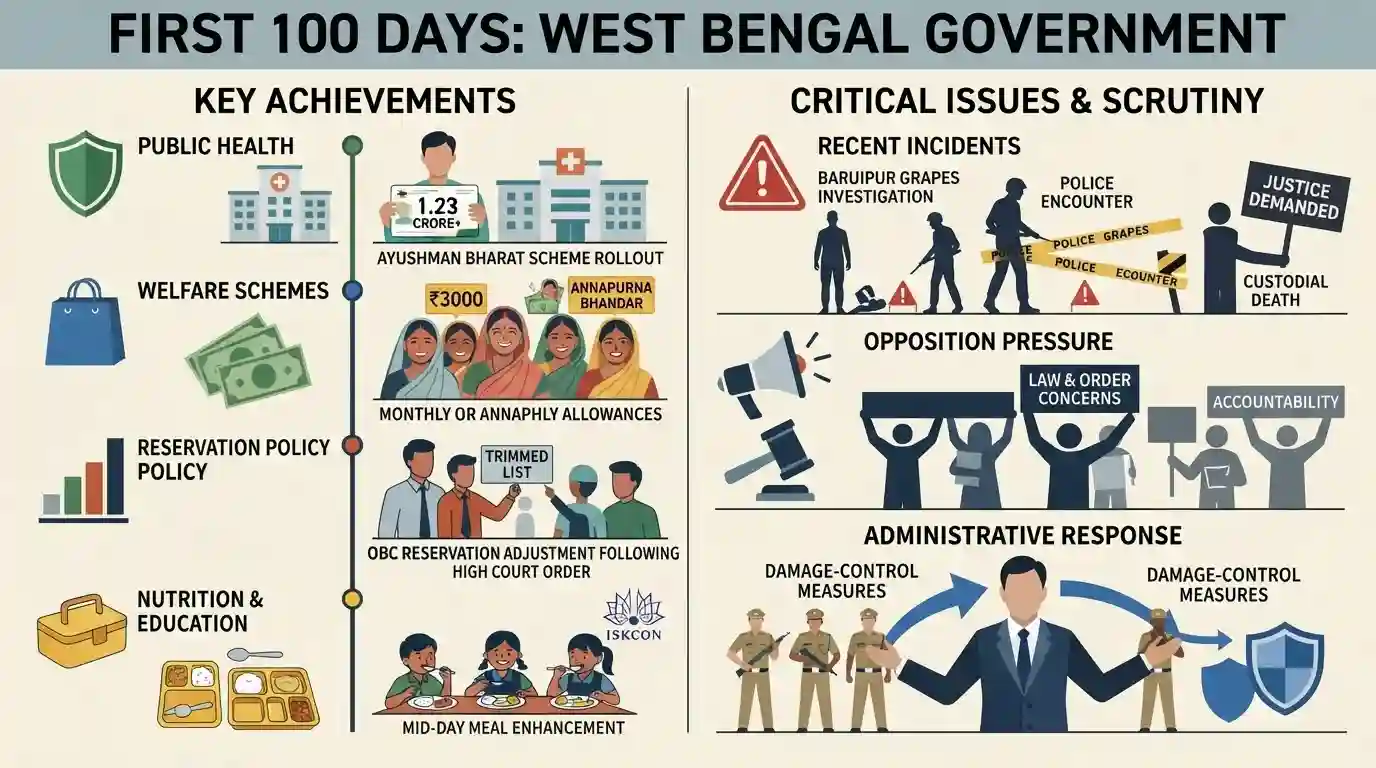
West Bengal Chief Minister Suvendu Adhikari has marked the first 100 days of his BJP-led government, highlighting rapid implementations of key welfare programs and policies. Successes outlined include bringing 1.23 crore people under the Ayushman Bharat scheme, providing ₹3000 monthly allowances to rural women through the Annapurna Bhandar scheme, and introducing the Bharatiya Nyaya Sanhita (BNS) to replace the IPC. The government also trimmed the OBC reservation list following a High Court order and enhanced mid-day meals in collaboration with ISKCON. However, the administration faces significant scrutiny from opposition parties over recent law and order incidents, such as a gangrape in Baruipur, a police encounter, and a custodial death in Halisahar, which have prompted rapid damage-control measures by the Chief Minister.
Key Points
- Suvendu Adhikari completed 100 days as the Chief Minister of West Bengal, heading a BJP government that replaced the TMC.
- Key achievements include expanding healthcare via Ayushman Bharat, the Annapurna Bhandar scheme providing ₹3000 monthly to rural women, and implementing the Bharatiya Nyaya Sanhita.
- The state complied with a Calcutta High Court order by trimming the OBC list to 66 communities.
- The government is also providing eggs twice a week in mid-day meals run by ISKCON and enhancing daily meal budgets in government hospitals.
- Opposition scrutiny remains high following law and order issues, including the Baruipur gangrape, a police encounter, and a custodial death in Halisahar.
Important Terms
Ayushman Bharat Pradhan Mantri Jan Arogya Yojana (AB-PMJAY)

A central government scheme providing up to ₹5 lakh in cashless annual health insurance coverage per family for secondary and tertiary care.
UPSC context
Important for GS Paper II (Welfare Schemes). State vs. Central implementation dynamics are highly relevant for WBCS exams.
Bharatiya Nyaya Sanhita (BNS)
India's new official criminal code, enacted in 2023 and effective July 2024, replacing the colonial-era Indian Penal Code (IPC) of 1860.
UPSC context
Crucial for GS Paper II (Polity & Governance). Represents a major overhaul of India's criminal justice system.
Annapurna Bhandar scheme
A West Bengal state welfare scheme introduced by the BJP government, replacing Lakshmir Bhandar, providing ₹3,000 monthly financial assistance to eligible women.
UPSC context
Key for State Specific questions in WBCS Prelims and Mains (GS Paper II) focusing on state welfare policies and Direct Benefit Transfers.
Indian Penal Code (IPC)
The comprehensive criminal code of India established in 1860 during the British colonial era, recently repealed and replaced by the Bharatiya Nyaya Sanhita.
UPSC context
Relevant for historical context in Polity (GS Paper II). Its replacement is a highly testable topic.
Prelims Trap
"The Calcutta High Court order completely abolished the OBC reservation quota in West Bengal."
The High Court struck down specific post-2010 classifications, reducing the quota from 17% to 7% (66 communities). It did not completely abolish the state's OBC reservation policy.
Static Concepts Connected
How is the OBC list determined at the state level vs. the central level?
- 102nd Amendment: Granted the President the power to notify the Central OBC list, initially creating ambiguity over state lists.
- 105th Amendment: Explicitly restored the power of State governments to identify and notify their own Socially and Educationally Backward Classes (SEBCs).
- Article 15(4) & 16(4): State-level reservation policies derive their constitutional mandate from these articles, subject to the 50% ceiling (Indra Sawhney).
What are the statutory nutritional guidelines for the PM POSHAN (Mid-Day Meal) scheme?
- Caloric & Protein Norms: Minimum 450 calories and 12g of protein per day for Primary classes. 700 calories and 20g protein for Upper Primary.
- State Flexibility: States have the flexibility to add supplementary nutrition (like West Bengal providing eggs twice a week) using their own state budgets.
Cross-Topic Patterns
Welfare Rebranding vs. State Fiscal Health
The shift from Lakshmir Bhandar to Annapurna Bhandar with enhanced payouts (₹3000) ties into WBCS Mains GS-II debates on populist welfare economics and sub-national fiscal deficits.
Healthcare Funding & Cooperative Federalism
West Bengal's integration into Ayushman Bharat shifts the healthcare funding dynamic from entirely state-funded (Swasthya Sathi) to a centrally sponsored scheme, impacting state financial planning.

Changes to WB's OBC list and quota percentages following HC orders will likely form a direct data-point question in WBCS Prelims.
Linked PYQs · 4
Linked PYQs · 4
- 2021WBCS_PRELIMSGS1
What proportion of the Insurance Premium payable for Swasthya-Sathi Scheme is borne by the State Government?
- 2006WBCS_PRELIMSGS1
Mid-day meal Scheme was launched in
- 2024WBCS_PRELIMSGS1
The Anarchical and Revolutionary Crimes Act was popularly known as
- 2021WBCS_PRELIMSGS1
Article 21 of the Indian Constitution ensues
