West Bengal industrial reforms and ease of doing business strategy
Source:business-standard ↗
Why It Matters
This article highlights the state-specific economic and industrial reforms of West Bengal, which are critical areas of study for the WBCS Prelims. Historically, questions related to state-level corporations like WBIDC (established in 1967), single-window initiatives (Silpasathi), and national/state rankings in Ease of Doing Business frequently appear in the examination.
Summary
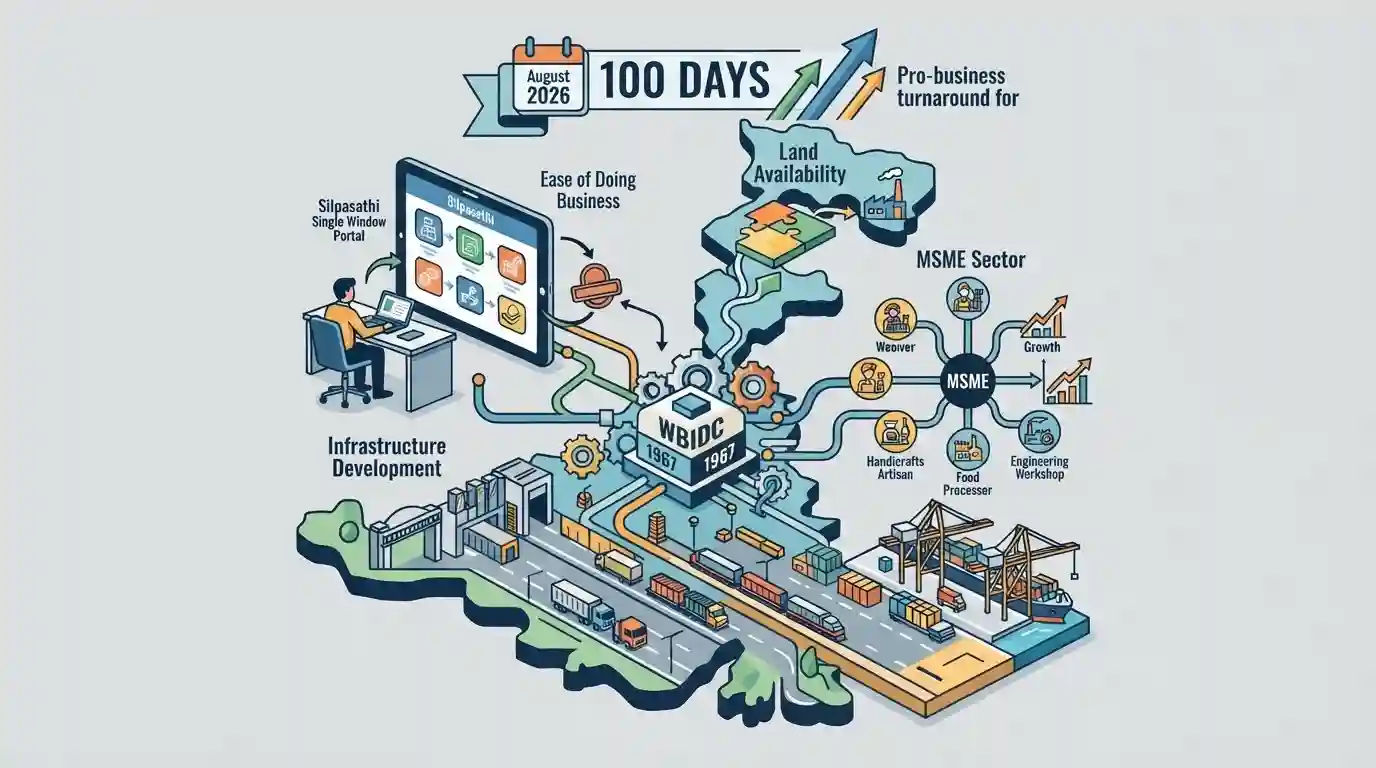
Following its 100 days in office in August 2026, the newly formed or re-elected West Bengal government is steering the state towards a pro-business turnaround. The state's economic strategy focuses on improving the ease of doing business via the 'Silpasathi' single-window portal, resolving land availability challenges for industries, boosting the state's dominant MSME sector, and accelerating major infrastructure projects like industrial corridors and deep-sea ports. The West Bengal Industrial Development Corporation (WBIDC), established in 1967, remains the cornerstone agency driving these industrial promotion and investment facilitation policies.
Key Points
- The West Bengal government is emphasizing a pro-business turnaround as it completes 100 days in office in August 2026.
- A central focus is placed on enhancing the 'Ease of Doing Business' in the state by strengthening 'Silpasathi'—the state's single-window clearance portal for industries.
- The state plans to address industrial land acquisition hurdles by creating a robust land bank, utilizing closed PSU lands, and developing state-backed industrial parks.
- Prioritizing the MSME sector is a core pillar, given that West Bengal possesses one of the largest MSME networks in India, with policies targeting improved credit access and cluster development.
- Key infrastructure projects such as industrial corridors (Dankuni-Haldia and Dankuni-Raghunathpur) and port developments (like Tajpur Deep Sea Port) are being prioritized to establish the state as a regional logistics hub.
- The West Bengal Industrial Development Corporation (WBIDC), established in 1967, serves as the premier state-level nodal agency to spearhead and facilitate these industrial investments and policies.
Important Terms
Silpasathi

A digital single-window portal launched by the Government of West Bengal to simplify and expedite statutory licenses and clearances for setting up and operating businesses.
UPSC context
Relevant for West Bengal Economy and Governance, highlighting state-level Ease of Doing Business (EoDB) and digital administration reforms.
Bengal Global Business Summit (BGBS)
An annual flagship corporate event organized by the West Bengal government to highlight its investment potential and forge global strategic and business alliances.
UPSC context
Crucial for Paper V (Economy), as it tracks the state's efforts to attract domestic and international investments and boost industrial growth.
West Bengal Industrial Development Corporation (WBIDC)
Formed in 1967, it is the premier state nodal agency responsible for the conceptualization, development, and facilitation of industry, investment, and infrastructure in West Bengal.
UPSC context
Highly important for Paper V and Paper VI, testing knowledge on key state statutory bodies driving industrial promotion and infrastructure.
Industry, Commerce and Enterprises Department, Government of West Bengal
The nodal administrative department of the West Bengal government overseeing industrial growth, trade, and commerce policies, and acting as the parent body for agencies like WBIDC.
UPSC context
Relevant for understanding state administration structures and industrial governance in Paper V (Economy) and Paper VI (Polity).
Prelims Trap
"West Bengal possesses the highest number of MSME enterprises in India."
Aspirants often assume heavily industrialized states like Maharashtra lead, or mistake West Bengal as first. Uttar Pradesh holds the top spot for MSME units, while West Bengal ranks second.
Static Concepts Connected
What are the key functions and background of WBIDC?
- Establishment Year: Formed in 1967 as the premier state-level nodal agency to drive industrial growth and investments.
- Nodal Department: Operates under the Industry, Commerce and Enterprises Department of the Government of West Bengal.
- Core Functions: Facilitates investment, manages state-backed industrial parks, and implements the 'Silpasathi' single-window clearance portal.
What is the geographical and economic significance of the proposed Tajpur Port?
- Location: Located in the Purba Medinipur district, designed as West Bengal's first greenfield deep-sea port.
- Natural Draft: Planned with a natural draft of 12-15 meters, enabling large cape-size vessels to dock without extensive dredging.
- Corridor Linkage: Anchors the 398 km Raghunathpur-Dankuni-Tajpur sub-corridor under the State Industrial and Economic Corridor Policy.
Cross-Topic Patterns
Tajpur Port and Sagarmala synergy
West Bengal's push for Tajpur Deep Sea Port links directly to national port-led development (Sagarmala), designed to overcome the chronic siltation and draft limitations of the riverine Syama Prasad Mookerjee Port.
MSME dominance and Priority Sector Lending
The state's reliance on MSME cluster development intersects with RBI's Priority Sector Lending (PSL) targets, making credit access policies vital for sustaining Bengal's ranking as a top MSME hub.

Expect a multi-statement question on WB's industrial geography combining Tajpur's natural draft, WBIDC's founding year, and MSME rankings.
Linked PYQs · 2
Linked PYQs · 2
- 2022WBCS_PRELIMSGS1
West Bengal Industrial Development Corporation Ltd. (WBIDC) was established in
- 2019WBCS_PRELIMSGS1
In the latest 'Ease of Doing Business Report 2019' released by the World Bank, India has secured
