CSR Initiative Trains Tribal Women in Wayanad as Certified Ayur Nurses
Source:The Hindu ↗
Why It Matters
Demonstrates a successful real-world case study for Mains GS2/GS4 answers on how CSR and NGOs can collaborate to uplift marginalized communities (tribal women), impart employable skills, and promote traditional alternative medicine systems.
Summary
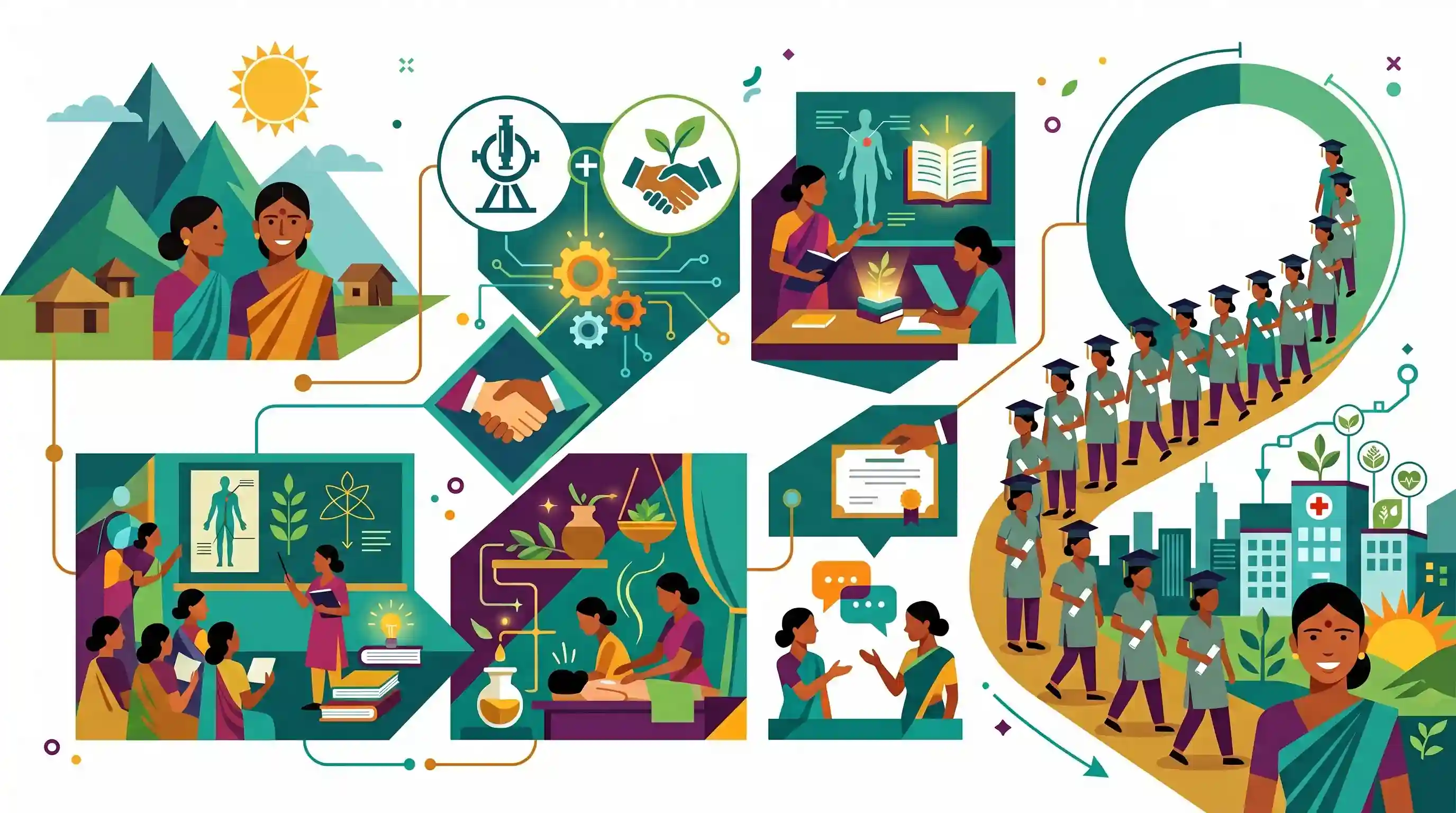
A collaborative Corporate Social Responsibility (CSR) initiative between ZEISS India and the NGO Bharat Shodh successfully trained 25 tribal women from below-poverty-line (BPL) families in Wayanad, Kerala, as certified 'Ayur Nurses'. The six-month program provided intensive theoretical and practical training in Ayurveda therapies, alongside soft skills, leading to 100% campus placements in top AYUSH hospitals in Bengaluru. The initiative underscores the role of NGOs and CSR in tribal empowerment, skill development, and leveraging traditional medicine to meet alternative healthcare demands.
Key Points
- 25 tribal women from BPL families in Wayanad graduated as certified Ayur Nurses with 100% campus placement in Bengaluru.
- The six-month program was fully funded by ZEISS India's CSR wing and executed by the NGO Bharat Shodh.
- Training bridged traditional knowledge and alternative healthcare demand, covering Ayurveda Panchakarma therapies and soft skills.
- An 'Ayur Nurses' mobile app is being developed to connect certified graduates with verified Ayurvedic healthcare providers.
Important Terms
Corporate Social Responsibility (CSR)

Mandatory social spending (2% of average net profit) by eligible companies under Section 135 of the Companies Act, 2013, targeting sectors like education and healthcare.
UPSC context
GS Paper 2 (Governance) and GS Paper 4 (Ethics); tests understanding of corporate accountability and inclusive growth.
AYUSH
The acronym for traditional Indian medical systems: Ayurveda, Yoga & Naturopathy, Unani, Siddha, and Homeopathy, governed by a dedicated Union Ministry since 2014.
UPSC context
GS Paper 2 (Health); relevant for alternative medicine's role in public health and diversifying human resources.
Tribal Empowerment
Socio-economic upliftment of Scheduled Tribes through education, healthcare, and livelihood initiatives to bridge the development gap while preserving cultural identity.
UPSC context
GS Paper 1 (Society) and GS Paper 2 (Social Justice); pertains to the welfare of vulnerable sections and constitutional provisions.
Non-Governmental Organizations (NGOs)
Voluntary, non-profit organizations that facilitate grassroots development, bridge government implementation gaps, and advocate for marginalized communities' rights.
UPSC context
GS Paper 2 (Governance/Development Process); tests the role of civil society and pressure groups in national development.
Ayur-nurses
Specialized healthcare workers trained in Ayurvedic therapies (e.g., Panchakarma) and herbal pharmacology, often serving as a bridge between traditional wisdom and modern nursing.
UPSC context
GS Paper 2 (Human Resources/Health); demonstrates skill-based vocational training for employment in the growing traditional medicine sector.
Aspirational Districts
A NITI Aayog program aimed at transforming the most socio-economically challenged districts (like Wayanad) through convergence, collaboration, and competition.
UPSC context
GS Paper 2 (Governance); important for understanding decentralised planning and targeted development strategies.
Prelims Trap
"CSR spending under the Companies Act 2013 is mandatory only for companies with a net profit exceeding ₹500 crore."
The ₹500 crore threshold applies to 'net worth'. For 'net profit', the threshold is merely ₹5 crore. Aspirants often mix up these financial criteria under Section 135.
Static Concepts Connected
What are the statutory thresholds for mandatory CSR spending under the Companies Act, 2013?
- Net Worth: Companies with a net worth of ₹500 crore or more during the immediately preceding financial year.
- Turnover: Companies with a turnover of ₹1,000 crore or more during the immediately preceding financial year.
- Net Profit: Companies with a net profit of ₹5 crore or more during the immediately preceding financial year.
- Mandatory Spend: Mandates spending at least 2% of the average net profits made during the three immediately preceding financial years on Schedule VII activities.
What are the core components of the National AYUSH Mission (NAM)?
- Universal Access: Co-location of AYUSH facilities at Primary Health Centres (PHCs), Community Health Centres (CHCs), and District Hospitals.
- Institutional Upgradation: Upgrading state government AYUSH educational institutions, pharmacies, drug testing laboratories, and dispensaries.
- Medicinal Plants: Supporting the cultivation of medicinal plants by integrating farming protocols and maintaining reliable supply chains for traditional medicines.
Cross-Topic Patterns
CSR intersecting with Tribal Livelihoods
Corporate partnerships bridging targeted skill gaps in tribal areas act as crucial force multipliers, complementing state-run livelihood frameworks like the PM-PVTG Development Mission and the Van Dhan Yojana.
Gig economy formalization in traditional care
The development of an 'Ayur Nurses' app illustrates the ongoing formalization of unorganized, traditional healthcare workers into the digital gig economy, enhancing discoverability and standardizing care.

Expect a Mains question evaluating NGO-Corporate synergy (CSR) in bridging last-mile healthcare and skilling gaps for tribal communities.
Linked PYQs · 4
Linked PYQs · 4
- 2024MainsGS2
Public charitable trusts have the potential to make India's development more inclusive as they relate to certain vital public issues. Comment.
- 2025MainsGS2
Women's social capital complements in advancing empowerment and gender equity. Explain.
- 2023MainsGS2
Skill development programmes have succeeded in increasing human resources supply to various sectors. In the context of the statement analyse the linkages between education, skill and employment.
- 2021MainsGS2
Can Civil Society and Non-Governmental Organizations present an alternative model of public service delivery to benefit the common citizen? Discuss the challenges of this alternative model.
