Decade of Una Flogging Highlights Systemic Hurdles in Justice
Source:Indian Express ↗
Why It Matters
This article represents a major real-world case study for the UPSC CSE on caste-based atrocities, the efficacy of the SC/ST (Prevention of Atrocities) Act, and the systemic challenges within India's judicial machinery (including witness protection and police complicity). It also highlights the implementation of the new Bharatiya Nagrik Suraksha Sanhita (BNSS) regarding victim compensation.
Summary
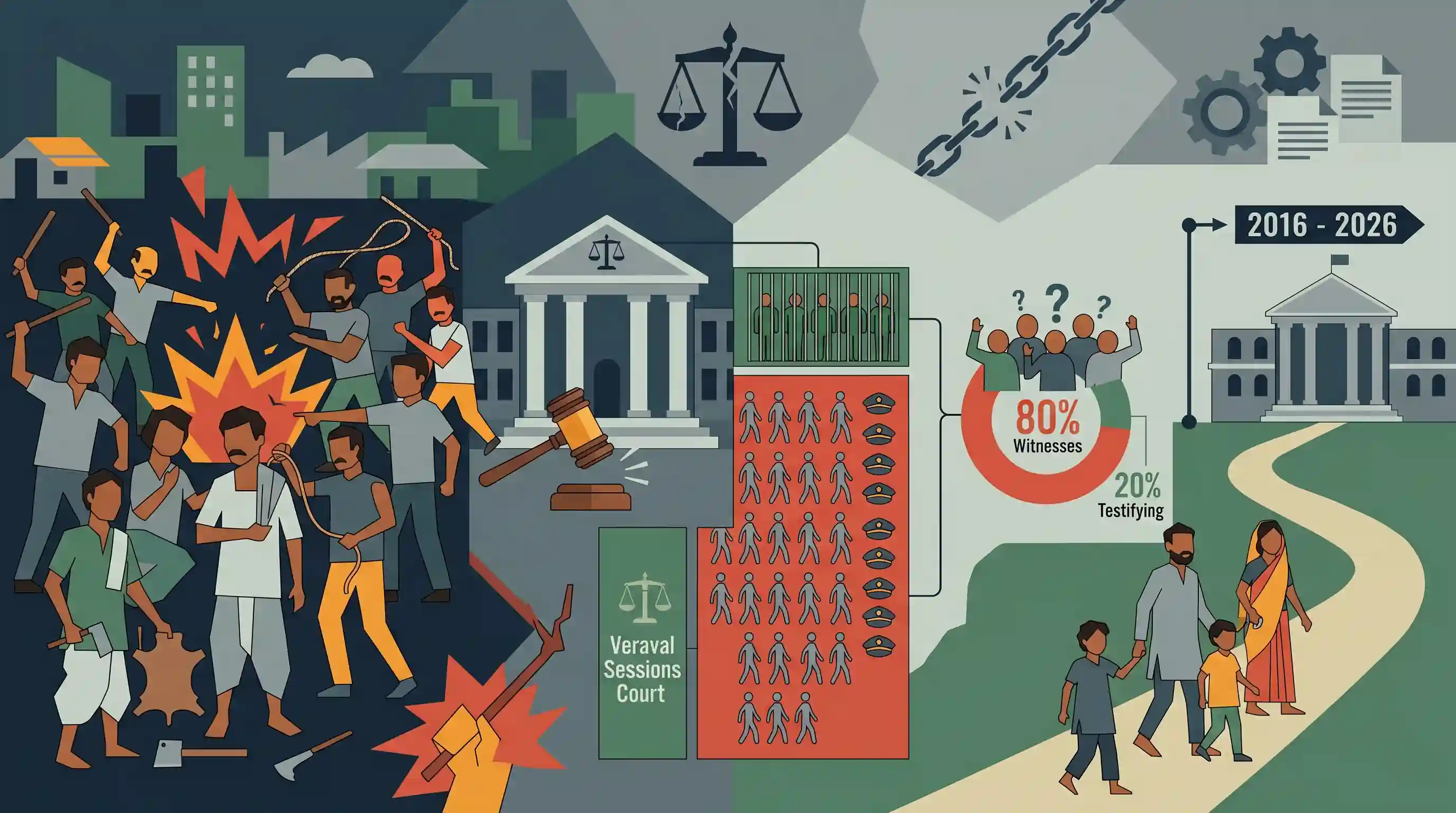
The article reports on the 10th anniversary of the 2016 Una Dalit flogging incident, highlighting the family's ongoing struggle for justice. Following a Veraval Sessions Court verdict in March 2026 that convicted only five individuals and acquitted 35 others (including local police officers), the victims' family has moved the Gujarat High Court. The case highlights major structural flaws in India's criminal justice system, such as high witness hostility rates (80 witnesses turned hostile) and issues of vigilante violence and state-sponsored rehabilitation of vulnerable sections.
Key Points
- Marking 10 years of the July 11, 2016 Una flogging incident, where four Dalit men were publicly stripped and beaten by self-styled cow vigilantes for skinning a dead cow (which CID probe later confirmed was killed by a lion).
- A Sessions Court in Veraval in March 2026 sentenced only 5 of 40 accused facing trial to five years of imprisonment, while acquitting the remaining 35 accused, including three police officers charged with neglect of duty, abetment, and forgery of public records.
- The five convicted individuals did not face further prison time as their five-year sentence was counted as concurrent with their pre-trial jail custody. They were fined Rs 5,000 each.
- A crucial systemic hurdle in the trial was that 80 prosecution witnesses turned hostile, which weakened the prosecution's case and led to the mass acquittals.
- In a unique administrative/judicial order, the sessions court directed that the victims be provided copies of Mahatma Gandhi's autobiography as part of their compensation under the newly enacted Bharatiya Nagrik Suraksha Sanhita (BNSS).
- The Dalit victims' family has filed an appeal in the Gujarat High Court to contest the mass acquittals, while community leaders urge the state government to fulfill long-pending rehabilitation promises (agricultural land, government jobs, and housing plots) made in 2016 by the then-CM Anandiben Patel.
Important Terms
Scheduled Castes and Scheduled Tribes (Prevention of Atrocities) Act

A special central legislation enacted in 1989 to prevent hate crimes, discrimination, and atrocities against Scheduled Castes (SCs) and Scheduled Tribes (STs) in India.
UPSC context
GS Paper II (Social Justice, Vulnerable Sections). Crucial for understanding constitutional protections and legal remedies for marginalized communities.
Bharatiya Nagrik Suraksha Sanhita (BNSS)
The primary procedural law of India enacted in 2023, replacing the Code of Criminal Procedure (CrPC), 1973, to govern arrest, investigation, bail, and prosecution.
UPSC context
GS Paper II (Criminal Justice Reforms, Governance). Key to analyzing updates in India's procedural jurisprudence and victim-witness protections.
CID (Crime)
The Crime Investigation Department, a specialized investigative and intelligence wing of a state police force in India, dealing with serious offences like riots and forgery.
UPSC context
GS Paper II & III (Police Reforms, Internal Security). Crucial for studying state-level law enforcement structure and specialized crime detection.
Gujarat High Court
The highest judicial institution in the state of Gujarat, established under Article 214 of the Indian Constitution, possessing appellate, original, and supervisory jurisdiction.
UPSC context
GS Paper II (Judiciary). Critical for examining federalism, appellate processes, and judicial oversight over subordinate state courts.
Prelims Trap
Witness protection in India is exclusively governed by the Witness Protection Scheme 2018, with no statutory backing in caste-specific legislation.
Chapter IVA (Section 15A) was added to the SC/ST Act via the 2015 Amendment, creating a robust, statutory victim-and-witness protection regime specifically for caste atrocities, predating the general 2018 scheme.
Static Concepts Connected
What are the key victim-protection and trial provisions under the SC/ST Amendment Act, 2015?
- Strict Timelines: Section 14 mandates the designation of Exclusive Special Courts to complete trials within two months from the date of filing the charge sheet.
- Witness Protection: Chapter IVA (Section 15A) places a proactive duty on the State to shield victims, dependents, and witnesses from intimidation, coercion, or inducement.
- Public Servant Negligence: Section 4 prescribes a punishment of 6 months to 1 year of imprisonment for public servants who willfully neglect duties under the Act.
How do Restorative and Retributive systems of justice differ in criminal jurisprudence?
- Retributive Justice: Focuses strictly on penalizing the offender proportionally to the crime committed to deter future offenses, viewing crime as a violation of the State.
- Restorative Justice: Focuses on repairing the harm done to the victim and community, encouraging rehabilitation, mental healing, and symbolic restitution.
- Statutory Tool (BNSS): Section 395 of the BNSS expands judicial discretion to order diverse, non-traditional forms of victim compensation and rehabilitation.
Cross-Topic Patterns
Atrocity Act vs. Judicial Backlog
The 10-year delay in the Una trial exposes the friction between the statutory two-month fast-track mandate under the SC/ST Act and systemic judicial backlog in lower courts.
Caste Assertion as Economic Decoupling
Post-Una mobilizations show how asserting dignity involves rejecting hereditary, caste-assigned occupations, directly disrupting the traditional economic hierarchies that sustain untouchability.

Mains 2026: Evaluating the structural gaps between SC/ST Act witness protection mandates and high rates of hostile witnesses in trials.
Linked PYQs · 2
Linked PYQs · 2
- 2015MainsGS1
Debate the issue of whether and how contemporary movements for assertion of Dalit identity work towards annihilation of caste.
- 2017MainsGS3
Mob violence is emerging as a serious law and order problem in India. By giving suitable examples, analyze the causes and consequences of such violence.
