Decade of demonetisation cash trends and counterfeit notes
Source:The Hindu ↗
Why It Matters
Provides a macro-economic evaluation of a major structural policy shift a decade later, showing the coexistence of cash and digital payments and persistent internal security challenges related to fake notes.
Summary
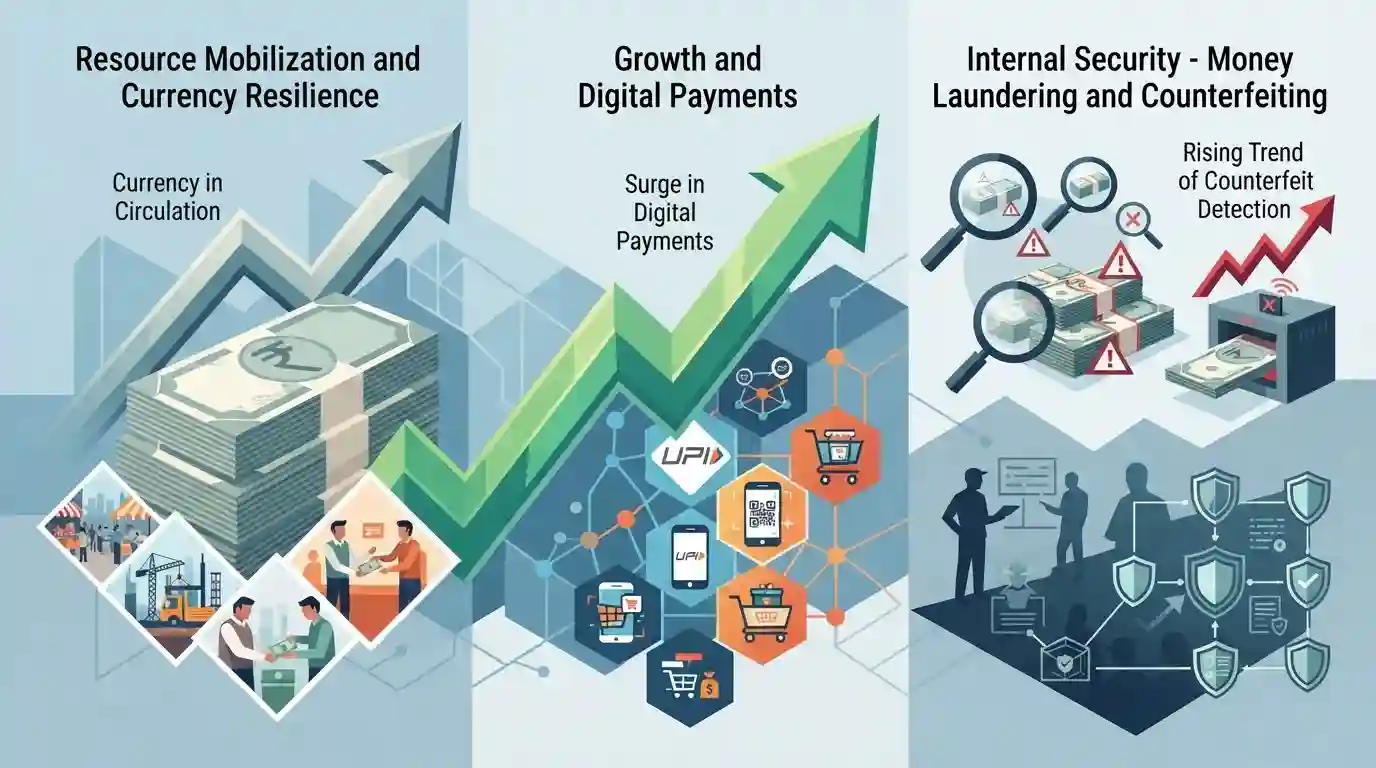
Ten years after the demonetisation of high-value currency notes in India, data shows that overall cash usage and currency in circulation have largely rebounded or remained resilient despite the massive surge in digital payments like UPI. Furthermore, the detection of counterfeit or fake currency notes has witnessed a rising trend, reflecting ongoing security challenges.
Key Points
- A decade after demonetisation, currency in circulation remains high relative to GDP, showing that cash usage persists alongside digital payment growth.
- Fake Indian Currency Notes (FICN) have seen a resurgence in recent years, posing ongoing challenges for security and law enforcement.
- While UPI and digital transactions have grown exponentially, cash remains a preferred medium for daily transactions and informal sector liquidity.
Prelims Trap
Exponential growth in digital payments like UPI automatically causes a proportional decline in currency in circulation.
Aspirants often assume a massive rise in UPI transactions means a proportional drop in physical currency, ignoring that absolute currency in circulation and cash-to-GDP ratios have rebounded or remained steady.
Static Concepts Connected
What are the core functions of the Reserve Bank of India (RBI) regarding currency management?
- Note Issue Authority: Monopoly over note issue under Section 22 of the RBI Act, 1934 (except one-rupee notes issued by the Ministry of Finance).
- Distribution Network: Managing currency distribution through Issue Offices and currency chests spread across commercial banks.
- Withdrawal & Disposal: Withdrawing and disposing of soiled, mutilated, or counterfeit currency notes to maintain cleanliness and integrity of notes.
Cross-Topic Patterns
Informal Economy & Digital Adoption Paradox
The persistence of cash in the informal economy runs parallel to challenges in formalizing employment through e-Shram and expanding social security nets.
FICN, Border Security, and Money Laundering
Counterfeiting trends directly tie money laundering risks to international borders and cross-border organized crime networks tracked by central agencies.

Demonetisation anniversary data + currency-to-GDP ratio trends will likely be paired in a multi-statement Prelims question on central banking.
Linked PYQs · 1
Linked PYQs · 1
- 2023MainsGS3
What is the status of digitalization in the Indian economy? Examine the problems faced in this regard and suggest improvements.
