ISRO Space Assets and Strategic Border Surveillance Integration
Source:The Hindu ↗
Why It Matters
This article provides practical examples of the integration of space technology (satellite surveillance) and defense strategy. It also highlights contemporary border management challenges (drone attacks, ceasefire violations) and India's proactive military posture against cross-border terrorism (Operation Sindoor), directly relevant to GS-3 Internal Security and GS-2 International Relations.
Summary
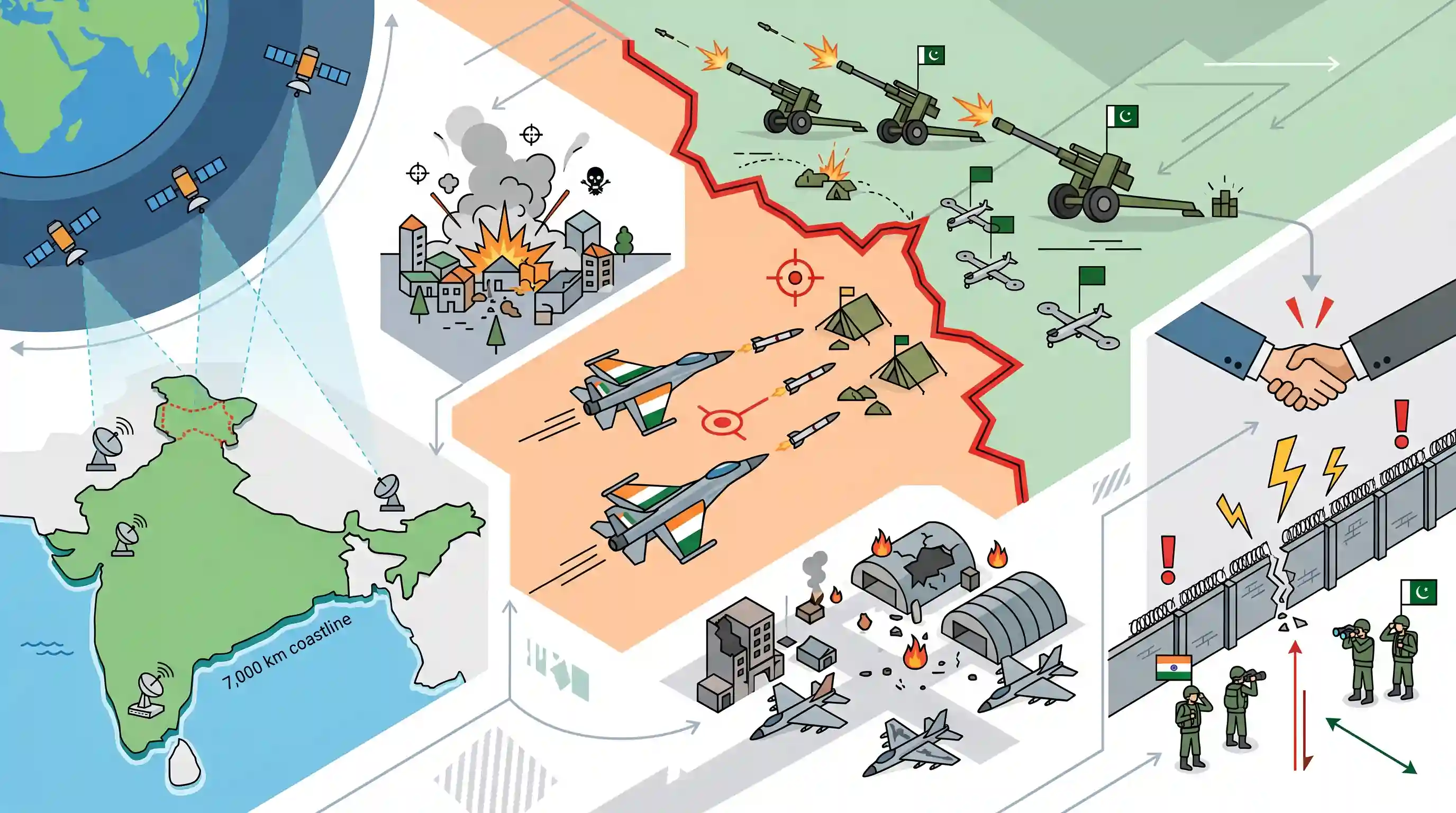
ISRO Chairman V. Narayanan highlighted the critical role of space technology in national security, revealing that at least 10 satellites are continuously monitoring India's northern borders and 7,000 km coastline. This emphasis on strategic surveillance comes during heightened tensions with Pakistan following 'Operation Sindoor'—India's retaliatory military action against terror camps in Pakistan and PoK after the April 22 Pahalgam attacks. The operation triggered heavy cross-border shelling and drone intrusions by Pakistan, to which the Indian Armed Forces responded by destroying 11 Pakistani air bases. A briefly negotiated cessation of hostilities was quickly violated by Pakistan, underscoring ongoing volatility along the Line of Control and International Border.
Key Points
- ISRO Chairman V. Narayanan announced that at least 10 satellites are actively monitoring India's 7,000 km coastline and northern borders round-the-clock for strategic security purposes.
- This surveillance is critical amid ongoing border tensions and recent escalations with Pakistan, which involved cross-border firing, heavy artillery shelling, and drone attacks.
- The escalation follows 'Operation Sindoor', launched by the Indian Armed Forces to destroy terror launch pads in Pakistan and PoK in retaliation for the April 22 Pahalgam terror attacks.
- India destroyed 11 air bases in Pakistan in response to the subsequent shelling, significantly degrading its military capabilities.
- Despite a brief agreement on cessation of hostilities between the DGMOs of both nations, Pakistan violated the ceasefire within hours, prompting robust responses from India.
Important Terms
Operation Sindoor

A tri-service military operation launched by India in May 2025 against terror infrastructure in Pakistan and PoK, following the April 22 Pahalgam attack. It featured precision missile strikes and drone warfare.
UPSC context
GS Paper 3 (Security); tests knowledge of counter-terrorism doctrine, retaliatory military strategy, and regional security dynamics.
ISRO (Indian Space Research Organisation)
India's primary space agency, which by 2026 operates at least 10 dedicated satellites for round-the-clock strategic surveillance of national borders and coastlines under the leadership of Chairman V. Narayanan.
UPSC context
GS Paper 3 (S&T); tests awareness of indigenization of technology and the strategic utility of space assets for national defense.
Border Management
The coordinated oversight of national frontiers to prevent illegal intrusion and manage cross-border threats. It integrates traditional troop deployments with advanced technological assets like satellites and loitering munitions.
UPSC context
GS Paper 3 (Security); fundamental for topics on security challenges in border areas and the role of technology in defense.
Line of Control (LoC)
The 740-km long de facto border between India and Pakistan in Jammu and Kashmir. It remains a flashpoint for military tension, heavy shelling, and ceasefire violations during regional crises.
UPSC context
GS Paper 2 (IR) and GS Paper 3 (Security); essential for understanding India-Pakistan territorial disputes and border security protocols.
Strategic Surveillance
The use of high-tech assets (satellites, drones, sensors) to provide real-time intelligence on adversary movements. ISRO's surveillance fleet monitors India's 7,000 km coastline and northern borders.
UPSC context
GS Paper 3 (S&T / Security); relates to modern "Information-Led" warfare and national intelligence capabilities.
Cross-border Terrorism
Terrorist activities originating from one country targeting another, often involving state-supported proxies. In 2025-26, it remained the primary driver for retaliatory strikes and heightened border alert levels.
UPSC context
GS Paper 3 (Security); central to the study of internal security threats and India's "Zero Tolerance" policy toward terrorism.
Prelims Trap
India relies entirely on dual-use civilian remote sensing satellites and possesses no dedicated military satellites in orbit.
India operates dedicated military communication satellites like GSAT-7 (Rukmini) for the Navy and GSAT-7A for the Air Force. ISRO does not exclusively build civilian platforms.
Static Concepts Connected
What are India's key dedicated and strategic military satellites?
- GSAT-7 (Rukmini): Dedicated to the Indian Navy, providing secure, real-time communication across the Indian Ocean Region (IOR).
- GSAT-7A (Angry Bird): Dedicated to the Indian Air Force and Army Aviation, boosting drone operations and network-centric warfare capabilities.
- RISAT Series: Synthetic Aperture Radar (SAR) satellites that provide all-weather, day-and-night reconnaissance for border surveillance and anti-terror operations.
How is India's maritime and coastal security structured post-26/11?
- Three-Tier System: Marine Police secure shallow waters (up to 12 NM), Indian Coast Guard patrols the EEZ (up to 200 NM), and Indian Navy secures the deep seas.
- IMAC (Information Management and Analysis Centre): A nodal center in Gurugram that synthesizes data from the Coastal Radar Chain Network, AIS, and space assets for maritime domain awareness.
Cross-Topic Patterns
Space assets & CIBMS integration
ISRO's satellite reconnaissance is a critical technological multiplier for the Comprehensive Integrated Border Management System (CIBMS), providing real-time terrain mapping to plug physical vulnerabilities in hostile borders like the LoC.
Cross-border drones & GSAT-7A
The escalating use of drones by Pakistan for weapon and narcotic drops across Punjab/J&K necessitates satellite-enabled network-centric warfare and anti-drone communication relays (like GSAT-7A).

The shift from dual-use to dedicated military satellites (GSAT-7 series) + CIBMS integration is highly probable for a GS-3 Mains question.
Linked PYQs · 3
Linked PYQs · 3
- 2023MainsGS3
The use of unmanned aerial vehicles (UAVs) by our adversaries across the borders to ferry arms/ammunitions, drugs, etc., is a serious threat to the internal security. Comment on the measures being taken to tackle this threat.
- 2020MainsGS3
Analyze internal security threats and transborder crimes along Myanmar, Bangladesh and Pakistan borders including Line of Control (LoC). Also discuss the role played by various security forces in this regard.
- 2016MainsGS3
The terms 'Hot Pursuit' and 'Surgical Strikes' are often used in connection with armed action against terrorist attacks. Discuss the strategic impact of such actions.
