Ayushman Vay Vandana Yojana Rollout and Geriatric Care Politics
Source:The Hindu ↗
Why It Matters
The article underscores key debates in India's public health policy, specifically the contrast between insurance-led hospitalization models (like Ayushman Bharat) and primary care/OPD-focused models. It also highlights the policy focus on geriatric care amid India's demographic transitions and the impact of political dynamics on welfare scheme implementation.
Summary
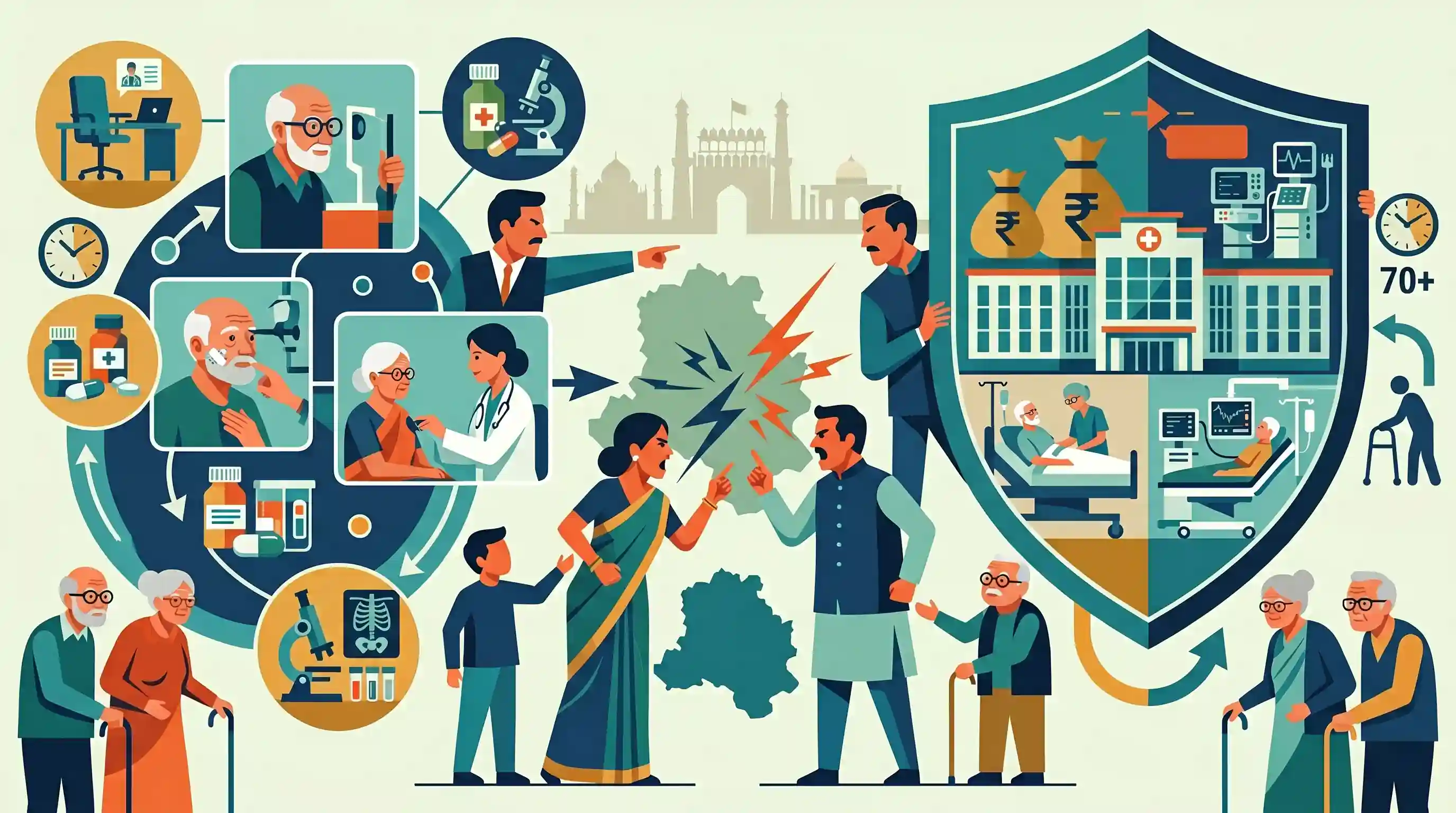
The Union Health Ministry's Ayushman Vay Vandana Yojana (AVVY) has been launched in Delhi, offering a ₹10-lakh health cover for secondary and tertiary hospitalization to residents aged 70 and above. The rollout sparked a political dispute between Delhi's ruling BJP government, led by CM Rekha Gupta, and the opposition AAP. While the BJP emphasized the scheme's commitment to the elderly, AAP criticized the insurance model for neglecting routine Out-Patient Department (OPD) care, contrasting it with the previously implemented 'Arvind Kejriwal model' that provided comprehensive free healthcare.
Key Points
- The Ayushman Vay Vandana Yojana (AVVY) provides health insurance coverage of up to ₹10 lakh for citizens aged 70 and above in Delhi, irrespective of income.
- The scheme exclusively covers secondary and tertiary care hospitalization across approximately 100 empanelled hospitals, requiring registration for a 'Vay Vandana' card.
- Beneficiaries availing of other government health schemes, such as the Central Government Health Scheme (CGHS), must choose to retain only one scheme.
- Delhi CM Rekha Gupta (BJP) accused the former AAP government of deliberately delaying the implementation of the central scheme due to political motives.
- The opposition AAP criticized the scheme's insurance-based approach for excluding Out-Patient Department (OPD) services and medicines, advocating instead for the previous administration's comprehensive 'Kejriwal model' of healthcare.
Important Terms
Ayushman Vay Vandana Yojana (AVVY)

A specialized vertical under AB PM-JAY providing ₹5 lakh (₹10 lakh in Delhi) annual health cover for senior citizens aged 70+, regardless of income, for secondary and tertiary hospitalization.
UPSC context
GS Paper II: Government schemes for vulnerable sections; tests understanding of universal healthcare and elderly social security.
Central Government Health Scheme (CGHS)
A comprehensive healthcare scheme for Central Government employees and pensioners, providing OPD, IPD, and specialist consultations through a network of wellness centers and empaneled hospitals.
UPSC context
GS Paper II: Social Sector/Services relating to Health; tests knowledge of specific health administration models for government personnel.
Tertiary Healthcare
Specialized consultative healthcare, usually for inpatients and on referral from primary or secondary levels, involving advanced medical investigation and treatment like major surgeries or cancer care.
UPSC context
GS Paper II: Health issues; tests understanding of the three-tier healthcare structure and specialized medical services in India.
Out-Patient Department (OPD)
The department of a hospital providing medical consultations, diagnostics, and treatments that do not require an overnight stay or admission to a ward.
UPSC context
GS Paper II: Health/Social Sector; tests distinction between hospitalization-based insurance models and comprehensive primary healthcare provision.
Union Ministry of Health and Family Welfare (MoHFW)
The nodal central agency responsible for formulating and implementing national health policies, including flagship schemes like Ayushman Bharat and managing medical education and standards.
UPSC context
GS Paper II: Statutory/Regulatory/Quasi-judicial bodies; tests knowledge of executive machinery in health governance and federal scheme implementation.
Prelims Trap
"AVVY provides comprehensive primary healthcare to senior citizens above 70 belonging to BPL categories."
AVVY for 70+ has NO income ceiling; it applies universally regardless of economic status. Additionally, it exclusively covers hospitalization, completely excluding OPD care.
Static Concepts Connected
Why do insurance-based health models often fail to significantly reduce Out-of-Pocket Expenditure (OOPE)?
- OPD Exclusion: Public insurance schemes (like PM-JAY/AVVY) typically cover only secondary and tertiary hospitalization (IPD), explicitly excluding primary care.
- Bulk of OOPE: Routine Out-Patient Department (OPD) consultations, diagnostics, and essential medicines constitute nearly 50% of India's total health OOPE.
- Structural Gap: Without robust, state-funded primary healthcare (like Mohalla Clinics), out-of-pocket costs remain high for daily medical needs despite hospitalization cover.
What distinguishes Centrally Sponsored Schemes (CSS) like Ayushman Bharat from Central Sector Schemes?
- Funding Model: CSS are jointly funded by the Centre and States (usually 60:40 or 90:10), whereas Central Sector Schemes are 100% centrally funded.
- Implementation Authority: CSS are executed by State Governments, often leading to adoption delays, localized rebranding, or political friction in opposition-ruled states.
Cross-Topic Patterns
Health Federalism & Welfare Politics
Disputes over AVVY mirror state-level opt-outs from Centrally Sponsored Schemes (like PM-JAY), highlighting the tension between national welfare portability and competitive state-level populism.
Demographic Transition & Geriatric Policy
With India's elderly population projected to double by 2050, AVVY signals a welfare pivot towards managing the 'silver economy' and the rising fiscal burden of geriatric non-communicable diseases (NCDs).

AVVY’s 'universal for 70+ without income cap' and 'OPD exclusion' are prime for a 2026 Prelims statement question on scheme eligibility.
Linked PYQs · 4
Linked PYQs · 4
- 2024MainsGS2
In a crucial domain like the public healthcare system the Indian State should play a vital role to contain the adverse impact of marketisation of the system. Suggest some measures through which the State can enhance the reach of public healthcare at the grassroots level.
- 2015MainsGS2
Public health system has limitations in providing universal health coverage. Do you think that the private sector could help in bridging the gap? What other viable alternatives would you suggest?
- 2024MainsGS2
What changes has the Union Government recently introduced in the domain of Centre-State relations ? Suggest measures to be adopted to build the trust between the Centre and the States and for strengthening federalism.
- 2013MainsGS1
Critically examine the effect of globalization on the aged population in India.
