Gujarat distributes free rations to millions under food security
Source:deshgujarat ↗
Why It Matters
It provides concrete data on the scale and implementation of the Public Distribution System (PDS) and NFSA at the state level. Understanding food subsidies, economic cost, and targeted welfare schemes is crucial for GPSC exams focusing on governance and the economy.
Summary
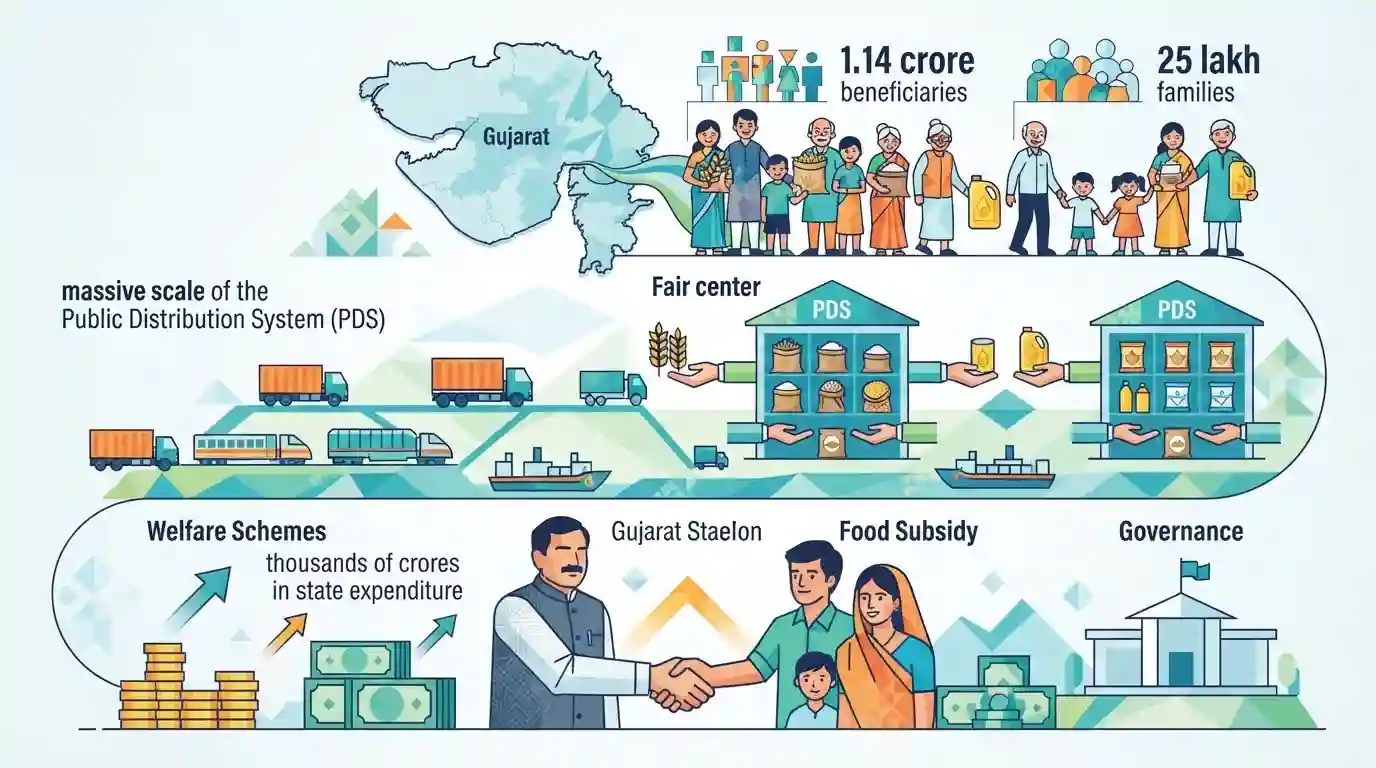
The Gujarat government has distributed free ration to over 1.14 crore beneficiaries from 25 lakh families in the past five years under the National Food Security Act (NFSA). Food and Civil Supplies Minister Ramanbhai Solanki detailed the massive scale of the Public Distribution System (PDS) in the state, which supplied huge quantities of wheat, rice, coarse grains, edible oil, and sugar. The initiative, spearheaded by CM Bhupendra Patel's administration, involved thousands of crores in state expenditure to ensure food security and support vulnerable sections of society.
Key Points
- Over the past 5 years, the Gujarat government has provided free ration to 1.14 crore beneficiaries across 25 lakh families under the Food Security Scheme.
- The extensive distribution through the Public Distribution System (PDS) included 39.09 crore kg of wheat, 71.97 crore kg of rice, and other items like coarse grains, sugar, and edible oil.
- State expenditure highlights significant subsidies, spending Rs. 1827.67 crore on edible oil and Rs. 1381 crore on gram over the last 5 years to support vulnerable families.
- The data underscores the state's commitment to zero hunger and robust food grain management at subsidized rates or free of cost.
Important Terms
National Food Security Act (NFSA)

A 2013 law ensuring a rights-based approach to food security by legally entitling up to 75% of rural and 50% of urban populations to highly subsidized foodgrains.
UPSC context
GS Paper 2 (Social Justice). Tests knowledge of welfare schemes, statutory rights, and poverty alleviation strategies.
Public Distribution System (PDS)
A government-managed food security network that distributes subsidized essential commodities like wheat, rice, and sugar to eligible households through a widespread system of Fair Price Shops.
UPSC context
GS Paper 3 (Economy). Relevant for understanding food security, supply chain management, and agricultural procurement challenges.
Food and Civil Supplies Department
The nodal state government department in Gujarat responsible for managing the Public Distribution System, identifying eligible beneficiaries, and ensuring the timely delivery of subsidized rations.
UPSC context
GS Paper 2 (State Governance). Essential for GPSC-specific questions on public administration, state welfare delivery, and policy implementation.
Food Subsidy
Financial support provided by the government to bridge the gap between the economic cost of procuring foodgrains and the subsidized rates at which they are sold to beneficiaries.
UPSC context
GS Paper 3 (Economy). Crucial for analyzing fiscal policy, government expenditure, and the economic burden of welfare schemes.
Antyodaya Anna Yojana (AAY)
A targeted food security scheme under the NFSA designed for the poorest of the poor households, providing them with a fixed entitlement of 35 kg of foodgrains per month.
UPSC context
GS Paper 2 (Welfare Schemes). Tests understanding of targeted poverty alleviation and vulnerable section protection.
Prelims Trap
The Central government identifies NFSA beneficiaries and manages Fair Price Shops across states.
The Centre handles bulk procurement and allocation. Identifying eligible households, issuing ration cards, and managing Fair Price Shops are the exclusive responsibilities of State governments.
Static Concepts Connected
How are responsibilities divided between the Centre and States under the PDS?
- Central Government: Responsible for procurement, storage, transportation, and bulk allocation of food grains through the Food Corporation of India (FCI).
- State Governments: Responsible for identifying eligible households, issuing ration cards, and the licensing and monitoring of Fair Price Shops (FPS).
How does the National Food Security Act (NFSA) 2013 promote women's empowerment?
- Head of Household: The eldest woman of the household aged 18 years or above is mandatorily designated as the head of the household for the issuance of ration cards.
- Maternity Benefit: Pregnant women and lactating mothers are entitled to a minimum maternity benefit of Rs. 6,000 under the Act's provisions.
Cross-Topic Patterns
Food subsidies and State Fiscal Deficits
The massive state expenditure on free rations intersects with the economy syllabus, specifically food subsidy burdens impacting state fiscal deficits while simultaneously targeting SDG 2 (Zero Hunger).
PDS distribution and MSP procurement cycles
PDS distribution relies on FCI's open-ended procurement at Minimum Support Prices (MSP), directly linking state welfare schemes to national agricultural pricing policies.

Expect a multi-statement question testing Centre-State PDS responsibilities alongside NFSA eligibility limits and women empowerment clauses.
Linked PYQs · 1
Linked PYQs · 1
- 2026GPSC_PRELIMSGS1
Food subsidy is the difference between
