Special Intensive Revision voter programme commences in Uttarakhand
Source:governoruk ↗
Why It Matters
The Special Intensive Revision (SIR) and door-to-door voter enumeration represent crucial administrative procedures under the ECI to ensure electoral integrity. Knowledge of Uttarakhand's state executive (such as the Governor's role) and local administration is highly relevant for polity-based and Uttarakhand-specific state-service questions in the UKPSC PCS Prelims.
Summary
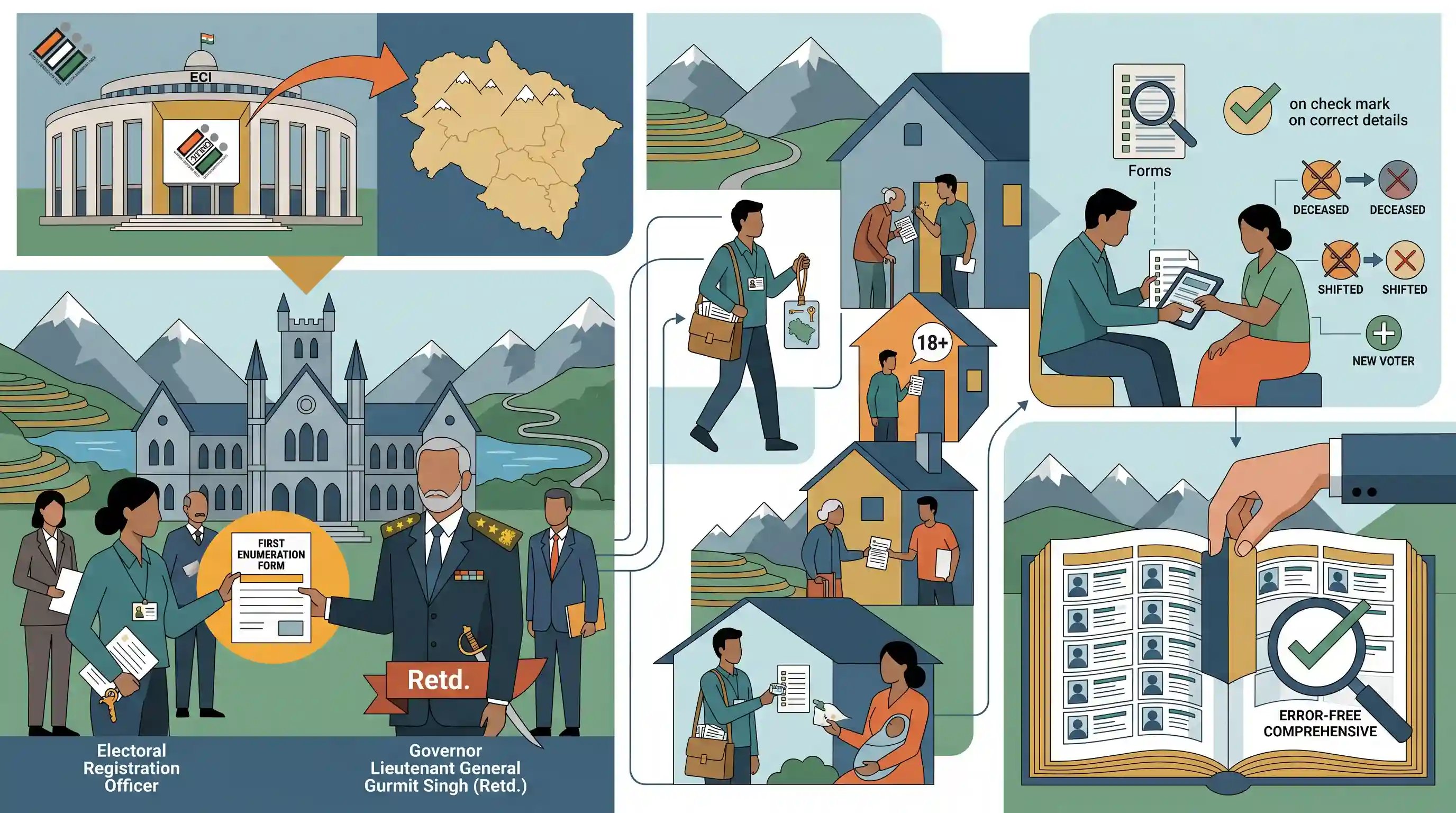
The Special Intensive Revision (SIR) programme, directed by the Election Commission of India (ECI), has commenced in Uttarakhand. The campaign was formally launched at Lok Bhavan, Nainital, where the Electoral Registration Officer (ERO) presented the first enumeration form to Governor Lieutenant General Gurmit Singh (Retd.). Under the SIR campaign, Booth Level Officers (BLOs) will conduct door-to-door visits to distribute enumeration forms, verifying and updating voter details to ensure an error-free, comprehensive electoral roll. Key administrative figures of the region were also present at the launch.
Key Points
- The Special Intensive Revision (SIR) programme has officially commenced in Uttarakhand under the directives of the Election Commission of India (ECI).
- The initiative was launched at Lok Bhavan, Nainital, with the Electoral Registration Officer (ERO) presenting an enumeration form to Uttarakhand Governor Lieutenant General Gurmit Singh (Retd.).
- Under the SIR campaign, Booth Level Officers (BLOs) will conduct door-to-door visits to every voter's residence to distribute and gather enumeration forms.
- The main objective of the campaign is to verify and update voter details, ensuring an accurate, updated, and error-free electoral roll.
- The event was attended by key administrative officials, including Kumaon Commissioner Deepak Rawat, Additional Secretary Reena Joshi, Additional District Magistrate Vivek Rai, and Sub-Divisional Magistrate Nawazish Khalik.
Important Terms
Special Intensive Revision (SIR) programme

A comprehensive, time-bound voter list cleaning and re-enumeration campaign by the ECI, involving door-to-door verification by officials under the Representation of the People Act, 1950.
UPSC context
GS Paper II (Polity & Governance). Relevant for topics on electoral reforms, constitutional mandates, and representation of people act.
Election Commission of India (ECI)
An autonomous, permanent constitutional body established under Article 324, responsible for administering, directing, and controlling free and fair parliamentary and state assembly elections in India.
UPSC context
GS Paper II (Constitutional Bodies). Covers powers, functions, and key issues related to electoral oversight and democratic processes.
Booth Level Officer (BLO)
A local government or semi-government official appointed under Section 13B of the RPA, 1950, acting as the ECI's grass-roots representative for updating and managing electoral rolls.
UPSC context
GS Paper II (Elections/Representation of People Act). Tests understanding of decentralized administrative structures and grass-roots electoral management machinery in India.
Lok Bhavan, Nainital
The official summer residence and office of the Governor of Uttarakhand, built in the British era using local stone and boasting Gothic architecture.
UPSC context
GS Paper II (State Executive). Relevant for understanding the office of Governor, Centre-state administrative setups, and historical executive structures.
Prelims Trap
The Election Commission has final statutory authority to legally determine and adjudicate an individual's citizenship status during electoral roll revisions.
While the ECI can verify voter details to clean rolls, the Supreme Court (2026) ruled that it cannot make final legal determinations of citizenship, which belongs to authorities under the Citizenship Act, 1955. Also, electoral roll preparation is governed by RPA 1950, not RPA 1951.
Static Concepts Connected
What is the structural division of subjects between the RPA 1950 and the RPA 1951?
- RPA 1950 scope: Governs the allocation of seats, delimitation of constituencies, voter qualifications, and preparation/revision of electoral rolls.
- RPA 1951 scope: Governs the actual conduct of elections, qualifications/disqualifications of MPs/MLAs, corrupt practices, and election disputes.
- Key Distinction: The administrative machinery for registering electors (EROs, BLOs) is established under the 1950 Act, not the 1951 Act.
What is 'deemed deputation' under Section 13CC of the Representation of the People Act, 1950?
- Definition: Designates officers/staff employed in electoral roll preparation as being on deputation to the Election Commission of India.
- Control transition: During this period, these officers are subject to the direct control, superintendence, and discipline of the ECI, not their regular state departments.
- Penal consequences: Any breach of official duty makes them directly liable for prosecution and disciplinary action under ECI’s direct mandate.
Cross-Topic Patterns
Electoral Rolls + Federalism friction
State employees deployed as BLOs on 'deemed deputation' to the ECI highlights the delicate administrative federalism balance during election cycles.
Voter Registration + Citizenship laws
The Supreme Court's limit on ECI's citizenship adjudicating powers connects voter registration directly to executive jurisdiction under the Citizenship Act, 1955.

Distinctions between RPA 1950 and 1951 regarding electoral roll revision and the ECI's control over BLOs are highly likely for Prelims 2026.
Linked PYQs · 3
Linked PYQs · 3
- 2025UKPSC_PRELIMSGS1
Consider the following statements with reference to Uttarakhand and choose the correct answer: 1. The executive of Uttarakhand includes Governor as the head of the state. 2. It also includes the Chief Minister and his/her council of ministers.
- 2016UKPSC_PRELIMSGS1
Who recognizes the political parties in India?
- 2025UKPSC_PRELIMSGS1
Which among the following pairs is correctly matched? 1. Chairman of First Finance Commission - Nityanand Swami 2. First Advocate General of Uttarakhand - Nanda Ballabh Tiwari 3. First Chief Minister of Uttarakhand - Indu Kumar Pandey 4. First Woman Governor of Uttarakhand - Margaret Alva
