Investopia Dialogues and Economic Partnership in Ahmedabad
Source:aletihad ↗
આ શા માટે મહત્વનું છે
The continuous expansion of the India-UAE economic corridor underscores a significant geopolitical shift towards strong middle-eastern economic integration, bringing crucial FDI and sovereign wealth into India's emerging tech and infrastructure sectors.
સારાંશ
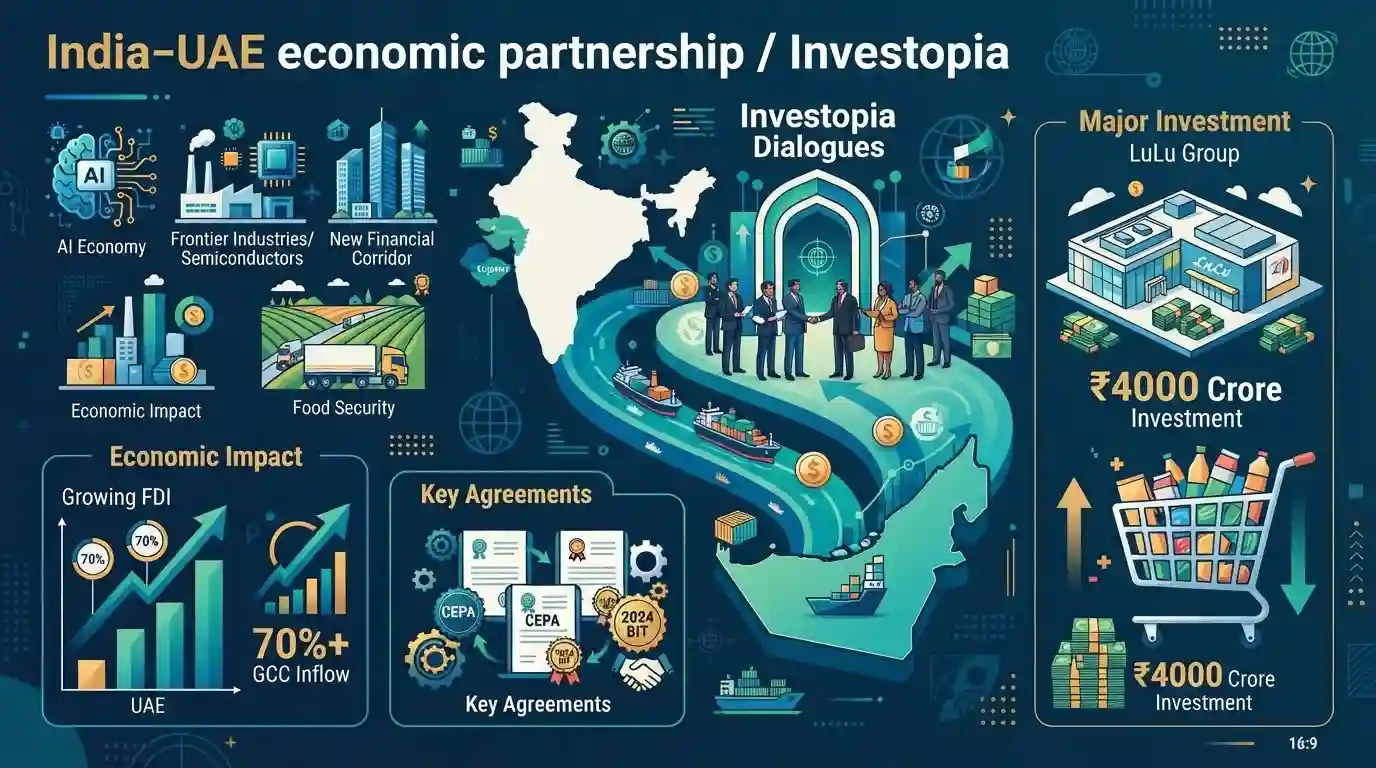
The UAE launched the 'Investopia Dialogues' in Ahmedabad, Gujarat, marking its fifth edition in India, with the goal of strengthening the UAE-India economic partnership. Organized in collaboration with Invest India, the Confederation of Indian Industry (CII), and the Gujarat Government, the event convened over 500 leaders to explore investments in future-ready sectors. Key discussion themes included building Gujarat's AI economy, advancing frontier industries like semiconductors, developing the New Financial Corridor, and ensuring food security. The dialogue highlighted the impact of the UAE-India CEPA and the 2024 Bilateral Investment Treaty in driving substantial FDI, with the UAE currently contributing over 70% of all GCC investment inflows into India. Additionally, the LuLu Group announced a major INR 4000-crore investment project in Ahmedabad.
મુખ્ય મુદ્દા
- The 5th edition of the UAE’s 'Investopia Dialogues' was hosted in Ahmedabad, Gujarat to bolster bilateral trade, investment, and strategic cooperation.
- Discussions emphasized future-oriented sectors including Artificial Intelligence (AI), semiconductors, fintech, food security, and sovereign wealth investments.
- The UAE stands as a major economic partner, accounting for over 70% of the total Gulf Cooperation Council (GCC) foreign direct investment inflows into India.
- Bilateral economic ties are structurally supported by the UAE-India CEPA and the Bilateral Investment Treaty that came into effect in 2024.
- Major private investments were announced, notably an INR 4,000-crore investment by the UAE-based LuLu Group to develop a shopping mall in Ahmedabad.
મહત્વપૂર્ણ શબ્દો
UAE-India Comprehensive Economic Partnership Agreement (CEPA)

A landmark free trade agreement signed in 2022 to boost bilateral trade to $100 billion in goods and $15 billion in services by reducing or eliminating tariffs on key exports and simplifying trade in services.
UPSC context
GS Paper II (Bilateral Agreements) & GS Paper III (Indian Economy); tests trade agreements, tariff negotiations, and economic diplomacy.
India-UAE Bilateral Investment Treaty (BIT)
An agreement signed in 2024 to protect and encourage bilateral investments, guaranteeing post-establishment rights, minimum standard treatment, non-discrimination, and a faster three-year local remedies exhaustion period for dispute resolution.
UPSC context
GS Paper III (Investment Models) & GS Paper II (Bilateral Relations); tests investment protection policies and dispute settlement mechanisms.
Gulf Cooperation Council (GCC)
A political and economic alliance of six Middle Eastern monarchies (Saudi Arabia, UAE, Qatar, Kuwait, Oman, Bahrain) established in 1981 to promote regional security, economic integration, and policy coordination.
UPSC context
GS Paper II (International Relations); tests regional groupings, West Asian geopolitics, and India's energy security interests.
Invest India
The national investment promotion and facilitation agency of India, established in 2009 as a non-profit joint venture under the DPIIT, Ministry of Commerce and Industry, serving as the first contact point for investors.
UPSC context
GS Paper III (Indian Economy & Mobilization of Resources); tests national agencies, FDI policy promotion, and ease of doing business.
Investopia
A global investment platform launched by the UAE government in 2021 to connect investors, business leaders, and governments to identify opportunities, incubate future economies, and foster bilateral investment dialogues.
UPSC context
GS Paper II (Bilateral Relations); tests global investment summits, economic diplomacy, and bilateral platforms strengthening international economic partnerships.
પ્રિલિમ્સ ટ્રેપ
The UAE currently stands as the largest source of overall Foreign Direct Investment (FDI) into India.
The UAE contributes over 70% of FDI from the *GCC region*, not globally. Countries like Singapore, Mauritius, and the USA typically lead India's total FDI inflows.
સંલગ્ન સ્થિર ખ્યાલો
How does a Comprehensive Economic Partnership Agreement (CEPA) differ from a traditional FTA?
- Broader Scope: CEPAs inherently cover services, investments, intellectual property rights (IPR), and government procurement, rather than focusing almost exclusively on trade in goods.
- Deeper Integration: CEPAs involve more comprehensive regulatory cooperation, trade facilitation measures, and deeper tariff reductions than standard Free Trade Agreements.
What are the core components of India's revised 2016 Model Bilateral Investment Treaty (BIT)?
- Local Remedies Exhaustion: Investors must exhaust domestic legal remedies for at least five years before they can initiate international arbitration (ISDS).
- Enterprise-based Definition: It protects actual investments operating as enterprises, specifically excluding purely financial portfolio investments or speculative capital.
- No MFN Clause: It deliberately omits the Most Favored Nation (MFN) clause to prevent foreign investors from treaty-shopping to claim broader protections.
આંતર-વિષય પેટર્ન
Food Security & the I2U2 Minilateral
The UAE's focus on food security investments in Gujarat directly operationalizes the I2U2 mandate of building integrated agricultural parks in India utilizing Middle Eastern capital and Israeli technology.
Gulf Capital & India's Semiconductor Mission
UAE sovereign wealth pivoting from traditional energy to frontier tech provides a vital, non-Western capital source for capital-intensive fab ecosystems under the India Semiconductor Mission (ISM).
2016 Model BIT & Foreign Capital
The 2024 India-UAE BIT is a crucial test case for India’s revised 2016 Model BIT framework, aiming to boost investor confidence while safeguarding state regulatory power.

Expect a 2026 Prelims multi-statement question linking the India-UAE CEPA, the 2024 BIT, and I2U2 food parks to shifting GCC capital flows.
સંલગ્ન PYQ · 3
સંલગ્ન PYQ · 3
- 2025GPSC_PRELIMSGS1
Which of the following would be considered as foreign direct investment in India? 1. Subsidiaries of foreign companies in India 2. Majority foreign equity holding in Indian company 3. Portfolio investment Select the correct answer using the codes given below:
- 2022GPSC_PRELIMSGS1
What are the objectives of India developing Chabahar Port in Iran? a. Provides easy trade access with Arab countries b. Cuts down goods transport costs/time for India c. Road access to Afghanistan's four cities d. Develops access to Central Asian markets Select the correct answer using the codes given below:
- 2025GPSC_PRELIMSGS1
Consider the following statements: 1. The first SEZ policy in India was announced in 2000 2. The objective of SEZ policy was to increase foreign investment in India and to provide an internationally competitive environment for exports 3. The SEZ Act was passed in 2010 Which of the statements given above is/are correct?
